Tuesday, February 7, 2012

This North Coast Weekend


Beginning Wednesday (Feb. 8) at HSU is Venus by Pulitzer Prize-winning playwright Suzan-Lori Parks, directed by Jean O’Hara. This multi-dimensional play is based on the true story of a South African woman who was displayed as a carnival freak in England in the early 19th century, before ending up as a “scientific” exhibit. Eboni Session plays Venus, with Shannon Bass, Robert Davis and Zach Scott in the other principal roles. This production breaks the usual mold for HSU: it’s at Gist Hall Theatre for only one week, with evening performances Wednesday-Saturday  at 7:30 p.m. and a 2 p.m. matinee on Sunday. Information: HSUStage.blogspot.com. Tickets: 826-3928.


The winter play at Ferndale Rep was scheduled to be Shakespeare’s The Taming of the Shrew, but it’s been cancelled due to the director’s illness. Instead, director John Heckel has stepped in to replace it with a production of John Osborne’s landmark 1956 drama, Look Back in Anger. It opens on Friday, February 10 at 8 p.m.  Heckel has directed many intriguing plays over the years on the North Coast and he’s got an impressive cast for this one, which includes Ethan Edmonds, Greta Stockwell, Charlie Heinberg, Tisha Sloan and Bob Morse. Tickets and information: 707-786-5483, ferndale-rep.org.

Friday, February 3, 2012

This North Coast Weekend

The Dell’Arte International School’s first years present their culminating creation of commedia chaos (starring “lovers, mothers, charlatans, thieves, posers, zanies, braggarts and windbags”) in Commedia: Unleashed! at the Carlo Theatre Thursday through Saturday (Feb. 2-4) at 8 p.m. Pay-what-you-can, reservations encouraged. 707-668-5663, www.dellarte.com.

On Friday and Saturday (Feb. 3, 4), VDAY Humboldt performs Eve Ensler’s Any One of Us: Words From Prison (monologues of women prisoners) as their annual benefit for the North Coast Rape Crisis Team and the Prison University Project, at HSU’s Native American Forum, at 7 p.m. 530-448-9458.

Beginning Wednesday (Feb. 8) for just 5 performances, HSU Theatre presents Venus by Suzan-Lori Parks, about an African woman displayed as a “wild female jungle creature” in 19th century Europe. It’s on stage at Gist Hall Theatre at 7:30 p.m. Wednesday through Saturday (Feb. 8-11) and 2 p.m. Sunday. 826-3928. HSUStage

Tuesday, January 31, 2012

Laughter on the 23rd Floor

Laughter On The 23rd Floor, a comedy by Neil Simon now onstage at the North Coast Repertory Theatre in Eureka, is about a roomful of writers for a 1950s comedy-variety TV show. Joe McCarthy and the Blacklist lurk in the background, and troubles with the network animate the plot. But mostly it’s about the characters in that room, and a parade of jokes that mirrors Simon’s tutelage on just such a show.

 The “Simon says” character is Lucas (played by Evan Needham), who narrates as well as participates. Milt (Scott Osborn) wears outlandish costumes to work (a bullfighter’s cape with a French beret) because it gets him noticed in a competitive arena. Carol (Darcy Brown) is the only woman on the staff, and the only one who seems to pay attention to the outside world.

 Kenny (Dave Fuller) is less ham than wry, and Ira (Ellsworth Pence) is the house hypochondriac, as well as a comic anarchist. Val (Anders Carlson) is a brooding paranoid Russian, while Irishman Brian (Clayton Cook), the only non-Jewish writer, has swallowed the show biz blarney stone. Helen (Kelly Hughes) is the perky secretary.

They all must contend with the imperious peccadilloes of the show’s star, Max Prince (David Hamilton.) Under creative and business pressure, Prince drinks too much and takes too many pills. “I fell asleep with my eyes open,” he says. “I thought I was dreaming about the ceiling.”

 There are brushes with sentiment, passes at seriousness and stabs at theories of humor. “All humor is based on hostility—isn’t that right, Kenny?” “Absolutely. That’s why World War II was so funny.”

The writers don’t seem to write anything, though the one sketch being developed is a highlight—a parody of Marlon Brando in Julius Caesar (Hamilton nails it.) But plot, context and philosophy are all secondary to laughs, and the high jinks and jokes in this 1993 play come faster than in anything Simon had written since his earliest plays.

 The whole cast is funny, but I was especially impressed by how Anders Carlson played his character with precise economy, and how Darcy Brown (formerly Darcy Daughtry) vocally and physically created an instantly believable 1950s character. And David Hamilton plays the mercurial shades of Max Prince with comic moves that kept surprising and delighting the opening night audience.

 Articulation and timing should even improve as the actors find new moments to play. Though this is a sanitized version of the 50s and this group, Calder Johnson designed a suitably tawdry writers room, and director David Moore keeps the actors and action moving in this single set. Costumes (including the outrageous ones) are designed by Lauren Wieland.

The Max Prince Show is based very loosely on the last two years of Your Show of Shows starring Sid Caesar, the play’s characters are even more loosely based on writers for this program and its immediate successor, Caesar’s Hour.  Caesar's writers rooms were legendary for who they produced: Mel Brooks, Woody Allen, Carl Reiner, Larry Gelbart--and Neil Simon.  Together they supplied much of the comedy on screen and on stage for at least the next fifty years.

The hypochondriac Ira is based on the hyperglycemic Mel Brooks, and Milt and Kenny are even more vaguely based on Carl Reiner and Larry Gelbart (creator of TV’s M*A*S*H). the two closest parallels are Val, based on Russian immigrant Mel Tolkin, and Carol, who is a little of Selma Diamond but mostly Lucille Kallen (also famously allergic to the pervasive cigar smoke. In the play she claims she has to keep her dresses in a humidor.)

 These legendary writers’ rooms also inspired a film, My Favorite Year, which combined Sid Caesar with Steve Allen. It shows a shy writer whispering his jokes to another writer. That’s Neil Simon whispering to Carl Reiner. Reiner also drew on his Caesar experience for the classic sitcom he created, the Dick Van Dyke Show.

 But no play or movie or TV show has come close to suggesting the unique comic genius of Sid Caesar, or the inspired mayhem of his TV shows. I saw them as a child and remember some of the sketches to this day. There are a few on YouTube, and more on various DVDs.
                       
Exit Laughing: The Real Sid Caesar Shows

Neil Simon’s Laughter on the 23rd Floor is about a group of writers for a 1950s comedy-variety television show called (in the play)the Max Prince Show.  It is  based very loosely on the last year or so of Your Show of Shows starring Sid Caesar. Here I wanted to expand on the real sources of the play.

The play is set in the writers’ room of a weekly 90 minute comedy-variety series in 1953. The play’s characters are loosely based on the legendary writers who worked for Sid Caesar, but not all of them in the play worked on Your Show of Shows. Several joined later for its successor, Caesar’s Hour, a one hour show of mostly comedy that debuted in the fall of 1954.

The two characters in the play based most clearly on the real writers were the team that were there at the beginning of YSOS, Mel Tolkin and Lucille Kallen. “They set the tone for the whole show,” Carl Reiner said. They had written Caesar’s previous series, The Admiral Broadway Revue, which first teamed him with the now-legendary comedienne, Imogene Coca (pictured above.)

In the play, the character of Val Slotsky is based on Tolkin. Like Val, Tolkin was a Russian immigrant, by way of Canada. And like Val, he had a dour outlook, conditioned by pogroms in Russia. He trained as an accountant but entered show business through music. His first writing was composing songs and then bits to go with them. Larry Gelbart called him the “founding father” of YSOS, where he was head writer. Despite his years in North America, he had a heavy Eastern European accent, but he was highly literate, with a European sophistication and Old World manner.

The character of Carol Wyman is based slightly on Selma Diamond, who was on the staff of Caesar’s Hour and later became a brassy, gravel-voiced performer. But Carol is mostly based on Lucille Kallen, the only woman on the staff of YSOS. Kallen was famously allergic to the pervasive cigar smoke in the writers room. In the play, Carol complains that she has to keep her dresses in a humidor. Like Carol in the play, Kallen got pregnant during the run of the show, and the play has a kind of in-joke about that. Some reference is made to a writer being hired temporarily to replace Carol. Temporary replacements were in fact hired for Kallen—they happened to be Neil Simon and his older brother Danny Simon. By the time Kallen was ready to return, the show was over. (The play is narrated by “Lucas Brickman,” the Neil Simon stand-in. Brother Danny isn’t mentioned, and he would not follow Neil to Caesar’s Hour.)

Kallen had worked with Tolkin, first at a large Jewish resort in the Pocono Mountains, and then on the Admiral TV show. Kallen wrote especially for Sid Caesar and Imogene Coca as a couple, either in stand-alone sketches or for their regular segment, the Hickenloopers. She was a small woman in a room of large men, and sometimes had to stand on a couch and wave a red sweater to be heard. Reiner remembers her as very pretty, and concerned with preserving her femininity as a professional woman. She later wrote a novel with this theme, before becoming known to a different public as the author of the C.B. Greenfield mystery novels.
Mel Brooks, who had also written jokes for the Admiral show, was soon added to the YSOS staff. Like the play’s character Ira Stone, he would often arrive late and complain of some ailment. It later transpired, Reiner said, that he was in fact hypoglycemic, which was a source of some of his woes, perhaps including his insomnia.

The play tends to nail each character with a defining characteristic and elaborates on it, sort of like a comedy sketch. But except for a few scenes it doesn’t really deal with the process of writing this show, nor the characteristic contributions of these writers. So the play doesn’t have much to say about Mel Brooks as a writer.

In an archival interview Larry Gelbart described Brooks’ method as creating whole routines, whereas Gelbart was used to throwing in an appropriate line or joke. With Mel, he said, it wouldn’t be “why does the chicken cross the road? To get to the other side.” Instead Mel “would become the chicken, then he’d play both sides of the road, and he’d cross himself, doing 18 choruses of something while he’s crossing it—nobody else does this. He’s the funniest writer—and chicken—in the business.”

One of Brooks’ specialties for Caesar was “the Professor”—an expert on something or other (sleep, archeology, etc.) being interviewed. Carl Reiner was first hired on the show as an actor to be the interviewer. Later the Professor would evolve into the 2000 Year Old Man, which Brooks himself did, with Reiner. It started Brooks’ performing career, which later contributed to the success of his movies.

Carl Reiner became one of the regular sketch actors on YSOS and informally one of the writers, especially for Caesar’s Hour. According to wikipedia, he was the prototype for the Milt Fields character in the play, but I’ve yet to see a reference to Reiner showing up for work in a matador’s cape and a French beret, as Milt does in the play.

As Larry Gelbart explains, comedy writing is based a great deal on improvisation, and Reiner was skilled and imaginative. He was also skilled at “doubletalk--” improvising dialogue in a foreign language with words that don’t necessarily mean anything but sound right, and also funny. Sid Caesar was the acknowledged master, but Reiner held his own in sketches like the satire on the Italian neorealist movie The Bicycle Thief, performed completely in fake Italian.
Reiner with Brooks as 2000 Year Old Man

Reiner was probably with Sid Caesar the longest, and for a long while was identified with him. Though he’s had a career as a performer (most recently in the new Ocean’s Eleven series), he made his enduring mark with the Dick Van Dyke Show. It's remembered for introducing Mary Tyler Moore as Laura Petrie, but Van Dyke as Rob Petrie worked on a comedy show based on the Sid Caesar shows. Rose Marie as Sally Rodgers was again based on Lucille Kallen and Selma Diamond—though this time, more on the harsh voiced, one-of-the-guys Selma.  Reiner also wrote and/or directed several of Steve Martin's early films, from the satiric (and Caesar-like) Dead Men Don't Wear Plaid to the classic romantic comedy All of Me.
Writers for Caesar's Hour: (from left, front row) Gary Belkin, Sheldon Keller, Michael Stewart and Mel Brooks; (from left, back) Neil Simon , Mel Tolkin, and Larry Gelbart. (pbs/file 1956)

Larry Gelbart himself joined the team in 1955, with Caesar’s Hour. He’s supposedly the model for Kenny Franks in the play. His experience had been as a joke writer, and Caesar’s Hour taught him sketch writing, with basic beginning-middle-end story construction. It was a stage in development that led to his first stage play, collaborating on A Funny Thing Happened On the Way to the Forum, and later famous plays, movies and the television series M*A*S*H.

The character of Brian Doyle is based on Michael Stewart, who (like Brian) was Irish, and who would go on to write for the theatre. He was a writer for Caesar’s Hour, where he had the role of the one who actually wrote down what the group had come up with—a role previously filled by Lucille Kallen and Joseph Stein on YSOS. 

Another character that appears in at least the TV movie version of Laughter on the 23rd Floor is Harry Prince, based on Dave Caesar, Sid’s brother who appeared on Caesar’s Hour. But he’s not in the play, at least as produced at NCRT.

At the center of it all was Sid Caesar. However he was much more the Max Prince character during the run of Caesar’s Hour. YSOS was controlled more by its director, Max Liebman, and Caesar wasn’t even the star at first. But by Caesar’s Hour, he ran the show.

As a creative performer, Sid Caesar was a comic genius. That’s only implied in the play, though the Marlon Brando’s Julius Caesar movie excerpt suggests one of his particular kinds of mayhem. He was also mercurial, with a growing dependence on alcohol and pills, as Max Prince is.  Caesar later conquered these dependencies.

Sid Caesar gives unique meaning to the idea of physical comedy. He did physical comedy with his eyes, his eyebrows, his whole body and not least of all, his voice.

An aside: the NCRT production sort of makes fun of Max Prince’s saxophone playing. In reality, Sid Caesar started out professionally as a saxophone player. In the funniest sketch on the Sid Caesar Collection Vol. 1 DVD is Caesar as a progressive jazzman Progress Hornsby being interviewed on "Ominous" (parody of the interview program Omnibus.)  At the end of it Caesar actually plays jazz saxophone. (The Progress Hornsby sketch on YouTube is different and not nearly as good.)
Neil Simon
All of this adds texture to the differences between the Max Prince Show in Neil Simon's play and Your Show of Shows.

In the play it’s 1953 and the network wants to cut the Max Prince Show from 90 minutes to an hour, because it’s getting less popular. One reason is discussed: the television audience isn’t just New York anymore. The reach of television is growing—New York was its biggest audience, but new technologies enable broadcasters to reach farther into the Midwest and South. The urban-oriented humor wasn’t translating. There’s reference in the play to more popular shows being Leave It To Beaver and Father Knows Best. 

But the play is set in 1953, and in fact these changes were a little further in the future, and didn't seem to influence the fate of the always popular Your Show of Shows.  39 original shows a year, each one live for 90 minutes, were broadcast from 1950 to the end of the 1954 season, on NBC every Saturday night from 9 p.m. to 10:30.  Your Show of Shows ended partly because its stars wanted to do different shows. According to Larry Gelbart and Carl Reiner, Sid Caesar himself wanted to do an hour show that concentrated on comedy, with less “jumping” as he called it, which meant dancing, or musical numbers in general. These were prominent on Your Show of Shows.
Nanette Fabray, probably the best known of
Sid's "wives" on Caesar's Hour

At the same time, Imogene Coca—Caesar’s partner in many comedy pieces—had become a big star, and she was slated to have her own show on NBC. When YSOS ended, she got the 9 p.m. Saturday slot. Sid Caesar got Caesar’s Hour on Monday night. (In the play, the cutting back from 90 minutes meant a writer would have to be fired.  But because Caesar's Hour had more comedy, the writing staff actually expanded.)  Your Show of Shows ended in June 1954, and both of these shows started with the new TV season in September.

But The Imogene Coca Show never found a stable identity, changing from a sitcom to a comedy sketch show back to a sitcom with an entirely different premise, all in one season. It wasn’t renewed for a second. Caesar’s Hour prospered however, and in 1956 moved back to Saturday night.

It was a hit series for several years, but Caesar reportedly saw the writing on the wall when The Lawrence Welk Show (which started in 1955) started getting higher ratings.  Caesar's Hour ended its run in May 1957 (before Leave It To Beaver had begun.)    

After Caesar’s Hour went off the air, Sid Caesar had a couple of other shows. Sid Caesar Invites You ran for the first 5 months of 1958, reuniting Caesar and Imogene Coca, with Carl Reiner and several of the writers, including Neil Simon and Mel Brooks. There were three half hour specials in 1962 and 1963 called As Caesar Sees It, leading to The Sid Caesar Show in the 1963 season with a similar sketch comedy format but different regulars. It was for either the specials or the Sid Caesar Show—or probably both—that Woody Allen wrote (uncredited) for Sid Caesar, with (according to Allen) lasting influence on his style.

The Sid Caesar writers' room has become so legendary that the writers and the shows are routinely mismatched and remembered together.  The play preserves some aspects, and neglects others. The physical set prescribed for this play is based on Neil Simon’s memory of the actual writers room for one of the Caesar series, which Sid Caesar praised for its accuracy on the original Broadway production’s opening night. The NCRT is a slight variation of the usual set. It doesn’t attempt to mimic one of the actual room’s characteristics: the 39 or so pencils stuck in the acoustical tile ceiling, sent there by frustrated writers.

But the play doesn't fully give the flavor of what the experience might have been like for the writing staff.  Just imagine the work week before each show aired on Saturday: Some of the show's regular features could be planned as early as the previous Friday, Lucille Kallen said, with writing started over the weekend. But basically the writing started on Monday, and had to be finished by Wednesday. For Caesar’s Hour, that meant four or five sketches.

Thursday the cast would get the show on its feet, and Friday they would do it for the director. Saturday was intense. The whole show would be done three times before air. The first time for blocking, the second a smooth rehearsal where cuts for time and changes were set, the third was full dress. Then it was done live for broadcast.  Eventually it would be done once again, for broadcast to the West Coast. Then Sid Caesar would take everyone out, usually to a place called Danny’s Hideaway, for a Bacchanalian feast. Then they’d have Sunday with their families. But basically, the show was their life.

The Sid Caesar writing staffs are legendary for a reason.  Here is a partial list of titles (plays, movies, TV shows etc.) that entered American life for generations, generated by writers who worked for Sid Caesar: A Funny Thing Happened on the Way to the Forum, The Odd Couple, Blazing Saddles, Fiddler on the Roof, the Dick Van Dyke Show, Annie Hall, Get Smart, Barefoot in the Park, Bye, Bye Birdie, Tootsie, The Producers, The Jerk, All in the Family, City of Angels, Young Frankenstein, M*A*S*H, Enter Laughing, Hello Dolly, Dead Men Don't Wear Plaid, The Sunshine Boys, Manhattan...and so many more...
the classic parody of "From Here to Eternity" where the
sea rushes in--and soaks them.
I was a child when Sid Caesar was a fixture on television, but I watched him whenever I could. I could stay up later on Saturday nights, but still, it might require me to be very quiet so my parents wouldn’t notice I was still up. I remember Your Show of Shows, and the team of Sid Caesar and Imogene Coca. I remember that she got her own show for awhile. But I more clearly remember Caesar’s Hour, including individual sketches.

So from that perspective I judge the verdict on his “urban” comedy a little differently. For instance, those foreign movie parodies, which Middle America wasn’t supposed to like because they never saw foreign films. We sure didn't have any in my small western Pennsylvania town.  I didn’t see a foreign language film until college, but that didn’t stop me from seeing those parodies as funny. They were just funny, partly because they were strange. I’m sure knowing the movies made them funnier, but the level of satire wasn’t always that deep. They were just funny situations, and opportunities for Caesar to do his doubletalk, which doesn’t require knowing the language in question to appreciate it.

But there’s something else. Caesar’s Hour had a regular segment called "the Commuters." The suburban flight that would transform New York and pretty much end New York theatre (leading to the Broadway for tourists of today) was introducing people to the new culture of suburbia. There were new manners, expected behaviors. These sketches—some lasting almost the entire hour—explored these in the Caesar way. For example, I clearly remember a moment in one from seeing it once as a child. The couples were out together at a restaurant. They were all sitting in a booth and talking. A waiter brought a salad bowl. Carl Reiner told Sid to “toss the salad, Bob.”  Sid did one of his series of takes—he didn’t understand what he was supposed to do. Carl kept talking to someone, only to say again, more insistently, “toss the salad!” So Sid tossed it up in the air, lettuce leaves falling on everyone.

“Toss the salad” was a new concept to a city guy, probably from a poor immigrant family. It was part of middle class suburban manners. But it also happened to be a new concept to me. I was vaguely aware that the people on television were richer and more sophisticated than anyone I actually knew. So I saw it perhaps as something “ritzy” people said and did. But it also seemed possible that it was something I would need to know, or something I should know—something that adults knew.
another classic sketch--trying to be quiet during
"The Recital"

When you’re a kid just about everything “adult” is strange-- tossing a salad as much as foreign movies. You spend a lot of time trying to imagine why adults do and say things, and what they mean.  Sid Caesar’s humor was often based on exaggeration, and on taking something literally that wasn’t meant to be taken that way. It’s exactly the kind of humor that appeals to children, because we often make those mistakes, and we also often think adults are strange and don’t make much sense. Sid Caesar represented us.

Now the exaggeration in those sketches can also be appreciated for the variations, the lines of logic and the moments in which the logic jumps the tracks (the classic sketch "The Recital" is a good example.)   But there’s still something wonderful about their kinship to the imagination of childhood.

Thursday, January 26, 2012

This North Coast Weekend

North Coast Rep opens the Neil Simon comedy, Laughter on the 23rd Floor. In a way it’s a sequel to Simon’s autobiographical trilogy (Brighton Beach Memoirs, Biloxi Blues, Broadway Bound) since it is based on his “big break” job, writing for the early 1950s television hit, Your Show of Shows, starring Sid Caesar. NCRT’s production opens on Thursday, January 26, as the usual benefit for cast and crew. It runs through February 18. Information and tickets: 442-6278, www.ncrt.net.

The Young Actors’ Guild juniors and seniors of Northcoast Prep present Shakespeare’s The Winter’s Tale: A Retelling, directed by Jean Heard Bazemore. It’s a limited run—just Friday and Saturday (Jan. 27 & 28) at 8 p.m., and Saturday at 2 p.m. It’s at the Arkley Center in Eureka, which is also handling the tickets at the box office, by phone (442-1956) or online (arkleycenter.com)--but be advised, there’s a hefty service charge for online purchase.

Friday, January 20, 2012

This North Coast Weekend


On Saturday (January 21) Redwood Curtain presents the latest in this locally favorite form--the live radio comedy-- in its fifth annual fundraiser, appropriately titled A Fifth of Zounds!

Artistic Director Clint Rebik describes it as Prairie Home Companion meets Saturday Night Live, with a Humboldt County twist. It’s presented in the Sapphire Palace at the Blue Lake Casino (along with drinks and dinner) and broadcast live on KHUM. Participants include Pamela Lyall, James Floss, Randy Wayne, Bonnie Halverson, Ron Halverson, Terry Desch, Steve Carter and Christina Jioras. Doors open at 6:30 p.m. Information and tickets: www.redwoodcurtain.com.

Wednesday, January 18, 2012

Wendy Williams

Sad news: North Coast playwright Wendy J. Williams has passed away. She came to Humboldt as a journalist but found a home in theatre, first by acting for the Pacific Arts Center Theatre, Ferndale Rep and NCRT in the 1980s and 90s, and then earning an MFA in dramatic writing at HSU. Among her works was a one-person show, Motherhood: Made in China, based on her own experiences adopting a girl in China. She performed it at the Plays in Progress theatre. Her play Range of Light, inspired by the life of Eureka’s Carole Sund and her murder at Yosemite, was produced at HSU in 2006. (This small photo is from a group shot when she participated in the HSU 10 Minute Play Festival.)

Over those years she worked with many people still active in the North Coast theatre community.  I wrote a little about her in my Stage Matters column this week, and I knew of several people involved in productions mentioned in the column that she worked with.  Her teachers at HSU, her editor at the TV publication she wrote for, all admired her.

 I spoke with her at length only once, when I talked to her about Range of Light, with her daughter (then in grade school, now a teenager) doing her homework at the next table in the late afternoon light on the Wildberries patio.  She was the only person who specifically mentioned reading the last chapters of the paperback edition of The Malling of America, in which I wrote about the experience of writing and publishing it.  As a journalist and freelance writer, that interested her.

 Of her portrait of motherhood in Range of Light, she told Journal reporter Cynthia E. Gilmer: "Even the little, everyday acts of kindness can lead to greatness." It’s one kind of greatness by which Wendy will be remembered.

Tuesday, December 27, 2011

R.I.P. 2011

top, l to r: Pete Postlethwaite, Peter Falk, Vaclev Havel, Susannah York.
Harry Morgan, Elisabeth Sladen, Anna Massey, Romulus Linney, Ellen
Stewart, Lanford Wilson.

Among those the international world of theatre lost in 2011 were: Czech playwright and author Vaclev Havel (who later got a day job as the first president of the Czech Republic,) and American playwrights Lanford Wilson and Romulus Linney. 

Also American playwright and dramaturg Max Wilks, British playwright N.F. Simpson. Ellen Stewart (founder of La Mama), Arthur Laurents (playwright, screenwriter, director,) Irene Gilbert (actor and teacher), and Gilbert Cates (founder of the UCLA School of Theatre, Film & Television.)

These days actors are known primarily for film and television. Particularly in the UK but also to some extent in the U.S., the participation of these actors in live theatre is important. So among those lost to UK theatre are Pete Postlethwaite, Susannah York, Anna Massey, Dulcie Gray, Roy Skelton, Donald Hewett, Dulcie Gray, Shelagh Delaney, Elisabeth Sladen. American actors Peter Falk, Paul Michael, Harry Morgan, Elizabeth Taylor, Dana Wynter, Michael Sarrazin, Cliff Roberson, Jackie Cooper.  American actor and critic Leonard Harris, choreographer and actor Tony Stevens, choreographer Roland Petit. May their work be remembered, and may they rest in peace.

Friday, December 9, 2011

Year Not In Reviews 2011: Communities in Hard Times

The Mousetrap at NCRT
 Bad economic times are more than a theme in at least four recent North Coast stage productions. They are a fact of life that local theatres face. From anecdotal evidence, it appears that the economy is injuring some theatrical organizations more than others.

 But in hard times particularly, all these theatres depend on the strength of community. Each of them has its own distinct community that often includes participants as well as audience members. That participation may be as actors and other artists, fundraisers, suppliers or simply volunteer ushers and ticket-takers.

 These communities can be drawn from natural constituencies: the associated school, the hometown. But basically these communities are self-selected, and they can be very loyal. For example, the Redwood Curtain community kept the faith through years of exile until a new venue was found. But there is also support from the larger community that is not regularly involved in productions, even as audience.

 During the past year I’ve made a point of seeing performances that weren’t on opening night (which is typically when that theatre’s own community gathers), with a variety of audiences in attendance. So I’ve seen Sunday matinees at Ferndale Rep with seniors bussed in from senior centers in Eureka and Redway, and an evening performance at the Arcata Playhouse with members of Soroptimist International of Arcata (an organization of “professional women dedicated to helping women and children in our community.”)

 This latter event was an example of a non-profit organization essentially renting a performance and selling tickets at a price of its choosing, often as a fundraising event. North Coast Repertory Theatre executive director Michael Thomas calls them “benefits,” and NCRT typically does two for each play, usually on opening weekend.

 “We like to do benefits because it helps other local non-profits raise money and it is a good way to get word of mouth advertising going after opening weekend,” he said. “Full houses on opening weekend are good for everybody. In any season, local non-profits raise a total of twenty to twenty-four thousand dollars by sponsoring benefits.”

 I saw NCRT’s most recent production (Agatha Christie’s The Mousetrap) at an especially interesting benefit for Reading Service of the Redwoods, which performs services centered around reading daily newspapers for broadcast to the blind. (As it happens, I was a volunteer reader some years ago.)

 That audience included not only supporters and participants but clients. So for blind audience members attending, the set was described in detail (the location of the doors and the furniture) before the show started, and the actors came out to introduce their characters, including what they were wearing and where they would first enter.

 Afterwards, Michael Thomas asked a group of blind audience members if even that cursory information had helped. You don’t know how much, is essentially what they told him.

 This is an obvious example of extending a theatre’s community, but these benefits seem to do so more generally. At several it was clear that some attendees had never been there before. Such events strengthen community ties, and together with other efforts to build loyalty (like creating very good shows), they can help theatrical organizations weather hard times.  These non-opening nights also remind me that in almost any audience, for even the most performed plays, there are those who are seeing it for the first time.

 As for a trend in presentations of the past several months, the most obvious was the march of musicals: six of them from June to November. If that’s a record, it may be broken in the next six months. After a February production of Shakespeare’s comedy, The Taming of the Shrew, Ferndale Rep presents three musicals in a row: Evita in April, followed by Cabaret and Woody Guthrie’s American Song.

 After its own Shakespeare comedy (Much Ado About Nothing) in March, North Coast Rep performs Avenue Q. In April, Humboldt Light Opera presents Damn Yankees. And rumor has it that a sequel to Mary Jane: The Musical  is in the works at Dell’Arte for the Mad River Festival in June.

 Musicals are popular with local audiences, so they may be a recession hedge, but they are also popular with North Coast performers. The flip side of that is a concern expressed by some directors that local actors (even students) are reluctant to perform in shows they don’t know. This can contribute to a theatrical tedium, and lack of adventurousness that is detrimental to actors and audiences.

 Still, the new year will bring plays by contemporary playwrights Suzan Lori-Parks (at HSU) and Julia Cho, Eric Cable and Paul Weitz (at Redwood Curtain) as well as a locally rare Noel Coward classic at HSU.

Coming Up:

 Northcoast Prep presents a musical adaptation of The Odyssey, Wednesday December 7 through Saturday, December 10 at 7:30 p.m. (plus a Saturday matinee at 1:30) in the Studio Theatre at HSU. Adapted and directed by Gretha Omey Stenger. Reservations at brownpapertickets.com or 445-2355.

The Dell’Arte School’s second years present their Character Projects (one act plays) December 8-11 in the Carlo.

Some Assembly Required at HSU
It's the final weekend for A Playhouse Recessionary Christmas at the Arcata Playhouse.  Also the final weekend for Some Assembly Required at HSU, which I do not review in the Journal, but which is a funny show and a worthy play, a kind of askew sequel to A Christmas Story, at Ferndale Rep through Dec. 18.

The Dell'Arte Christmas show, The Nutcaper  is at the Eureka Theater on Dec. 10, and the Van Duzer at HSU on Dec. 13 before returning for paid shows at the Carlo Dec. 15-18.

The Ladies of the Flies, a new play based on William Golding’s classic novel Lord of the Flies, is a work-in-progress created by an ensemble including Dell’Arte Company member Zuzka Sabata, Synapsis Arts Collective co-founder Leslie Howabauten and Dell’Arte grads Cara McClendon and Elana Levitan. Friday, Dec. 9, at 8 p.m. at the Synapsis Warehouse (47 Third St. in Eureka) and on Sunday, Dec 11, also at 8 p.m. at the Arcata Playhouse.

Beyond this weekend:

On Thursday December 15 at 7:30 p.m., Jeff DeMark and the LaPatina band perform That Train Has Sailed, his new show that’s evolving from recent live performances, at a new performance venue: the Sewell Gallery of Fine Art at 423 F Street in Eureka. The LaPatina's are Paul DeMark, Jim Hatchimonji, Andrew Goff, Neil McLaughlin and Deric Mendes.

For one night only, North Coast Rep presents a mostly musical and entirely family-oriented evening, Christmas at NCRT, with the Redwood Dixie Gators Jazz Band and the Bare-Stage Singers. It’s Saturday December 17, at 7 p.m. 442-6278, www.ncrt.net.

Happy holidays to all and to all a good night.

Thursday, December 1, 2011

This North Coast Weekend

Opening Thursday at HSU was the contemporary holiday comedy, Some Assembly Required by Canadian playwright Eugene Stickland (who will not after all be on campus this weekend, as director Rae Robison had hoped.)  The opening night audience rocked Gist Hall Theatre with laughter, and audience members noted resemblances to their own crazy families at the holidays.

The HSU Theatre, Film & Dance production features Evan Needham (familiar from NCRT roles), Romy Clugston (an exchange student from Australia), and HSU students Kyle Handziak, Karianne Nelson and Shea King.  Stars were born!  The show continues Friday and Saturday this weekend at 7:30, then one more weekend, Thurs-Sat. with a 2 p.m. matinee on December 11.  Much more at HSU Stage & Screen.

Also opening Thursday at the Arcata Playhouse is A Recessionary Christmas, with Jacqueline Dandeneau as an upwardly mobile woman who suffers a foreclosure and must return to her unusual parents, played by Bob and Lynn Wells. A crazy sister (Amy Tetzlaff) and various neighbors popping in (different guests artists for each performance) add to the holiday mayhem.  Live music by Tim Randles, Tim Gray and Marla Joy, written by Tyler Olsen and directed by Lydia Foreman. The Playhouse Recessionary Christmas runs Thursday through Sunday, December 1-10 at 8 p.m..  For more information call (707) 822-1575.

Continuing: A Christmas Story at Ferndale Rep, The Mousetrap at NCRT and Dell Arte's The Nutcaper at various locations.

Monday, November 28, 2011

Yule Tales

Some Assembly Required
What’s behind the coincidences of Christmas shows? There are perennial themes such as family and Christmas itself, as exemplified this year by A Christmas Story at Ferndale Rep, and Eugene Stickland’s Some Assembly Required at HSU, which could be considered a slightly askew sequel. (I wonder if audiences anywhere else in North America have the opportunity to see these two shows in this same season.)

Opening Thursday at HSU was the contemporary holiday comedy, Some Assembly Required by Canadian playwright Eugene Stickland. The opening night audience rocked Gist Hall Theatre with laughter, and audience members noted resemblances to their own crazy families at the holidays. The HSU Theatre, Film & Dance production features Evan Needham (familiar from NCRT roles), Romy Clugston (an exchange student from Australia), and HSU students Kyle Handziak, Karianne Nelson and Shea King. Stars were born! The show continues Friday and Saturday this weekend at 7:30, then one more weekend, Thurs-Sat. with a 2 p.m. matinee on December 11. Much more at HSU Stage & Screen.

As for the two shows reviewed here today, the common economic theme is expressed in the title of one of them: A Playhouse Recessionary Christmas, currently at the Arcata Playhouse. That’s pretty clear, but it also suggests to me that the economy might have been a subtle factor in the shows of Christmas past.

 Back in 2007, when the economy was seemingly riding high, fueled mostly by the fantasy of making money by moving money around with no visible means of support, we had our fantasy-laden Lewis Carroll Christmas at Dell’Arte and Ferndale Rep. But in 2009, after it was all exposed as illusion and the Great Recession was underway, we had our Dickensian Christmas at NCRT as well as Dell’Arte and Ferndale, with children in rags ignored by the 19th century 1%.

 As do the first two shows mentioned, A Playhouse Recessionary Christmas portrays a family preparing for the holidays. This time the parents, Esther and Frank Happy (played with sweet hilarity by Lynne and Bob Wells) are taking in adult daughter Violet (Jackie Dandeneau) because her house is in foreclosure. Her wild younger sister Rose (Amy Tetzlaff) is already there, and Violet brings her two children, Lily (Amelia David) and Daisy (Cora Dandeneau.)

 But the script by Tyler Olsen doesn’t dwell on the foreclosure situation directly, though the payoff at the end concerns recessionary gifts. The story goes off in other twisted sitcom directions, including Rose’s green wax obsession and Frank’s campaign to unmask Santa as an alien in league with corporations. It’s all also a pretext for music, including a unique “Twelve Days of Christmas” by Lynne and Bob, songs by Jacky and by the band of Tim Randles, Tim Gray and Marla Joy (“Grandma Got Run Over By a Reindeer” is one) and by different guest artists at each performance. The kids (Amelia and Cora) are delightful troupers already.

 The show is directed by Lydia Foreman (who also designed the costumes), with set by Lush Newton and lighting by David Ferney. There are surprises and silliness for the whole family, for one more weekend at the Arcata Playhouse.

 Meanwhile, the Dell’Arte holiday show is on the road. This year the textual victim is The Nutcracker, as three poor mice turn to crime and learn who their real oppressor is (the dirty rat) in The Nutcaper.

 With the comic ballets to that familiar Tchaikovsky music, this has the gentle charm of shows that kids put on for themselves. Performed with Dell’Arte School skill, it’s probably the most child-oriented of the Dell’Arte holiday shows I’ve seen, though there are of course a few class warfare jokes for grownups.

 Meredith Anne Baldwin, Rachel Brown and Meghan Frank are the lovable mouse trio. Myque Franz is the Nutcracker (who turns out to be another exploited worker) and Pratik Motwani is the suitably sinister Rat King who might remind older kids (really older) of the Blue Meanies. Joan Schirle directs, with choreography by Laura Munoz. Daniel Spencer designed the sets, Lydia Foreman the costumes, Michael Foster the lighting, Tim Gray the sound.

Meanwhile, back at Ferndale Repertory Theatre by popular demand is A Christmas Story. It’s the same story as the movie which has been seen in 24-hour marathons on various Turner cable stations since the 90s, but with Ralphie, the young hero, recalling his Depression era Indiana childhood as an adult. It’s also the same play that Ferndale presented in 2008, and not the musical version that’s been touring with Peter Billingsley, the actor who played Ralphie in the movie, as producer.

The story by radio raconteur Jean Shepherd is gentle nostalgic comedy with icons from the movie that fans worship, like the leg lamp, or the kid whose tongue is frozen to a flagpole. Philip Grecian’s stage adaptation of course preserves them all.

 Ginger Gene directs a cast that includes Nathan Emmons, Kristi Peifer, Brian Morrison, Aiden Vergen, Megan Walsh, Keelan Franklin, Andrew Cutler, Hailey Benbow, Brianna Schatz, Kate Haley, Charlie Beck, and Steve Vergen as young Ralphie. Costumes are by Lori Knowles, lighting by Greta Stockwell, sound by Ian Schatz, and Scenic Charge Artist is Daniel C. Niyiri. The Ferndale Repertory Theatre’s 40th Anniversary holiday production of A Christmas Story runs on weekends including Sunday matinees through Dec. 18.

Tuesday, November 22, 2011

The Illustrated Mousetrap

Anders Carlson and Shannan Dailey in The Mousetrap at NCRT


Joan Hickson 
Though Agatha Christie is the best-selling novelist of all time, I suspect most of us now know her stories principally from the many television and movie versions. Christie herself adapted a dozen or so of her stories for the stage, sometimes ruthlessly. She staged three stories starring her famous detective, Hercule Poirot, but eliminated Poirot. In Appointment with Death she outfoxed her readers by reproducing the novel’s plot and characters but she chose a different murderer. This play premiered in 1945 with a young Joan Hickson in the cast. Christie wrote to her, hoping she would one day play her other famous detective, Miss Marple. Hickson did—in the 1970s BBC series that’s arguably the best of the available DVD sets.


Agatha Christie

Marlene D. in 1957 Witness movie
 Aficionados rank three of her plays among the best of the genre: Witness for the Prosecution (which was successfully filmed at least twice), Ten Little Indians, and by far her most celebrated play, The Mousetrap, now on stage at North Coast Repertory Theatre in Eureka. The Mousetrap premiered in London in November 1952, where its record as the longest running play in history is unlikely to be broken, especially since to this day it is still running at the St. Martin’s Theatre.

Albert Finney as Poirot


"The Unicorn and the Wasp" on Doctor Who: David
Tennant, Catherine Tate and Fenella Woolgar
as Agatha Christie
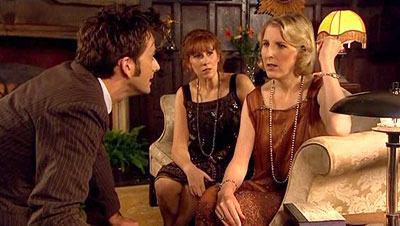
With their relatively slow pace and reliance on plot mechanics, stage mysteries aren’t done much anymore. Christie’s plots in particular inspired parody, from the self-consciousness of the all-star movies in the 1970s based on Christie novels (with Albert Finney and Peter Ustinov each portraying Poirot) to the hilarious burlesque of Tom Stoppard’s play, The Real Inspector Hound, and an affectionately funny episode of Doctor Who a few years ago.

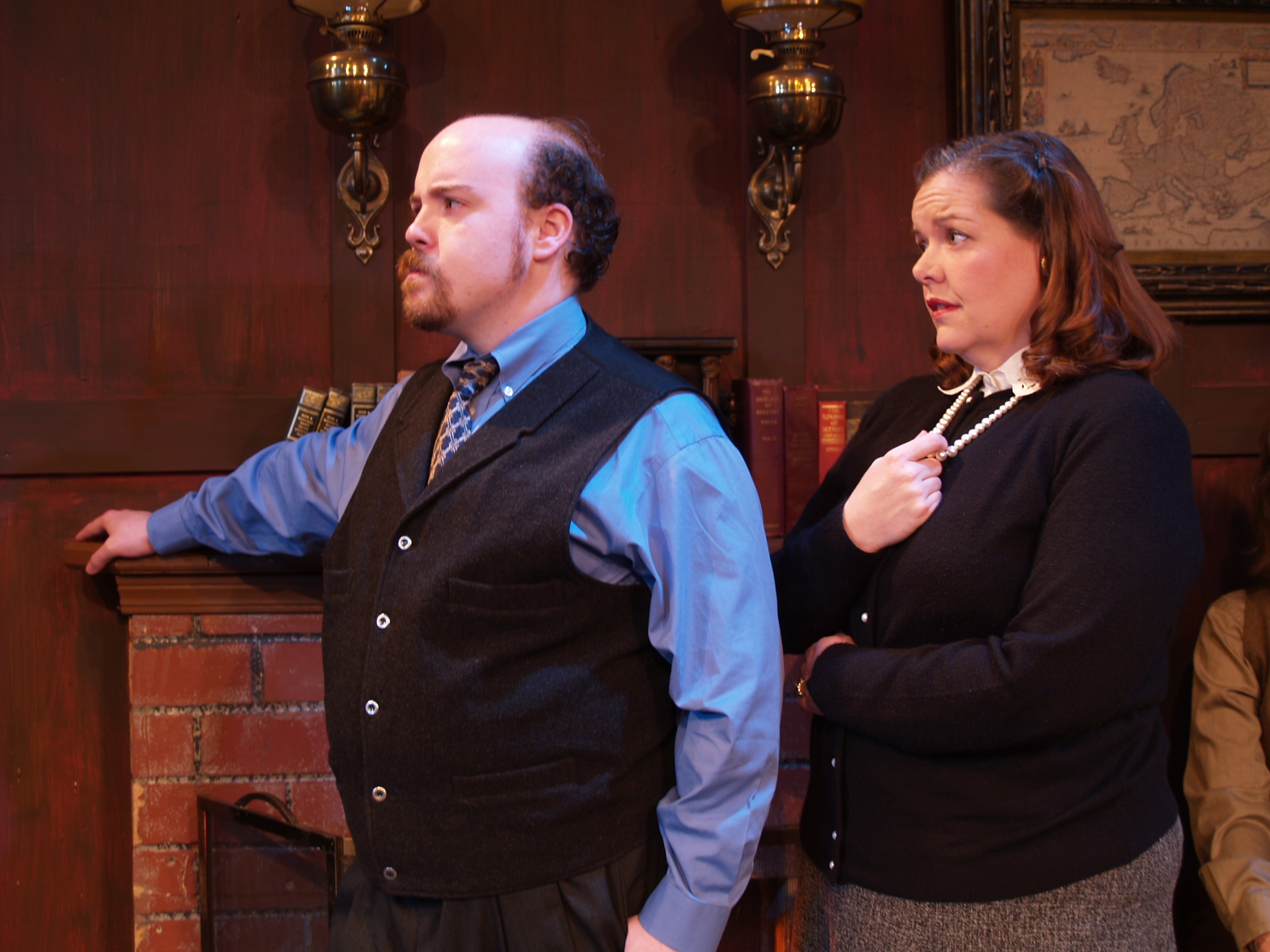
The Mousetrap is handsomely mounted at NCRT, as directed by Tom Phillips, with set by Calder Johnson, costumes by Shelley Stewart and lighting by David Tyndall. The cast capably provides the required shades of sympathy and suspicion for each character. Shannan Dailey and Anders Carlson are Mollie and Giles Ralston, welcoming a group of strangers into their old Guest House in suburban London during a snowstorm. The guests are Mrs. Boyle, a demanding older woman (played by Toodie SueAnn Boll); Major Metcalf, a retired soldier (Scott Malcolm); Christopher Wren, a fey young man (Selavy Skaggs); Miss Casewell, a mannish woman (Gloria Montgomery, with the best British accent.) David R. Simms plays Mr. Paravicini, a mysterious foreigner who arrives unexpectedly. (Christie hoped audiences would think he might be Poirot.) Jasper Anderton plays Detective Sergeant Trotter, who shows up to investigate a murder.

The characters are recognizable types, and while some of the portrayals might seem over the top, the main task of keeping the mystery alive is accomplished. The first act ends with another murder. By the end, the murderer among them is revealed, but there are enough clues (and enough loose ends left dangling) to lead plausibly to several other suspects.

The Mousetrap includes the sly social commentary that enlivens some of Christie’s stories, and it preserves a sense of the dislocations in British society being felt in the years immediately following World War II. Absent the expectation that it will rival the televised stories, it may provide fun for an entertaining night out.

Thursday, November 17, 2011

This North Coast Weekend

Opening Thursday at North Coast Repertory in Eureka is The Mousetrap, a stage mystery by Agatha Christie.  The longest running play by the best-selling author in history, it's a whodunit without Poirot or Miss Marple.  Actors Benefit and champagne reception Thursday, continuing Fridays and Saturdays at 8 p.m. through December 10.For reservations, group rates, or more information, please all 442-NCRT (6278). http://www.ncrt.net/.

 For one weekend only at the Arcata Playhouse, the award-winning Human Nature troupe from Petrolia presents its latest climate crisis comedy, Two Old Birds or Tripping on the Tipping Point.  It runs Thursday through Saturday (Nov. 17-19) at 8 p.m. For reservations: the Playhouse at 822-1575.

Tuesday, November 15, 2011

North Coast Auditions

Auditions for Redwood Curtain's 2012 acting company will be held Saturday November 19.  Details: www.redwoodcurtain.com/auditions.

College of the Redwoods will be holding auditions for their tenth annual spring comedy, The Miser by Moliere on Dec. 1 and 2. Auditions will take place at the CR Forum, room FM103, from 7 to 10 p.m. both nights. No preparation will be required.

HSU Theatre, Film & Dance will audition for its Feb.29-March 4 production of Noel Coward's Blithe Spirit on Sunday December 4 (4pm-6:30) and Monday December 5 (8-10pm) in Gist Hall 2.  Cast is 5 women and two men.  Script available at TFD office.  Contact: Jyl@reninet.com.

Looks like I missed posting auditions for Ferndale Rep's upcoming musicals and NCRT's Shakespeare production, Much Ado About Nothing earlier this month.  Apologies.

Monday, November 14, 2011

Couldn't Resist

A second comment has appeared at the NC Journal site to my review of The Last Five Years at Redwood Curtain by someone who signs himself as Jonathan.  He refers to the program note cited by the previous commenter, "Dianne" (presumably the show's director):

“the action moves simultaneously between the present and the past” is definitely a confusing way of describing what’s going on.

i think what the show needs is a preamble describing exactly how Cathy became stuck in the temporal paradox in the first place. was it a highly localized wormhole creating a parallel universe? a massive breech in the anti-matter containment system that fractured the time-space continuum? the audience is left in the dark."

Photo: The Enterprise-D enters a temporal rift in the classic episode, "Yesterday's Enterprise."

Thursday, November 3, 2011

This North Coast Weekend

At the Arcata Playhouse, Bay Area actor and Celtic harpist Patrick Ball performs his musical tribute to Irish legend Turlough O’Carolan in O’Carolan’s Farewell to Music for one night only on Friday November 4 at 7 p.m.

Opening on Friday (November 4) at the College of the Redwoods Forum Theater is the Humboldt Light Opera Company KidCo production of Alice in Wonderland, Jr. Directed by Cindy Cress, with musical direction by Amy Chalfant, this family musical with familiar characters and scenes from the Lewis Carroll Alice books features children from ages 5 to 17, including Ciara Cheli-Colando, Camille Asbill, Kyra Dart, Rachel Post, Isabella Loch, Lily Buschmann, Kayla Kossow, Gabby Fell, Leah Selcer, James Zwiker, Kalex Sweetfire-Spoon, Allie Sanchez, Estelle Fuller, Anna Vodopals, Erin Casper and Kaylie Doebel. It runs Fridays and Saturdays, Nov. 4-5 and 11-12 at 7 p.m., with a 2 p.m. matinee on November 6.

At the Redbud Theatre in Willow Creek, the comedy Academia Nuts by Gregg Kreutz is performed November 4, 5, 11 and 12 at 8 p.m. The cast includes Brian Bottemiller (who also directs,) Roland Grubb, Libby Pinto and Vicki Kurtz.

Continuing at Redwood Curtain, the musical The Last Five Years.  See post below.

The Last Five Years

The Last Five Years, now on stage at Redwood Curtain in Eureka, is the fifth musical produced on the North Coast since August, and the 11th since last September (if you count the two Mozart operas along with the three Sondheims and the two Lerner and Loewes.) It’s even the second time in that period for The Last Five Years, which Humboldt Light Opera performed (in part) in April.

 Written and composed by Jason Robert Brown, this show is almost entirely sung. There are only two characters: Jamie, a young novelist on the rise in Manhattan, and Catherine, a struggling actress. The story is about their relationship as a couple. However, they are together on stage for just one scene. The rest of the time each sings alone.

 On the level of the music and the performances, this is an enjoyable show. Ably supported by the band of Justin Ross, Amber Grimes and Pete Zuleger, the music is pop-oriented in various styles, with literate lyrics. There’s a definite imbalance: Jamie gets the big numbers and Cathy gets a lot of slow songs that are bittersweet at best. At times it’s like Billy Joel versus Alanis Morisette (two songwriters from Brown’s formative years.)

Nanette Voss-Herlihy is heroic in finding and expressing Cathy’s essence, and Kyle Ryan is confidently dazzling as Jamie, both as a singer and an actor. His every moment felt true. Out of his many recent appearances on various local stages, this is Ryan’s most complete performance.

 But regarding the story, if (like me) you haven’t seen this show before, I have some information you will probably find useful: Jamie’s story is told from the beginning to the end of the relationship, but Cathy’s story is sung from the end to the beginning. I learned this later from Wikipedia. I certainly didn’t learn it from seeing the show (or even from the enigmatic program note.)

 Starting at the end of a relationship and going back to the beginning has worked on the stage, notably in Harold Pinter’s Betrayal. Deconstructing a relationship from each person’s perspective, going in different directions in time, is a provocative postmodern idea, and it could even work if the procedure was made clear to the audience. Playing with relative time has its moments, but you shouldn’t have to be Einstein to figure out what’s going on. There is so much ambiguity in this text, helped not at all by the staging, that much of its emotion and possible meaning are lost.

 Apart from the universals of relationship, this story about the perils of success (first produced in 2002) has an almost nostalgic, 1990s Bright Lights, Big City, Masters of the Universe feel. However, the problems of two-career couples in the arts are particular and perennial.

 The Last Five Years is directed by Dianne Zuleger, with scenic and lighting design by Michael Burkhart, and costumes by Kevin Sharkey. It is on stage at Redwood Curtain Thursdays through Saturdays at 8 p.m. through Nov. 17, with a 2 p.m. matinee on Nov. 13,

 So what about this run of musicals since summer? Qualitatively, I’d suggest Mary Jane: The Musical as the most relevant, Dirty Rotten Scoundrels as the most fun, Into the Woods as the most family-friendly. Sweeney Todd was the best play and Brigadoon had the best music.

 Generally speaking, North Coast companies do musicals well, and this run kept people busy but stretched the talent base thin, not to mention the audience. It also suggests that communication among these institutions could still be a lot better.

 Coming Up: At the Arcata Playhouse, Bay Area actor and Celtic harpist Patrick Ball performs his musical tribute to Irish legend Turlough O’Carolan in O’Carolan’s Farewell to Music for one night only on Friday November 4 at 7 p.m.

 Opening on Friday (November 4) at the College of the Redwoods Forum Theater is the Humboldt Light Opera Company KidCo production of Alice in Wonderland, Jr. Directed by Cindy Cress, with musical direction by Amy Chalfant, this family musical with familiar characters and scenes from the Lewis Carroll Alice books features children from ages 5 to 17, including Ciara Cheli-Colando, Camille Asbill, Kyra Dart, Rachel Post, Isabella Loch, Lily Buschmann, Kayla Kossow, Gabby Fell, Leah Selcer, James Zwiker, Kalex Sweetfire-Spoon, Allie Sanchez, Estelle Fuller, Anna Vodopals, Erin Casper and Kaylie Doebel. It runs Fridays and Saturdays, Nov. 4-5 and 11-12 at 7 p.m., with a 2 p.m. matinee on November 6.

 At the Redbud Theatre in Willow Creek, the comedy Academia Nuts by Gregg Kreutz is performed November 4, 5, 11 and 12 at 8 p.m. The cast includes Brian Bottemiller (who also directs,) Roland Grubb, Libby Pinto and Vicki Kurtz.


Additional Notes on The Last Five Years

My review of the current Redwood Curtain show, The Last Five Years, is in the current NC Journal and here online.  If you check the online review at the Journal site, you can also see a "rebuttal" that seems to be from the show's director.

I'll skip over the dismissive tone of her comments to get to the substance.  I stand by my experience of the show, both of the outstanding performances (I don't know who she's arguing with there) and the failure of the play.  On that I feel even more strongly than I expressed in the review.  On the matter of intelligibility, she seems to think the program statement ("The action moves simultaneously between the present and the past”) clarifies the matter. In my review I said it was enigmatic, and that's being kind.  It's meaningless nonsense.  It's unintelligible just as a sentence let alone as a description that clarifies the narrative procedure.

 She notes that the songs are listed with dates in the program.  There is no indication however of what the dates mean (usually it would be date of composition), and they are phonied up anyway for this production.  As I suggested in my review, setting this in 2011 has doubtful credibility( based on references within the songs as well as the cultural realities.)  Anyway, should we have to be reading the program during the show to understand what's going on?  Let alone the theatre website.

As for the implication that this is just the misjudgment of one cranky reviewer, it isn't.  There are other cranky reviewers of other productions who had the same problem.  When I'm baffled by something I've experienced, I try to find out if it's something I missed that is clear to everyone else.  That's not the case with this play, beginning with the New York Times review of the original production. 

It is the experience of the play that strips it of emotional force, except within the context of each song.  There is no way to match the perceptions of the two characters in time.  Mostly they seem to be singing about a completely different person from the one we just heard sing--which may be part of the point, but as an experience it is simply incoherent.  There is no reference point, no ground to stand on. At the beginning of the show it's not at all clear they are even singing about each other--there are no clear indications in the text or the staging.

(See also this relevant temporal mechanics note.)

 Basically, the device (of one character starting from the beginning of the relationship while the other character starts from the end) may be clever but in practice, it just doesn't work as a play.  Presented in a concert setting perhaps, with titles of some kind to set the time, or people rustling through their programs to find the date, it minimally might.  Even blocking the play so that the character moving forward in time moves left to right like a clock might help, though in the digital age this may also be less psychologically suggestive.  

There are other problems I didn't get into.  The characters are barely credible.  Jamie is supposed to be a suddenly successful novelist. The playwright might have known about New York theatre from experience (he's writing about himself apparently, and his relationship at the time) but he's questionable about how things work in the literary world, or even did work in the 90s.  In this production, as wonderful as Kyle Ryan's performance is, his stage persona is a bit too likeable for the character of Jamie.  It makes many of Cathy's complaints and characterizations seem delusional. 

I'm glad to hear that audiences are enjoying the show. There's plenty in the songs themselves and certainly the performances to enjoy (as the review said.)