Showing posts with label Rosencrantz and Gildenstern Are Dead. Show all posts

Thursday, March 31, 2011

Stoppard's Start


[This is an expanded version of my North Coast Journal review of Tom Stoppard's Rosencrantz and Gildenstern Are Dead at the College of the Redwoods, where it completes its run this weekend, April 1-3.]

Celebrated for his erudition and wit, British playwright Tom Stoppard never went to college. Admired for his stagecraft, his only experience in theatre was as a newspaper drama critic. His “overnight success,” Rosencrantz and Gildenstern Are Dead, took years before an Oxford student group did it in 1966. It nearly failed, until rescued by praise in a newspaper column. Audiences, tipped off that it’s a comedy, came and laughed. Then Kenneth Tynan (another drama critic) got Laurence Olivier and the National Theatre interested, and Stoppard has been a major playwright ever since.
Stoppard’s m.o. is as a clever wordsmith, but it’s not just the vocabulary or even the ideas—it’s the rhythms.  They make his plays appealing to actors (for the movie version of R&G, Gary Oldman and Tim Roth kept exuberantly running scenes even after they’d been filmed) and especially appealing to read.  That’s fortunate, because Stoppard’s plays aren’t often available to see.


Above left--the original National Theatre production.
Above right, the New York premiere program. John Wood
played Guildenstern in New York, and he would become
the lead that Stoppard preferred for subsequent plays.


But there were new dimensions suggested by seeing the current College of the Redwoods production of R&G. As on the page, it’s still an “elsewhere in Elsinore” story while Hamlet is center stage. It’s still Samuel Beckett meets Beyond the Fringe (or perhaps Firesign Theatre—Stoppard was writing its prototype while in a traveling fellowship program with Firesign’s Peter Bergman.)

But on the stage it’s also Laurel and Hardy as scripted by Oscar Wilde. There’s the same fabled existential situation of two lost souls swept along in an indifferent world. But it occurred to me that there’s also a class aspect: they are powerless middle class gentlemen caught in the struggles of royals.

Not that this is necessarily the CR version’s viewpoint—it’s just a product of seeing live actors perform it. The mesmerizing words reveal structure and metaphor. These two characters are so gripped in the logic of fate, of formal tragedy, that time itself is disappearing, like an episode of Doctor Who (already a BBC hit in the 60s when Stoppard started writing for that TV network, around the time that R&G was first produced.)

In particular, the correspondences and refractions with the Players who entertain at Elsinore are more robust on stage than on the page. Rosencrantz and Gilderstern find themselves as trapped in their roles at court as actors in a play—which of course, they also are. They speculate that they could have refused the summons from the King, and they ruminate on decisions they could make, but in the end they are exactly like the Players—they have some latitude in what they play, but they are fated to be players at the beck and call of their patrons.

Except for some edited (or dropped) speeches, some funny physical business and the larger crowd scene for the ending eliminated, CR honors us with the whole play.  The physical comedy written into the play but not played is a real loss, though.  Stoppard’s theatricality is not just verbal: his early plays are full of physical humor. Sometimes he employs variations on tried and true gags (there's even a pants falling down scene in R&G) but often the visual and physical jokes are outrageous and completely integrated into the plot.

He added even more to R&G in the movie version, which he directed, including a running gag of Rosencrantz offhandedly inventing all kinds of things, including the Big Mac.  (The movie DVD, by the way, is well worth obtaining, especially for the extensive interviews with Stoppard, Roth, Oldman and Richard Dreyfuss, whose performance as the Player is terrific.) 
At CR, Daniel Lawrence provides a simple set and Kjeld Lyth directs a straightforward production. Lexus Landry as Rosencrantz and Charlie Heinberg as Guildenstern are a physical contrast, and they use this for character as well as comedy. Landry, like Oliver Hardy (of Laurel and Hardy) is a big person who moves delicately, and that’s on view in his many tip-toe strides to see and report what’s happening elsewhere in Elsinore.

The two keep up with the relentless dialogue for the most part, and make its humor and rhythms sing at certain moments—even in the third act, remarkably, for this play takes stamina to perform.

The other key character is Dmitry Tokarsky as The Player, who provides crucial connections. Tokarsky is a seasoned actor, so he communicates what’s needed from this character, though he didn’t look entirely comfortable on that stage. Aaron Thiele as Hamlet and Jesse Chavez as Polonius make the best of their fewer moments. Other roles are played by Jonathan LaValley, Levi Goldin, Morgan Johnson, Raylene Henderson, George Thorpe, Laurene Thorpe and Amanda Wood. Many of the supporting players are CR students in their first post-high school shows. Denise Ryles and Rosemary Smith provide the theatrical costumes.

Rosencrantz and Guildenstern Are Dead completes its run this weekend, April 1-3 in the College of the Redwoods Forum Theater.
Stoppard by now has an impressive body of work.  A rough count of his original plays still available for performance plus his adaptations that have supplanted the originals in performance comes to about 30.   Some of his 1970s plays require large casts and elaborate staging (one calls for a symphony orchestra onstage), and so are done rarely (though ACT in San Francisco did Travesties in 2006. See photo at right. They also did Stoppard's Rock & Roll in 2008.)

But beginning with The Real Thing in 1982,  even his full-lengths--which sometimes received elaborate staging in London or New York--were contained enough and with small enough casts that smaller theatres could do them.  But (except perhaps for The Real Thing), theatres seldom do.  Hereabouts, not even the Oregon Shakespeare Festival does them--one in 1997 (Rough Crossing, an adaptation--it was my first summer here and I was tremendously jealous of people I knew who could afford to go up to see it)  and another adaptation, On the Razzle in 2007, which I happily did see.  So I guess we can expect another in 2017?

I'm not aware of another North Coast production in the past decade.  Not even one of Stoppard's outrageously funny short plays.  The Real Inspector Hound, for example, is perfect for community or college theatre.  I saw it only once, a student production in western Pennsylvania, and I don't know why it isn't done more often. (This is from a production in the Boston area.)

Addendum for Stoppard Scholars

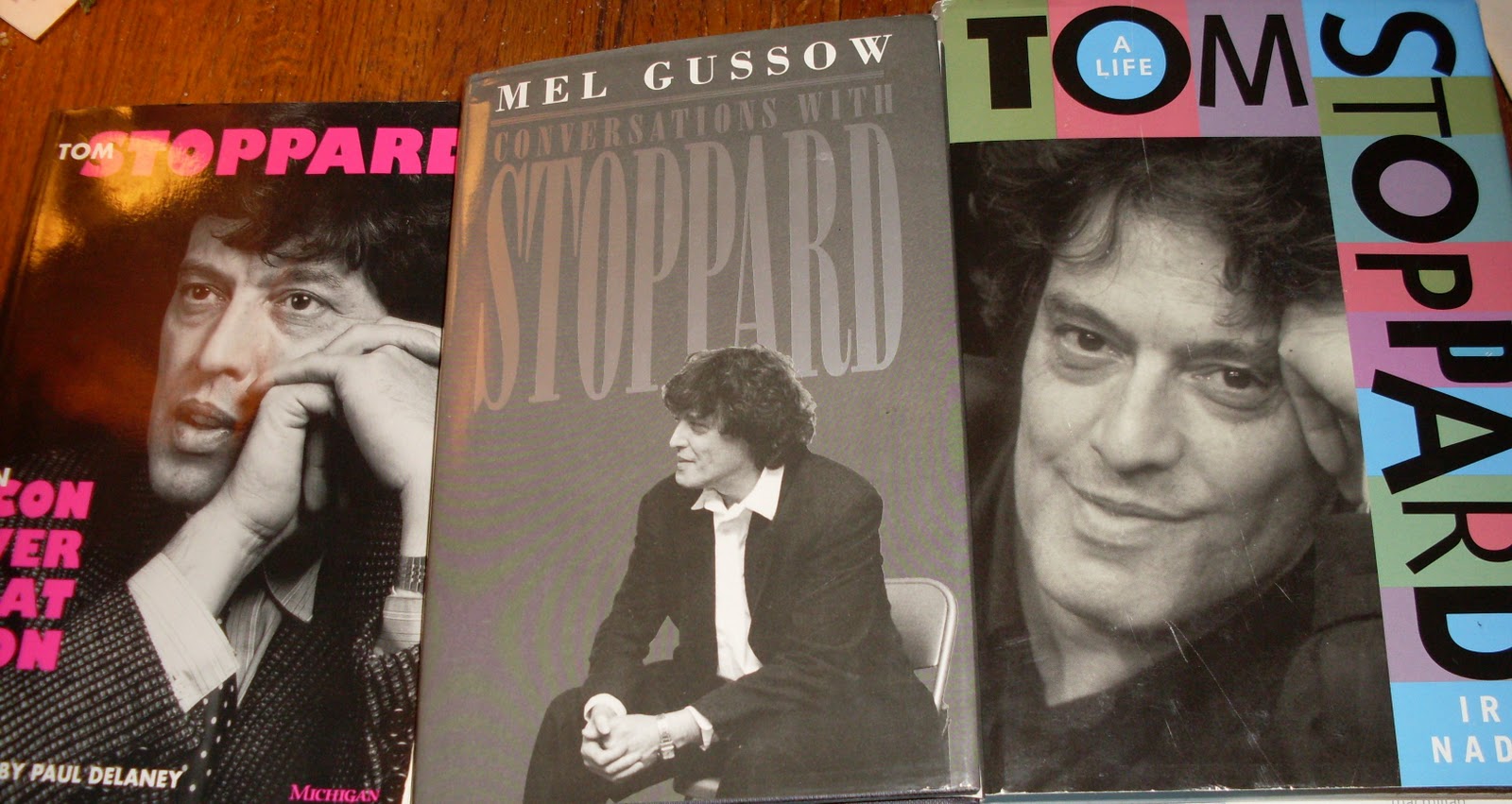
Another factor in Tom Stoppard success--or at least a big part of his reputation from the beginning--was that he gave good interview.  There are filmed or videoed examples on youtube, though most are recent, but the influential and substantive interviews were for print.  The University of Michigan Press collected about 40 of them from 1967 to 1993 (though some are quite short) in Tom Stoppard in Conversation.  This volume includes 3 interviews by Mel Gussow of the New York Times.  Gussow published a separate book,  Conversations with Tom Stoppard (Limelight Editions, 1995) that includes four more, plus Gussow's introductions and afterword.  Gussow was always the Times second string critic, and really prospered in that position.  Without the pressure of the Times lead reviews, he could pursue enthusiasms and delve in depth.  He put together similar volumes of conversations with Harold Pinter, and with (and about) Samuel Beckett.  I consider his career exemplary. (Apparently this book is out of print now--I see on Amazon it's alarmingly expensive.)

There's a good biography: Tom Stoppard, A Life by Ira Nadel (Palgrave/Macmillan, 2002.)  The biographical chat at the beginning of this piece is based largely on this book.