Showing posts with label year not in reviews. Show all posts

Friday, December 27, 2013

The Year Not in Reviews: Plenty of Fields, Backstage Drama

Michael Fields.  Photo by Kellie Brown
This is a slightly different version of my year end Stage Matters column in NCJ published during Christmas week.  So in the likely event you missed it, it's my annual opportunity to write about something--or some things--that didn't get into my reviews and columns over the year, which in this case is (or was) 2013.

North Coast stages depend on a relatively small number of producers, directors, designers and actors who often work on several shows in a given year, before moving on or staying for decades. But even within this context, Michael Fields had a remarkable 2013.

 Fields directed four major productions and was responsible for the final script of at least two. This was in addition to his normal duties as Producing Artistic Director of the Dell’Arte Company and as chair of the entire California State Summer School for the Arts Theatre Program. But more than quantity it’s the newsworthy and innovative nature of these productions for the North Coast that requires more notice.

 In February Fields directed a contemporary translation of Moliere’s The Misanthrope, called Hater. But this wasn’t at Dell’Arte—it was at HSU, with a cast of mostly HSU students. It was a fast-paced yet heartfelt production, visually bold and with lively and subtle performances, notably by Johani Guerrero.

 It was also the first production of this translation outside of New York—which doesn’t happen here very often. Fields had met translator Samuel Buggeln (who is also a New York-based director) and brought him to the North Coast for a week—also an unusual event.
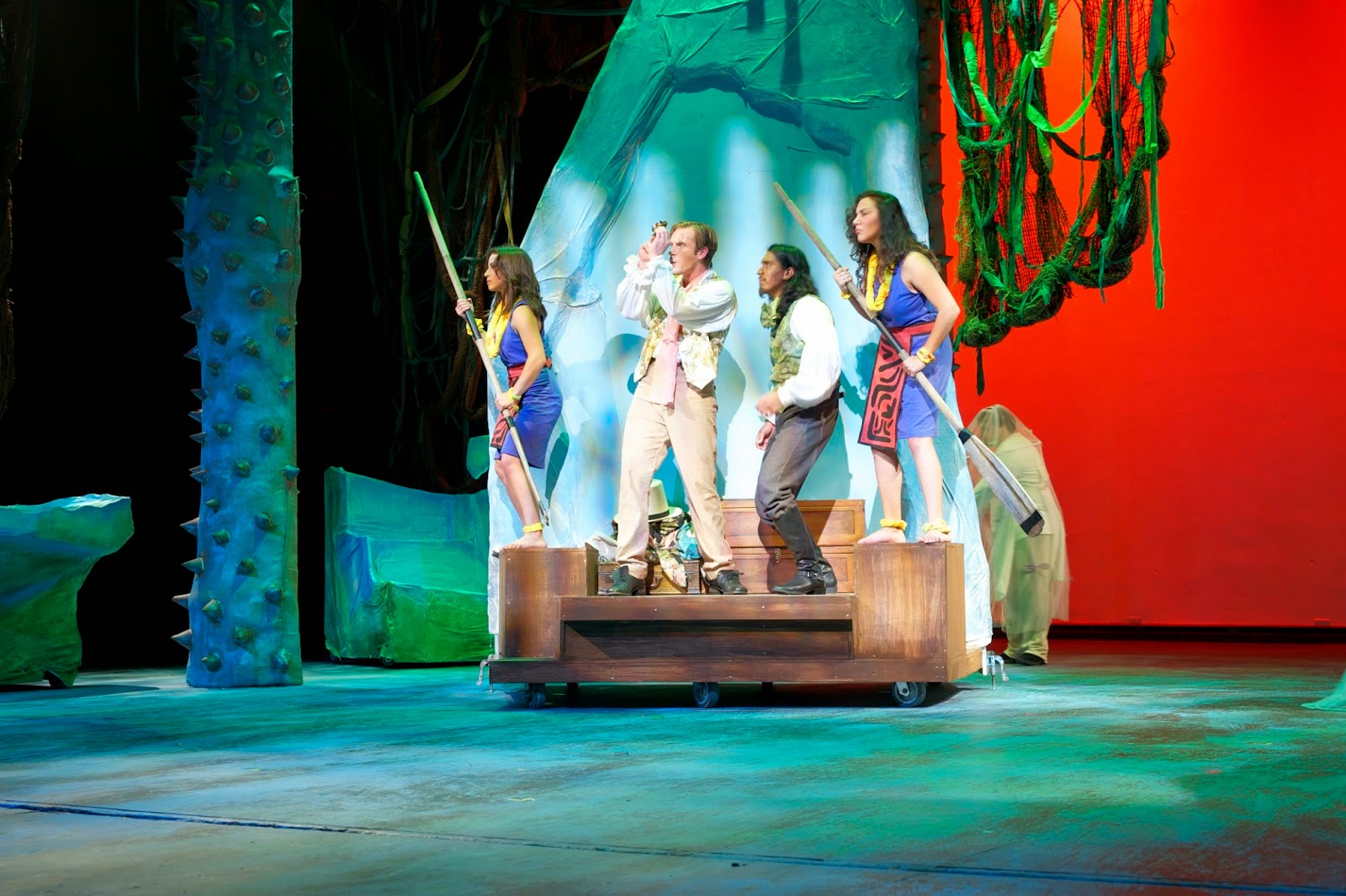
Even while he was adhering to a script in staging Hater, Fields was teaching one of the two classes that helped create Humboldt Unbound from scratch. HSU students and faculty collaborated on shaping ideas for a theatre piece on Alexander von Humboldt for HSU’s centennial year. Fields guided this unprecedented process at HSU (which required political as well as creative skills), wrote the final script, directed the show and tapped Dell’Arte colleagues to help create the sights and sounds of this singular production, which appeared on the Van Duzer stage in November.

And even while Humboldt Unbound was aborning, Fields was working with Dell’Arte International School students on their collaborative adaptation of Victor Herbert’s Babes in Toyland, which returns the Dell’Arte holiday show to a family-friendly narrative as a comprehensible and emotionally satisfying framework for the dazzle within it.
Joan Schirle in THE COMEDY OF ERRORS

 In between he directed (and in part adapted) The Comedy of Errors for the Mad River Festival, the first play by Shakespeare that Dell’Arte produced in 38 years (and he was in that one.) I wrote at the time that it was one of his best directorial efforts.

 I have reservations about Dell’Arte-style “devised theatre” and aspects of the school’s pedagogy, but two mainstays of the Dell’Arte philosophy are practically personified in Fields’ work: his attention to process and his commitment to community. This was not his easiest year offstage, but the care in his work never wavered.

 Fields included two quotes in this year’s Dell’Arte holiday greeting: "Far and away the best prize that life has to offer is the chance to work hard at work worth doing." (Teddy Roosevelt) “Wherever you stand, be the soul of that place.” (Rumi) These are words he lives by.

 So what else about North Coast stages didn’t make it into the reviews and previews this year? Well, just like every year, a lot of the drama, most of which has nothing to do with the play that’s presented. It’s supplied within the production itself.

 For instance: The leading man who leaves a happy musical a few weeks before opening because his girlfriend doesn’t like how he looks at the leading lady. The actors who can’t make eye contact onstage because of what’s happened offstage. The actors who hate their director, the director who can’t stand the actors.

 The musical director and the stage director of a musical comedy who are barely speaking. The set that remains the designer’s fantasy until there’s no longer time to do much more than throw some flats together. Rehearsals suddenly turn into group therapy; illnesses or bad behavior turn them to chaos. Passionate liaisons begin and end within the run of a show, so that two strangers at first rehearsals are estranged lovers by the final performance. (Not all of this happened this particular year... at least not necessarily.)

 Participants tell these stories, sometimes even to me (though some actors just look at me with a frozen expression that suggests they’re fighting the impulse to back away while holding up a cross.) Besides backstage gossip, I occasionally hear their critiques of their own shows that can be more bluntly devastating than anything I’ve written. Well, anything I’ve published.

 While creating a production doesn’t only (or always) involve backstage drama, this should remind us that it’s done by people. And while participants want to produce a good show for audiences, the process itself is often the reason they show up. Applause is nice and necessary, but the process is the point.

It's the journey they take together: they talk about the play, put it on its feet, create its world, solve problems, think about characters, work with each other and see what they can do. Doing it is the chief reward, especially in community and education-based theatre, which is most of what the North Coast offers. Even more than elsewhere, our theatre is subsidized by the work of the people presenting it.

Sunday, September 8, 2013

States of Plays: Where North Coast Shows Come From

As we pause after the traditional end of last season and before the start of the next, here’s a retrospective question: where do the plays we see on the North Coast come from?

 For many decades the answer to that would have been easy: New York. After tryouts in select northeastern cities, a show would play Broadway, then go on tour until years later community players would get their chance. Musicals, comedies, dramas—New York generated pretty much everything. But that’s no longer true.

Back in the mid-1980s I interviewed Jason Robards, Jr. backstage at Broadway’s Plymouth Theatre during a revival run of the 1930s classic You Can't Take It With You (soon to be seen at NCRT). He was the second generation of three (so far) to be New York stage actors. His father performed on Broadway in the 1920s.  One of his sons, Jason III, was in this production.

 “When I was starting out just after World War II,” Robards, Jr. said, “my father came to see me and he told me ‘This is terrible! When I was an actor there were 700 road shows out, and two hundred some-odd theatres on Broadway.’ But even when I was starting out we still had 134 theatres in New York, and many road shows and stock jobs and resident theatre jobs.”

 New York City dominated largely through size. Even in 1940 it had a bigger population than the entire state of California, or any other state. But war industries spread out across the country in World War II,  the population boomed and so did suburbia in the 1950s. Robards believed the new highways that sliced through city neighborhoods and led to the suburbs depleted New York City audiences. “Now I think the theatre in New York is going to become like the opera, if it isn’t already becoming that: a small, specialized thing.”

 Robards didn’t reckon with the rise of tourist-oriented blockbusters in a Disneyfied Broadway. That trend continues, as movie companies invest more in huge stage productions. The Off-Broadway and then Off-Off Broadway stages rose in the 60s and 70s, then settled to a sustainable level as “a small, specialized thing.” So now Broadway produces bigger but fewer shows, and non-Broadway houses have become incubators for shows that will live most of their lives in independent regional and community-based theatres across the country.

 So last season on the North Coast for instance, we saw products of traditional Broadway, from one of the earliest musicals (Anything Goes at North Coast Rep) to one of the last of its kind (Victor/Victoria at Ferndale Rep.)  The new blockbuster Broadway was represented by Shrek The Musical (Humboldt Light Opera) while Circle Mirror Transformation (seen at Redwood Curtain) had a modest Off-Broadway run before productions by Seattle Rep and the Guthrie in Minneapolis, and stages in Marin County and Grand Rapids, Michigan.

Some shows used to be developed outside New York, but became successful when they transferred to Broadway.  David Mamet's Chicago-born American Buffalo (NCRT) is that example.  The New York run still lends a reassuring patina, but more and more shows developed outside New York don’t even bother with the legitimizing New York showcase. The Fox on the Fairway (seen at NCRT) started in Arlington, Virginia before productions in New Brunswick, New Jersey and Naples, Florida. These shows are typically designed for export. Even prize-winning shows with decent Broadway runs (like the musical Next to Normal at NCRT or the drama Proof at HSU) have the small casts and modest staging to be done almost anywhere.

 Prolific American playwright Steven Dietz is a prime example of this new decentralized situation. His work is seldom performed in New York, but appears so often in regional and community venues that he’s in the top ten of produced playwrights in America. His comedy Becky’s New Car is currently onstage at Redwood Curtain.

Except for local group-generated shows and classics, the North Coast is primarily dependent on this new circuit of shows built for quick and relatively easy replication. Some may have virtues and perspectives a New York-generated show might not. But at worst they approach a stereotypical script that’s clever and a little odd but safe and small, with a slick first act and a slack second (that nevertheless includes a thesis statement.) The script too often shows signs of too many hands that got tired before the end.

 More generally, what are we missing on local stages? Due mostly to the demographics of our performers as well as our audiences, we seldom get shows centered on non-white characters or communities. On the other hand we get plays written about southerners, New Englanders and even New Yorkers, but not about North Coast characters. Fortunately, our live actors are surprisingly adept at bringing out the universal (or the North Coast) in any play.

 We also rarely get political plays in the larger sense, apart from gender politics. But hardly anyone in America does. We don’t have a David Hare (one of several British playwrights who look outward) or even a Robert Sherwood, who wrote three Pulitzer Prize winners in the 1930s and a book about FDR and World War II. Wallace Shawn and Tony Kushner are the closest. We’re unlikely to see a play as complex and provocative as Hare’s A Map of the World, for instance. For whatever reasons it’s not a time for singular playwrights with big voices.

 Our North Coast stage institutions do include variety, often at some risk. We're going to see that in the coming season, as well as examples of the kinds of plays I've described.  But our local stages operate in a particular theatrical environment, in a particular national context of this time.

Friday, December 28, 2012

The Year That Was: Topical and Timeless on North Coast Stages

A version of this year-end retrospective appears in the North Coast Journal "Top 10" issue.  I didn't do a top ten, though.  It's not practical.  Though I see a lot of shows, I don't see everything, so it wouldn't be fair.  And I've got multiple conflicts of interest when it comes to HSU shows.  But it's not fair to ignore those shows either.  So this is my compromise.

Drama is a mansion with an almost infinite number of rooms,” wrote Michael Billington, the great drama critic for the Guardian. “I see no point in shutting off any of them.” As I’ve noted on other occasions, there are gaps in the North Coast theatrical ecology. But it’s worth noticing the variety that does exist, and that this past year’s productions supported and altered that ecology, however subtly.

Dell’Arte pioneered “theatre of place” on the North Coast, and this year saw a unique example in the second version of Mary Jane: The Musical. It’s unique precisely because it’s the second version. Dell’Arte has brought shows back before, updating their topical and local references. But this time they re-conceived a show from just the summer before, and so the 2012 version was actually the product of two successive years, which resulted in a deeper (and darker) show. I still recall their Blue Lake: The Opera as the more successful production (a coincidence of talent, music and story), but certainly Mary Jane is more relevant to local identity and its future.


Another successful “theatre of place” show was Women of the Northwest at the Arcata Playhouse. It also was a group effort, part of the national fascination with “devised theatre” that worked in these two productions, with adequate time and thorough process.

  It wasn’t so successful in the Dell’Arte holiday show, The Fish in My Head— well-performed and produced, but so disjointed that it’s the first show I can recall that got me to root for the villain: the guy who wanted it to make more sense.

  This year also brought an unusual number of topically relevant dramas written by actual playwrights: Sarah Ruhl’s In the Next Room at Ferndale, Justin Lance Black’s 8 and Suzan-Lori Parks’ Venus at HSU, for example. HSU and College of the Redwoods also contribute classics (Moliere at CR, Noel Coward at HSU) and a glimpse of a different cultural approach in HSU’s version of the Sanskrit drama Shakuntala. A theatrical ecology is sustained by educational inquiry for both participants and audience.

   Humboldt Light Opera Company added to its high quality contributions with Damn Yankees and Cinderella. Redwood Curtain continued to concentrate on small cast contemporary American comedies, but took a few more chances this year with plays of challenging form and content, such as Circle Mirror Transformation, Dusty and the Big Bad World, For Better and The Language Archive.  These forays work largely because Redwood Curtain nurtures a high level of acting.

  Our two community theatres (Ferndale and North Coast in Eureka) have the words “repertory” in their names, which refers to producing shows from “the repertoire,” or the roster of successful plays (artistically, commercially or both) of the accessible past. There are a lot of judgments involved: some shows are too big (and expensive) or too small, too new (rights are unavailable) or too old.

But how old is too old? Looking back at this year yields a rule of thumb. Dramas can be quite old, though Shakespeare is about the limit. This year we got a searing drama from the 1950s (Look Back in Anger at Ferndale Rep) and a mystery from the 1940s (Agatha Christie’s The Mousetrap at North Coast Rep.) Comedies and musicals are usually more recent. Which is another reason that North Coast Rep’s production of the pioneer musical comedy Anything Goes was so fascinating.


There are few if any Broadway musicals older than Anything Goes that get produced anymore. In fact, only 3 previous shows are generally classified as modern musicals (Show Boat in 1927, The Band Wagon in 1930 and Of Thee I Sing! in 1931.)

Songs have since been stolen from other Cole Porter shows for this version of Anything Goes, and the script is not exactly the same as the show that premiered in 1934. That script began with legendary Brits P.G. Wodehouse and Guy Bolton but the Broadway version was quickly assembled by its director Howard Lindsay with a press agent named Russel Crouse.  They were so successful at it that they themselves became a legendary Broadway writing team.  The script was revised for the 1987 revival by John Weidman and Timothy Crouse, Russel's son and the author of one of the great books on U.S. presidential campaigns and the press, The Boys on the Bus (1972).  I knew him for a few years around then.

Anyway, the changes in the latest, the Tony-winning 2011 version that’s on tour into 2013 seem to be in musical arrangements, etc.  So I don't actually know who is responsible for my favorite bit of dialogue.  Asked by a ship's officer if he'd seen infamous racketeer Snakeyes Johnson somewhere on the ship, one of the characters says he saw him at the mizenmast. “ But this ship doesn’t have a mizenmast.” “Oh. It must have been somebody else.” 


The constant in all this is Cole Porter.  His songs have not changed. His music is timeless, but his lyrics are very topical—particularly in one of this show’s most famous songs, “You’re the Top.”  They haven't been revised, so the lyrics are still a kind of mini-tour of 1934. While some of the places and the famous people named in the song are still well known, others mostly aren’t. Quite a few clever references go right by a lot of the audience nearly 80 years later.

 So how does the song still work? It was interesting to watch how Molly Severdia and Erik Standifird relieved anxieties by acting out contemporary reactions to some references in their performance of the song, a highlight of the North Coast Rep production. For instance, they gave the line “You’re broccoli!” the icky vegetable look, but in 1934, broccoli was new to the U.S. and quite fashionable.

They simply ignored other references, like Jimmy Durante, a showman who was often parodied into the 1960s. In fact some lyrics are now so obscure that there are several online attempts to track down their meaning. There was a long and involved theory about “you’re a drumstick lipstick” (which involved ice cream and kissing) until somebody uncovered an old ad that showed that Drumstick lipstick was a 1934 brand name.

 Still, it isn’t necessary to know that moisture-proof cellophane was a modern miracle in the 30s to laugh at the exuberant brilliance of “You’re the National Gallery/You’re Garbo’s salary/You’re cellophane!” The strange alchemy of the topical and the timeless in a play that lasts is one of the wonders of theatre, as it is in other arts. So it’s a vital part of our theatrical ecology.

Friday, December 9, 2011

Year Not In Reviews 2011: Communities in Hard Times

The Mousetrap at NCRT
 Bad economic times are more than a theme in at least four recent North Coast stage productions. They are a fact of life that local theatres face. From anecdotal evidence, it appears that the economy is injuring some theatrical organizations more than others.

 But in hard times particularly, all these theatres depend on the strength of community. Each of them has its own distinct community that often includes participants as well as audience members. That participation may be as actors and other artists, fundraisers, suppliers or simply volunteer ushers and ticket-takers.

 These communities can be drawn from natural constituencies: the associated school, the hometown. But basically these communities are self-selected, and they can be very loyal. For example, the Redwood Curtain community kept the faith through years of exile until a new venue was found. But there is also support from the larger community that is not regularly involved in productions, even as audience.

 During the past year I’ve made a point of seeing performances that weren’t on opening night (which is typically when that theatre’s own community gathers), with a variety of audiences in attendance. So I’ve seen Sunday matinees at Ferndale Rep with seniors bussed in from senior centers in Eureka and Redway, and an evening performance at the Arcata Playhouse with members of Soroptimist International of Arcata (an organization of “professional women dedicated to helping women and children in our community.”)

 This latter event was an example of a non-profit organization essentially renting a performance and selling tickets at a price of its choosing, often as a fundraising event. North Coast Repertory Theatre executive director Michael Thomas calls them “benefits,” and NCRT typically does two for each play, usually on opening weekend.

 “We like to do benefits because it helps other local non-profits raise money and it is a good way to get word of mouth advertising going after opening weekend,” he said. “Full houses on opening weekend are good for everybody. In any season, local non-profits raise a total of twenty to twenty-four thousand dollars by sponsoring benefits.”

 I saw NCRT’s most recent production (Agatha Christie’s The Mousetrap) at an especially interesting benefit for Reading Service of the Redwoods, which performs services centered around reading daily newspapers for broadcast to the blind. (As it happens, I was a volunteer reader some years ago.)

 That audience included not only supporters and participants but clients. So for blind audience members attending, the set was described in detail (the location of the doors and the furniture) before the show started, and the actors came out to introduce their characters, including what they were wearing and where they would first enter.

 Afterwards, Michael Thomas asked a group of blind audience members if even that cursory information had helped. You don’t know how much, is essentially what they told him.

 This is an obvious example of extending a theatre’s community, but these benefits seem to do so more generally. At several it was clear that some attendees had never been there before. Such events strengthen community ties, and together with other efforts to build loyalty (like creating very good shows), they can help theatrical organizations weather hard times.  These non-opening nights also remind me that in almost any audience, for even the most performed plays, there are those who are seeing it for the first time.

 As for a trend in presentations of the past several months, the most obvious was the march of musicals: six of them from June to November. If that’s a record, it may be broken in the next six months. After a February production of Shakespeare’s comedy, The Taming of the Shrew, Ferndale Rep presents three musicals in a row: Evita in April, followed by Cabaret and Woody Guthrie’s American Song.

 After its own Shakespeare comedy (Much Ado About Nothing) in March, North Coast Rep performs Avenue Q. In April, Humboldt Light Opera presents Damn Yankees. And rumor has it that a sequel to Mary Jane: The Musical  is in the works at Dell’Arte for the Mad River Festival in June.

 Musicals are popular with local audiences, so they may be a recession hedge, but they are also popular with North Coast performers. The flip side of that is a concern expressed by some directors that local actors (even students) are reluctant to perform in shows they don’t know. This can contribute to a theatrical tedium, and lack of adventurousness that is detrimental to actors and audiences.

 Still, the new year will bring plays by contemporary playwrights Suzan Lori-Parks (at HSU) and Julia Cho, Eric Cable and Paul Weitz (at Redwood Curtain) as well as a locally rare Noel Coward classic at HSU.

Coming Up:

 Northcoast Prep presents a musical adaptation of The Odyssey, Wednesday December 7 through Saturday, December 10 at 7:30 p.m. (plus a Saturday matinee at 1:30) in the Studio Theatre at HSU. Adapted and directed by Gretha Omey Stenger. Reservations at brownpapertickets.com or 445-2355.

The Dell’Arte School’s second years present their Character Projects (one act plays) December 8-11 in the Carlo.

Some Assembly Required at HSU
It's the final weekend for A Playhouse Recessionary Christmas at the Arcata Playhouse.  Also the final weekend for Some Assembly Required at HSU, which I do not review in the Journal, but which is a funny show and a worthy play, a kind of askew sequel to A Christmas Story, at Ferndale Rep through Dec. 18.

The Dell'Arte Christmas show, The Nutcaper  is at the Eureka Theater on Dec. 10, and the Van Duzer at HSU on Dec. 13 before returning for paid shows at the Carlo Dec. 15-18.

The Ladies of the Flies, a new play based on William Golding’s classic novel Lord of the Flies, is a work-in-progress created by an ensemble including Dell’Arte Company member Zuzka Sabata, Synapsis Arts Collective co-founder Leslie Howabauten and Dell’Arte grads Cara McClendon and Elana Levitan. Friday, Dec. 9, at 8 p.m. at the Synapsis Warehouse (47 Third St. in Eureka) and on Sunday, Dec 11, also at 8 p.m. at the Arcata Playhouse.

Beyond this weekend:

On Thursday December 15 at 7:30 p.m., Jeff DeMark and the LaPatina band perform That Train Has Sailed, his new show that’s evolving from recent live performances, at a new performance venue: the Sewell Gallery of Fine Art at 423 F Street in Eureka. The LaPatina's are Paul DeMark, Jim Hatchimonji, Andrew Goff, Neil McLaughlin and Deric Mendes.

For one night only, North Coast Rep presents a mostly musical and entirely family-oriented evening, Christmas at NCRT, with the Redwood Dixie Gators Jazz Band and the Bare-Stage Singers. It’s Saturday December 17, at 7 p.m. 442-6278, www.ncrt.net.

Happy holidays to all and to all a good night.

Wednesday, July 20, 2011

Stage Presence: the Official Stage Matters column


As the current theatre season winds down, announcements of next season’s offerings on North Coast stages are beginning. Before some of those are revealed later in this column, a few words on the wider context, and a reminder.

The reminder is this: all theatre is local. It’s true that the plays we see here are often done at many regional and community theatres around the country and even the world, for years and even centuries before we see them. It’s also true that some theatrical creations are more local than others—such as Dell’Arte International Theatre Company's Mary Jane: the Musical or The Loggers Project by Sanctuary Stage Theatre, and other “theatre of place” productions created out of local experiences.

But all productions are local in the sense that they are created on stage only by people of the here and now, and experienced by audiences exclusively here and now. That includes the experience of a play from elsewhere, its history and its meaning to us, here, now.

To suggest another meaning of “all theatre is local” consider a play that we won’t see this season or next, or probably ever: Spider-Man: Turn Off the Dark. This current Broadway musical cost $75 million to produce (including $2 million for harnesses and flying rigs), enough to finance all of North Coast theatre possibly until the end of time. Most local theatres would be happy with an annual budget matching the $1.2 million it costs to stage this show each week.

Yet after more than 180 previews, a fired director and a rewrite, it opened to reviews that would likely get a North Coast critic a shove off Trinidad Head: “This singing comic book is no longer the ungodly, indecipherable mess it was in February. It’s just a bore,” wrote Ben Brantley in the New York Times.

Other critics wrote: “This effects-driven musical is still situated a wide canyon’s distance from good. “A sad, stilted event that crashes consistently and rarely flies.” “Deteriorated from mindblowingly misbegotten carnival-of-the-damned to merely embarrassing dud.” Entertainment Weekly noted that the common complaints were incoherent storytelling and mediocre songs.

Tickets to see it on Broadway range from $69 to $362 (with broker fee.) In an era when even regional theatre tickets can flirt with or exceed $100, most North Coast theatres tickets are under $20. Obviously a Broadway show or a regional theatre production will be different in many respects. Some will be better—occasionally even the more than the ten times better suggested by the difference in ticket price. But not always. Theatre is an uncertain thing everywhere, all the time.

Even apart from cost, shows will always have different virtues and weaknesses, rewards and disappointments. Because all theatre is local. For instance, one of the repeated rewards of North Coast productions is the person on stage who lifts you out of your seat. It may be a well-known local veteran in a particularly revelatory role. Or it may be a young talent passing through, from local high schools to distant universities, from local colleges to destiny elsewhere, maybe on a bigger stage.

Stage presence is perhaps the most mysterious and most indispensible quality. It express itself as dramatic talent, of power and timing, or a comedic talent, of movement and personality. It may be a speaking voice that commands attention and expresses unexpected emotion, or a singing voice that thrills and touches the heart. Or it can be moments, or an entire production that’s illuminating or moving. But you have to be there. Because all theatre is local.

As for what North Coast audiences can see on stage beginning this fall, here are the next season productions announced by three local theatres.

North Coast Repertory Theatre begins with the Sondheim musical Into the Woods, followed by Agatha Christie’s stage mystery The Mousetrap. Neil Simon has been good to NCRT, so next year features his Laughter on the 23rd Floor. The annual Shakespeare is the comedy Much Ado About Nothing. Next spring the 2003 musical Avenue Q is followed by the comedy The Red Velvet Cake War.

Ferndale Repertory Theatre's season begins in October with a farce in which four actors reenact the Hitchcock film, 39 Steps. A stage adaptation of the viral TV classic A Christmas Story is followed in February by the first Shakespeare at Ferndale in awhile: The Taming of the Shrew. Then three musical productions complete the season: Evita, Cabaret and Woody Guthrie American Song.

HSU Department of Theatre, Film and Dance has announced its most ambitious season in years: Neil Labute’s Fat Pig (directed by Michael Thomas) in September, the musical Brigadoon in October, followed by Eugene Stickland’s Christmas comedy, Some Assembly Required. Venus by Suzan Lori-Parks is in February, the Noel Coward comedy Blithe Spirit in March, before the spring dance show and 10 Minute Play Festival.

Coming Up: But there are more shows before this season is over. Opening at North Coast Repertory Theatre on July 28 is The Kitchen Witches, a comedy by Caroline Smith, directed by Carol Escobar and featuring Kathleen Marshall, Laura Rose, Daniel Kennedy and George Szabo.

Thursday, December 30, 2010

The Year of Staging Dangerously


Theatre isn’t easy anywhere. But it’s particularly hard here, for both participants and audiences. Is there a well-equipped facility with comfortable seats and good sightlines, let alone adequate ventilation and amenities, on the North Coast? North Coast Rep is raising money to replace lighting equipment that is so old that parts aren’t made for it anymore, but it’s hardly the only local theatre with that kind of problem.

 Of course other local entertainment venues have their drawbacks, including the self-inflicted, as I experienced recently while trying to watch the dim and insultingly underpowered projection of the latest Harry Potter movie in an ice-cold cinema. But hereabouts theatre creators and audience are partners in what might be described as frontier theatre.

Add to this a depleted media environment. A few years ago a show might get three or even four reviews. But the loss of papers and pages (and the Times-Standard’s virtual abdication of local performing arts coverage) means two reviews at most, but more typically one or none while the show is running. The Lumberjack remains useless. At least this paper still makes room for this column about twice a month, though it is the one regular feature that the Journal doesn’t promote.

 Theatre may not get priority because its audiences are older (and though more likely to still read newspapers, are perceived as not attractive to advertisers) and the theatregoers aren’t very vocal, except when they don’t like a review. Given all the problems, plus the conflicts and emotional overloads common to theatre, it remains amazing that theatre gets done at all. These days I regard it as a residual minor miracle, like the continuing existence of libraries with actual books in them.

 What keeps theatre alive here? The dedication, perspicacity and effort of the people who run the theatres, community support, a cadre of actors and other theatre people who’ve found a niche here, and the talent and energy of young people from local schools who stick around long enough to renew North Coast stages—not just from HSU, CR and the Dell’Arte School, but from theatre programs at (for example) Eureka High, Arcata High and Northcoast Prep.

 This year has also seen an increasing cross-fertilization and cooperation among theatres and schools. Though InterAct seems largely moribund, perhaps other efforts to strengthen theatre as a whole may result.

 Another vitalizing factor is the at least occasional willingness to take more than the usual chances. Some theatre folk call it “stretching”: choosing to do a more challenging, more ambitious work, or to do a production in a more ambitious way, or both.

 That kind of ambition is crucial to the vitality—the lifeblood—of live theatre. It pushes theatre beyond pleasant entertainment to become startling, troubling, inspiring, thought-provoking, feeling-evoking—and, in a word, important. Even life-changing.  Yet it may also increase the chance of failure—or at least of raising more expectations than it fulfills. That’s the risk.

 In a year when nothing I saw on the North Coast failed to entertain to some degree, there were also efforts of particular ambition. Such ambitions may get short shrift in a review, which is largely about execution. For example, though I didn’t feel all the science-inspired ideas cohered in Charlotte Jones’ Humble Boy, the attempt to relate these concepts to how we might live our lives was admirable, as was Redwood Curtain for presenting them. Rent at Ferndale Rep, Michael Thomas’ direction of M Butterfly at HSU, the group creation of An Evening With Rumi at HSU, Doubt at North Coast Rep, all explored beneath the surface of topical concerns and difficult terrains. North Coast Rep took its brave annual Shakespeare challenge.

 Dell’Arte and the Arcata Playhouse continued to host intriguing visitors, including the nearby artists of Independent Eye and Human Nature. But the most conspicuous example of successful ambition was Dell’Arte’s original production last summer, Blue Lake: The Opera. Though it’s rumored that not everyone at Dell’Arte initially wanted to do it, people who saw it are literally still talking about this show.

 It was creatively ambitious.  Everyone involved rose to the occasion, opening a lot of eyes to the potential of local talent, and changing at least the life of one of its singing stars, David Powell, who subsequently enrolled in the Dell’Arte School.

 For Humboldt Light Opera Company, the challenge and ambition of producing the very familiar The Pirates of Penzance was to make it new. Apart from its usual musical excellence, HLOC did this with humor that didn’t displace feeling, and showmanship that combined taste with boldness (defying purists but adding color and spirit by increasing the number of “daughters” to absurd proportions.) Director Carol Ryder paid careful attention to the basics of audibility and intelligibility, in a memorable production.

 As my reviews reflect, I’m not always crazy about the plays local theatres choose to do. And I miss the plays nobody seems to do. I’ve become resigned to seeing Shaw only on DVD, and only imagining Stoppard outside of Rosencrantz and Gilderstern Are Dead, which CR will do soon. Or (just one example) of seeing any Thornton Wilder except Our Town, though with the popularity of apocalyptic plays, The Skin of Our Teeth could be fascinating. Still, a necessary ingredient in the alchemy of excellent theatre is surprise.

Sunday, December 20, 2009

The Year Not in Reviews 2009

Theatre is hard to do, in the best of times—even without economic hardships affecting box office and production decisions. There are multiple challenges and pitfalls in every show.

 There may be more drama backstage than on—as I’m told occurred at one local theatre this past year: a lead actor’s significant other got so upset by his onstage business with the leading lady that he dropped out of the show perilously close to opening.

 The interactions of producers, designers, directors, actors (and their spouses), limited resources and even more limited time, different agendas (professional, institutional and personal) and the interplay of text (its history, its contemporary expression) and its realization on stage—it’s all a complicated process.

 And yet, from the point of view of the audience, it’s very simple. If you know anything about baseball, you realize (and probably relish) that it’s a fiendishly complicated game, and playing it well is difficult. But it’s also very simple.
As the fictional manager of a minor league team in the classic movie Bull Durham tells his players: “This is a simple game. You throw the ball. You hit the ball. You catch the ball.”

 For the theatre audience, there are certain simple and basic expectations: the audience wants to see the play, hear the play, and follow the story of the play. A production’s first job is to make all of that easy.

 It isn’t so easy to accomplish, but I wonder if the focus on these tasks doesn’t get lost sometimes. Several productions this year seemed to take their eye off the ball.

 Scenic design may be dazzling and expressive, and it may carry out some aesthetic related to the play, but does it help or hinder the actors in being seen and heard?

 Directors may create “stage pictures” that keep the eye moving, but does the blocking help or hinder audibility, or focus the relationships of the characters?
I know that I’ve wondered more than once why two characters who are apparently engaged in intimate conversation are doing so by shouting at each other from opposite sides of the stage.

 Theatrical magic may include spectacle, but basically the spell can only be sustained by intelligibility. Part of following the story is knowing who the characters onstage are, and who they are talking about if that character isn’t present. The audience enjoys the engagement of figuring things out, but if it is too much of a struggle, they may just give up.

 This is as true ultimately of experimental work, like the often impressive Inverted Lorca at Dell’Arte this fall, as it is of established conventional plays. While certain moments and flourishes may remain strongest in the memory, sometimes effects take spectators out of the play rather than pulling them in.

 Probably the biggest distraction generally is the agony of scene changes and transitions. These cause such time-consuming technical problems that playwright Sarah Ruhl suggests—only partly in jest—that the traditional stage curtain be revived to separate scenes by rising and falling.

 My concern is the effect on the stage illusion and the audience’s engagement. Is more gained by specific scenery than is lost by watching people move things around every few minutes?

 Effectiveness is partly a game of expectations. Approaching a drama, audiences likely expect only to be engaged by something—the story, characters, subject or setting. A powerful dramatic and emotional experience is a bonus. But audiences approaching a comedy reputed to be funny expect to laugh, and if they don’t, the show has not done its job.

 Of the last four comedies I’ve seen, only one—the Dell’Arte Christmas show—was consistently funny. The other three had funny scripts and reputedly funny prior productions. But problems of intelligibility and pace—or maybe the apparent decision to concentrate on other aspects of the play-- cut the comedy.

 Still, there were several productions this year that did the basic stuff and went beyond it to create fine theatre: among them were North Coast Rep’s Love List, The Goat and The Producers; HLO’s Light on the Piazza, Ferndale Rep’s Crimes of the Heart, Dell’Arte’s revival of Intrigue at Ah-Pah, Redwood Curtain’s Bad Dates, visiting Cornerstone Theatre’s Jason in Eureka.

 And there were intriguing beginnings, like Joan Schirle’s aforementioned Inverted Alba, Dell’Arte’s The Body Remembers, John ADEkoje’s Jagun Fly at HSU, and David Ferney’s The Misunderstood Badger at the Arcata Playhouse, plus several visiting shows at the Playhouse. And again, our own unique Jeff DeMark.

 This is probably more than an area this size that’s this isolated could reasonably expect. On the other hand, every audience reasonably expects an intelligible performance every time, on the way to being entertaining and maybe even enlightening.

 Late News Headlines: The recent production of The Marriage of Bette and Boo is the first HSU show this decade to be selected to compete in the Kennedy Center American College Theatre regional festival. And Redwood Curtain’s long search for a new venue may be over, according to Bob Doran’s reporting. Stay tuned.

Tuesday, January 6, 2009

The Year Not in Reviews


Darcy Daughtry and Erik Rhea in Helen, one of HSU's productions this past calendar year--part of the ecology of North Coast theatre, explored in the post below.

The Year Not in Reviews: Exploring the Ecology of North Coast Theatre

[An extended version of my Journal column last week, without the part I already cannibalized for the previous post...]

By way of a year-end summing up, this column is about what doesn’t normally get into reviews.

The plays we see may have several purposes. Many—including productions by Humboldt State, CR, Dell’Arte International School, local high schools and organizations like the Laurel Tree Learning Center—are part of the participants’ education. Community theatres like North Coast Rep and Ferndale Rep provide talented community members opportunities to participate in making as well as seeing theatre. Both provide opportunities that participants wouldn't otherwise have to strut their stuff, and since there are many more talented people than ever get to work in theatre as a career, audiences benefit as well.

I seldom mention this in reviews, because what these and other theatres have in common is that they charge audiences money to see them, and I review their shows from that standpoint. But I do take their other missions into account, and I expect audiences do, too.

Something else I don’t mention in reviews but which productions have in common is the achievement: of a group of people preparing and then presenting a play from beginning to end for two or three hours, and then doing it again, over and over. This is an accomplishment by any definition. It’s also one of the great benefits to participants: to commit their energies from the beginning of the process, weeks or months before opening, to the end of it. For some, simply sticking with it from first to last actually changes their lives. When audiences applaud, it seems to me it’s partly for the accomplishment, regardless of the outcome.

We don’t have professional theatre hereabouts in the same sense as in San Francisco or Ashland, but audiences here benefit from our particular theatrical ecosystem in ways they might not realize. For example, both educational and community theatres emphasize participation, which often means large casts. Elsewhere there is tremendous financial pressure on commercial theatres to do nothing but small cast shows.

But we have these community and school theatres doing large cast shows, together with the small cast or one-person shows produced or imported by the Arcata Playhouse, Sanctuary Stage and Redwood Curtain (for instance), as well as Jeff DeMark’s unique solo work. So we have a pretty rich variety.

Another way our North Coast theatrical ecology is unusual is the predominance of a theatrical style that is relatively obscure in most other places: commedia dell’arte. This is due mostly of course to the Dell’Arte theatre and school, and those associated with Dell’Arte who remain or return here to form other theatrical enterprises. Jacky Dandeneau and David Ferney, impresarios of the Arcata Playhouse, are good examples. But there’s also Dan Stone, co-founder of Sanctuary Stage, who has brought commedia from entirely different sources.

The commedia emphasis on improvisational satires, often on standard themes, with acrobatics and clowning, may be a pronounced local characteristic, but a healthy theatrical ecosystem requires other approaches, too.

So other theatres here (including the companies that wax and wane) bring the balance of classic and newer plays; musicals (including the sterling work of the Humboldt Light Opera), drama and other kinds of comedy. We have theatre for (and by) children, for (and by) adolescents, and for (and by) elders. We need them all, and as fortunate as we are to have this much theatre, there are gaps in the ecosystem, too. Other things being equal (which they never are), we could use more.

Because of my very part-time job doing press for HSU plays, I don’t write about those productions in my part-time piecework columns here. But I’m dismayed that HSU productions aren’t covered much elsewhere in the Journal either. There was more copy in one recent issue about Dell’Arte (including in my column) than there has been cumulatively concerning HSU theatre for the past couple of years, at least. So in this context let me speak up for the role of HSU theatre in the local ecosystem, particularly when the university is taking a hard look at its priorities, and from time to time there have been rumors of threats to HSU theatre’s existence.

Besides benefiting the university as a much-needed public interface with the community, HSU theatre brings particular strengths and important contributions in the kinds of plays it does and how it does them. Its recent commitment to doing new plays, often by North Coast playwrights, is pretty much unique here right now. In general, HSU provides training and people essential to North Coast stages, with participation both by students who enliven local theatre while here, and by faculty and former students who remain active in the community. Just how much theatre would survive here without HSU is a real question.

Lastly, this fall was unusual for offering three productions of Shakespeare. That this theatrical community was able to mount two large cast productions pretty much simultaneously (The Merry Wives of Windsor at NCRT and The Winter’s Tale at HSU), while overlapping with the large cast of Noises Off at Ferndale Rep, is astonishing. That's one indication that there's a lot of interest in theatre here, with lots of participants and audiences.