Sunday, June 26, 2011

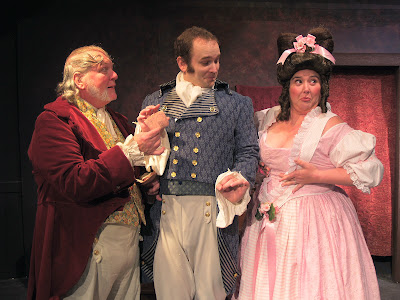
Mary Jane: The Musical


Back in the day, there were long-haired heads and crewcut straights. Out of their separate habitats and in the same public space, they still experienced different worlds. Even the same words meant different things.

 I’m not so conversant with the current status (or vocabulary) but it seems fair to say that the Dell’Arte summer show, Mary Jane: The Musical, is another recent landmark in open integration, if only because its official sponsor is the Humboldt Growers Association, formed to address issues involving medical cannabis. Maybe secret wads of cash that have aided various artistic enterprises need be secret no longer.

 Regardless of opinions on NORML, the crowd that came to opening night looked very (Humboldt) normal. Perhaps fewer young families with kids sprawled on blankets but otherwise there was the usual age mix, the same local establishment figures, and even less of that weedy aroma around than on an ordinary afternoon in Arcata.

 Though the event was something of a coming out party for “the Industry,” the show itself suggested issues and complexities on cultural and personal levels without a unified political stand. It was a “normal” Dell’Arte summer show: music, laughs, spectacle and fun, with lots of local references and ironies.

 But the topic was, as Mary Jane says, “our morality tale, our telenovela, a romantic myth, a foreign invasion, a black market, a daily headline, a medical movement, the reason we still got anything resembling an economy.”

 The pre-show music recognized the pre-60s history of marijuana in America with tunes from the 20s and 30s black music culture, like “Smoking Reefers” about puffing misery away, which includes the lines: “It’s the kind of stuff dreams are made of/it’s the thing that white folks are afraid of.”

Then after tunes from the 60s onward, the show stayed local and contemporary with the appearance of Mary Jane, a 60s refugee and original Humboldt grower, the “Duchess of Dope, the Princess Pioneer,” who is being crowned Queen of the Emerald Ball.

 Joan Schirle, in a long dress and bright lipstick as Mary Jane, starts off with a buoyant, dazzling Broadway-style production number that would be a complete show stopper except that it’s the opening song. Schirle’s command of the stage and our attention carries through the evening, even as she becomes pretty much an m.c. for a dozen more songs by as many local composers.


The tunes include Lila Nelson’s tale of doomed love between an indoor and an outdoor plant, Jeff DeMark’s narrative around discovering a Gin & Chronic drink on a Christmas vacation in Hilo (with a Hawaiian dance backing) and Tim Randles’ bluesy “Why is Whiskey Legal and Pot is Not,” with its nods to those 30s musical roots. Other tunes are by Curtis Thompson, Eldin Green, Zuzka Sabata, two by Joani Rose, and one each by Fred Neighbor and Joyce Hough, who also anchor the show with their priceless performances.  The evening ends with a flamboyant, expertly executed Bollywood number, written by Tim Gray and starring Dell’Arte International student Pratik Motwani.


The humor could be light and sweet, as in the early dialogue between two Humboldt Honeys on the Plaza: Crazy Jeannie (Meredith Anne Baldwin), who believes her new Russian Concussion drink will end war, and Chanterelle (Janessa Johnsrude), a vegan who makes cream cheese from tofu and mayonnaise, because (in my candidate for the funniest line in the show, which was either an improv or late addition to the script) “Cream cheese is murder!”

 But there’s also bad vibes in “The Industry” by Scott Menzies, staged as second-generation cynicism and rebellion in heavy metal and hip hop: “I hide in your neighborhood, hide behind closed doors/ Hear the lamps buzz as mold spreads on the floors/Jacked up housing prices skewed economy/ I am The Industry, it's all about me!” There’s also angry accusation: “All who share in Humboldt County's prosperity/Share culpability.”

Those are just some of the, ah, high points. This is less a play than last year’sBlue Lake: The Opera and more like sprawling shows of previous summers. Though the script’s content is substantial and threads of relationship suggest a story, what holds the evening’s meaning and madness together is Joan Schirle’s star power. We’re always with her, and we’ll follow her anywhere. Surely Schirle should eschew shamus shows and choose chanteusing. I know, easy for me to say.

David Powell and Ryan Musil are among this troupe of pleasing singers, dancers and actors. Michael Fields’ direction was able and imaginative, as were the contributions of Tim Randles (music), Daniel Spencer (scene), Michael Foster (lighting), Lydia Foreman (costumes), Laura Munoz (choreography), Zuzka Sabata and David Powell (vocal arranging.) The necessarily versatile band was Tim Randles, Marla Joy and Mike LaBolle, with Scott Menzies’ guitar on “The Industry.”

 Mary Jane: The Musical continues outdoors in the Dell’Arte Rooney Amphitheatre Thursday through Sunday, July 3.

Muse: July Preview

First on the July agenda for North Coast Repertory Theatre is keeping the lights on. In an already challenging economy for local theatres, NCRT urgently needs to replace lighting equipment that’s 40 years old. So the first of two fundraisers this month is Keepin’ the Lights On, a musical revue featuring show tunes performed by lights-out singers Katy Curtis, Evan Needham, Nanette Voss, Craig Waldvogel and Andrea Zvaleko, with musical accompaniment by Laura Welch. It’s on for two nights, Friday and Saturday, July 1 and 2 at 8 p.m. in the North Coast Rep theatre. Suggested donation is five bucks.

Next up at Redwood Curtain is Kimberly Akimbo by David Lindsay-Abaire, a play that puts the ultimate spin on growing up fast. It’s centered on a New Jersey teenager with a suspect family and a rare condition that causes her to speed rapidly to old age.

It’s Redwood Curtain’ s third Lindsay-Abaire play. “This playwright’s works are a perfect match for our uniquely twisted sense of humor,” said Artistic Director Clint Rebik. Adina Lawson plays Kimberly, with James Hitchcock, Elisa Abelleira, Peggy Metzger and Kody Dennis. Cassandra Hesseltine directs.

 One reviewer wrote that this play “buzzes along” like a balloon “tied to a firecracker”--which may make it perfect for an early July opening. Kimberly Akimbo previews at Redwood Curtain on Thursday and Friday July 7 and 8, with the official opening (and reception) on Saturday July 9 at 8 p.m. Performances continue Thursdays to Saturdays through July 30. Thursdays are cheap date nights. There’s one Sunday matinee, on July 24 at 2 p.m. Information at www.redwoodcurtain.com.

 The Mad River Festival in Blue Lake continues in July with A Suicide Note from a Cockroach, a circus theatre spectacle performed by Pelu’ Theatre, a company based in Portland but rooted in Puerto Rico. Billed as putting a comic twist on being an immigrant in a U.S. city, it’s presented in Dell’Arte’s Carlo Theatre July 7-10 at 8 p.m.

Also as part of this year’s Fest, the Dell’Arte production of Three Trees (with Joe Krienke, Stephanie Thompson and Lauren Wilson as wartime clowns) first staged in January, returns for four performances, July 14-17 at 8 p.m. in the Carlo. Information for both shows at www.dellarte.com, with reservations at 668-5663 ext. 20.

 Near month’s end, North Coast Rep opens The Kitchen Wives, a comedy by Caroline Smith that follows cable-access cooking co-hostesses who are old enough to know better, but hate each other anyway. Directed by Carol Escobar, it features Kathleen Marshall, Laura Rose, Daniel Kennedy and George Szabo. Opening night is Thursday, July 28, with weekend performances through August 20.

 NCRT’s second fundraiser is a few nights earlier, at the Blue Lake Casino’s Sapphire Palace on Saturday, July 23: cocktails at 6 p.m., dinner at 7, a variety show at 8, plus $10 in Casino Blue Bucks for a $40 donation, with proceeds again going to new lighting equipment.  For reservations to the play (The Kitchen Wives) and/or the fundraiser (Let There Be Light) call 442-NCRT (6278). www.ncrt.net.

 And what would summer be without summer camp? (Personally I’m looking for a Hogwarts camp that takes so-called adults.) But for actual children, Redwood Curtain Conservatory runs a youth summer day camp at the theatre, Mondays through Fridays, July 25-August 5. There are sessions for ages 6-10 (“Imagination and Play, an Introduction to Theatre”), and 11 to 14 (“Stage Presence, Performing from the Start.”) The instructor is Molly Armstrong.

 Up in Ashland at the Oregon Shakespeare Festival, To Kill A Mockingbird closes on July 2, but opening on July 20 in the Bowmer Theatre is The African Company Presents Richard III, an historical drama about a company of free black actors in 1820s Manhattan who rehearse Richard III at night, for an opening that clashes with an established theatre’s production. Check www.osfashland.org for all the month’s choices.

Friday, June 10, 2011

Lynne & Bob Wells: All's Wells

Lynne & Bob in Glorious!
At Dell’Arte this weekend Bob and Lynne Wells are being honored for their acting achievements and contributions to local theatre over a generation. But the thread that ran through our conversation at the Plaza Grill in Arcata last Friday did not concern the past. It was all about the next show. Especially since that would be their Lifetime Achievement dinner this coming Saturday (June 25).

 Lynne had assembled video and photos from past performances, but Dell’Arte Producing Artistic Director Michael Fields wanted something live. So they had to decide “What do we want to say at this point?” Lynne said. “Who are we still?”
 Both professed to be frightened by the prospect. “We’re being honored so we want it to be good. It’s kind of like, are we really worth it?”

 In just the past year North Coast audiences have seen the Wells in performances that would be on anybody’s highlight reel: Lynne’s bravura star turn as Florence Foster Jenkins in the Redwood Curtain production of Glorious! (with Bob’s comic support) and Bob Wells singing and busting some dance moves as Eliza Doolittle’s father in NCRT’s My Fair Lady.

 But these are just the latest occasions of more than twenty years onstage in Humboldt County. For in 1984 Bob Wells was “a furrowed-brow actor” when he wasn’t being music director and drive-time DJ at KINS in Eureka, and Lynne was a mother of three on an organic farm in Petrolia.

 Thanks to an acting class at College of the Redwoods, she was seeing a new world open up to her, and she got a part at Ferndale Rep in Neil Simon’s I Ought to Be in Pictures. Bob, who swore he’d never be in a Neil Simon play, didn’t want to audition and didn’t want to do a play right then, auditioned anyway and got the role. Within a year, he and Lynne were a couple.

 “It was cosmic,” he said. “It was supposed to happen.” “Warm water!” Lynn exclaimed, hearing this. “That’s what’s missing! In the opening piece we’re doing at the dinner—there’s something missing, and that’s it—warm water! We always used to say, we’re in warm water together.”

 They talked about that, in a combination of couples and actors shorthand. They’re planning a kind of physical theatre piece (Lynne won’t call it a clown piece—“I flunked clown!”) to reflect their Dell’Arte background.

 Together they attended a year at the Dell’Arte School in 1988, and Bob returned for another year, appearing in both the student and company productions of Joan Schirle’s Punch that traveled all over the state. Bob also did Out of the Frying Pan, which toured for two years, including a month at Park City, Utah, home of Sundance.  Both have performed in Dell’Arte shows since. But they seem unusual for Dell’Arte grads in returning to conventional theatre.

 Bob’s favorite acting role was as Estragon in Beckett’s Waiting for Godot. Lynne’s was in an all-woman production of the musical Quilters. Both productions were at the late lamented Pacific Arts Center Theatre.

 They’ve acted together, notably as George and Martha in Albee’s Who’s Afraid of Virginia Woolf? Asked to do something from this play at the dinner, they demurred—they just didn’t want to go to that intense and unpleasant place again. But what they remember about performing it is the surprise of hearing the audience laugh. They hadn’t quite realized its comic aspect.

 “How people respond—it’s always unknown but it’s always what we as actors live for,” Lynne said. “The breathing, living relationship that happens.” “That’s the best time,” Bob agreed. “When the audience is right there with you, and you get the back and forth. It doesn’t always happen but it’s great when it does.”

 “That’s what’s so scary about doing this one-time thing, “ Lynne said, returning to the dinner performance. “It’s beyond my comfort zone,” Bob admitted.

 But along with anxiety, there’s gratitude. Even though he doesn’t consider himself a singer, he’s planning to sing “A Song For You,” as done by Leon Russell. “I love that song so much,” he said. “It fits what I’m trying to say.”

 The song begins: “I've been so many places in my life and time I've sung a lot of songs/ I've made some bad rhyme I've acted out my love in stages/ With ten thousand people watching/ But we're alone now and I'm singing this song for you.”

 The Lifetime Achievement Awards dinner for Lynne and Bob Wells is at Dell’Arte on Saturday at 5 p.m. The $75 admission includes that night’s performance of Mary Jane: The Musical. For reservations call (707) 668-5663.

Thursday, June 9, 2011

The Government Inspector at NCRT

NCRT production

I review the North Coast Rep production of Gogol's The Government Inspector (also known as The Inspector General) in the North Coast Journal this week.  I'm reproducing that review below--unchanged from the print version, except for these photos--because I want to add something about the process, that may (or may not) reveal something about the process applicable to other plays.

As I've written here more than once, my approach to reviewing is the Stoppard system of expressing my response to the performance I see.  I add to this my belief that information about the play and other productions are of interest to readers, both those who have seen or will see this production, and those who won't.  Also because that information is of interest to me, and part of my experience of the play.

There are some reviews that are relatively easy to write: I responded to this in this way, and to that in that way, etc.  Most often it's not that easy, and sometimes it's really difficult.  This was one of those times.

I went to opening night: Thursday, June 2.  In many respects the production went very well.  The performers accomplished the physical and verbal humor with efficiency and style.  I laughed (even when no one else did--at some of Hatcher's more obscure jokes, apparently.)  So much slapstick can get wearying, and it seemed some of the audience felt that way as well as me. But there was a lot to like.  So why didn't I like it more than I did?  There just seemed something empty about it.  It seemed like some postmodern pastiche, yet this was a greatly praised play.

And so I spent the entire weekend trying to figure that out.  I couldn't put my finger on a reason, except maybe a mood I brought with me to the theatre that the show couldn't entirely shake.

I was pretty much in despair about this, as in the middle of the night I was barely keeping my eyes open as I scanned reviews of other productions of this play, especially of this particular adaptation, on the Internet.  That's where I got my clue.  I noticed that several reviews singled out two characters for praise: the Postmaster (a choice role, and a standout in the NCRT production, too) and the Mayor.  Rather, I absorbed this without particularly noticing it.

But then, moments after I'd left the computer it came to me.  The character they didn't name was the supposed government inspector.  That seemed odd, because the NCRT production really featured this character.  Then I realized why I felt that sense of emptiness.  The play I saw was the story of the faux inspector--how this rogue used this opportunity.  But the Gogol satire wasn't about him, it was about how the town leaders behaved.  It was the Mayor's story, and apparently other productions had emphasized this, probably through casting, staging, costuming, etc.  And with that small difference, it becomes a different play. 

That may or may not be a correct perception of this production---but at least now I understood how I had experienced it, and why it left me feeling the way I felt.  Apart from any other moods.  This idea allowed me to write the review.  The whole review was made possible by this idea.  But it is stated in one sentence, at the end of the review.  I didn't need to say anything more about it.  

The process of experiencing the play goes on after the performance, and in this case, after the review deadline.  Another bit of my research was about how to characterize the comedy.  The playbill and actors' statements called it a farce, and it certainly had some of the characteristics of farces.  But strictly speaking, it probably isn't a farce.  The style is farcical, but there can be differences between farce and satire.  Anyway, this led me to read Eric Bentley, who in his The Life of the Drama has separate chapters for Farce and Comedy, and points out various differences.  It's a bit abstruse, and a little too Freudian for me to follow completely.  Plus he gets pretty elliptical.  At one point he lists playwrights who write comedy rather than farce, and Gogol is on that list.  But he doesn't say specifically why he is on that list.

It was Monday by the time I thought of one possible reason.  The various town leaders--not just the Mayor but his wife and daughter, a teacher, head of the hospital, merchants, etc.--sometimes speak mournfully about the position they're in.  It's all part of the general high hilarity on stage, but people who feel they are stuck in provincial Russia and long for the city and nobility--those are characters in Chekhov, too.  So it is this Chekovian humanity in these otherwise absurdly small-minded and corrupt characters that might be why this is comedy rather than mechanical farce.  Fortunately, that possibility is implied in the review's final sentence--an elaboration of the comic complexity.

So with too much introduction, here's the review....


Meyerhold production 1926
 The Government Inspector, Nikolai Gogol’s mid-19th century surreal satire, has been called the greatest play in the Russian language by no less than mid-20th century prose stylist Vladimir Nabokov. Over the decades it’s been translated and adapted many times in many countries, but it seems particularly popular right now. A version that’s just opening in London is the second new adaptation in the UK in just the past few years. In 2008 American playwright Jeffrey Hatcher adapted it for the Guthrie Theatre in Minneapolis and Milwaukee Rep. Perhaps reflecting current attitudes towards government, the style of all these recent versions tilts decidedly towards farce.


premiere of Hatcher adaptation, Guthrie Theatre, MN 

Even before the current North Coast Repertory Theatre staging of the Hatcher version, there have been other productions here this year, sort of. Just last month, Northcoast Preparatory Academy used the Gogol play as the framework for their pastiche, Russian Promenade, at the Bayside Grange. Dan Sullivan’s play Inspecting Carol borrows from the framing story of The Government Inspector, as presented last December at the Arcata Playhouse by the Rialto Theater Company in a production that included no fewer than six participants in this North Coast Rep show, including four cast members.

current London production of a different adaptation

The play’s premise is simple: the Postmaster of a Russian village, who reads everyone’s mail in advance (which is why the mail is often late—he falls behind in his reading) tells the Mayor that a government inspector from the capital is secretly visiting towns in this region. But the news is months old, so the stranger from the city who has been staying at the inn is quickly identified as the government inspector.

Of course he isn’t—he’s a minor bureaucrat with delusions of grandeur and a gambling problem. But the Mayor and other officials ply him with bribes, while the Mayor’s wife simultaneously offers him her daughter and herself.

Groucho sings 'Lydia' in "At the Circus"

Mistaken identity is only the beginning. There is ample opportunity for slapstick, pratfalls and other shtick, and in this production, no such opportunity goes begging. The resulting mayhem is like a collision of classical Greek and Roman satire, French bedroom farce, absurdist commedia and American vaudeville. Meanwhile, Hatcher supplies verbal wit, both gross and subtle, with echoes of Jonathan Swift and anticipations of Stephen Colbert. But even though it’s no Duck Soup, the Marx Brothers as reining spirits are made explicit in the faux inspector’s improvised love song to the Mayor’s daughter—with nearly identical lyrics and the same melody as Groucho’s second-most-famous tune, “Lydia, The Tatooed Lady.”

The cast performs with unflagging energy and style: David Hamilton is the pretend inspector, Scott Malcolm the Mayor, Rae Robison the Mayor’s wife; Anders Carlson and JM Wilkerson are the Russian Tweedle-dee and Tweedle-dum. Also essential and entertaining in other roles are Daniel Amaral, Rebecca Caswell, Dave Fuller, Brittany Gonzales, Lexus Landry, Scott Malcolm, Scott Osborn, David Schlosser, David Simms, Jennifer Trustem, Brian Walker, James Wright and Andrea Zvaleko. Samuel Clemens Cord struck a notable balance as the comic Postmaster—a sunny, believable person, yet a few stops past eccentricity.

As North Coast Rep actors, director Adina Lawson and assistant director Evan Needham are both acquainted with what’s possible on this particular stage, so the orchestration of the action is flawless. Calder Johnson provides a handsome open set as well as lighting, Lauren Wieland and Rae Robison the costumes, Brittany Gonzales and Michael Thomas the sound. Together they present a funny and theatrical evening. I did feel that the production emphasized the phony inspector’s story: how a rogue improvises advantages from the mistaken identity. But it’s the Mayor’s story that’s the soul of the play, and through it the complexities of small town pretension, corruption and selfish ambition are satirically exposed and elaborated.

Wednesday, June 1, 2011

This North Coast Weekend


Jeffrey Hatcher

Jeffrey Hatcher looks eminently professorial in photos these days, and when I met him some years ago he already exhibited an impressive theatrical intelligence. But he also seemed a Noel Coward kind of guy, meant to greet you with a cocktail in hand.

So it’s not surprising that his version of The Government Inspector, Gogol’s comedy involving greed, corruption and mistaken identity, is noted for its wit. According to an interview in the St. Paul Pioneer Press, Hatcher had his eyes on this play since he acted in it in college. He thought: “Good construction. Could be funnier.” His approach was to keep the situation in historical period but update the dialogue. “A hundred and forty years ago in Russia, saying ‘That fish has three eyes, my friend’ was hysterical. And now it’s like, ‘What the hell?’”

Hatcher’s adaptation of The Government Inspector opens at North Coast Repertory Theatre in Eureka on Thursday June 2, and plays weekends through June 25 at 8 p.m., with Sunday matinees at 2 p.m. on June 12 and 19. Reservations: 442-NCRT.

Tinamarie Ivey is back in town from Oregon with The Logger Project: Bringing to Life Logger Stories of the Pacific Northwest. A combined effort involving Ivey and hubbie Dan Stone’s Sanctuary Stage, the Ink People and Arcata’s Four on the Floor (among others), it’s a script by Jacqueline Dandeneau based on interviews with local loggers and their families as well as historical research, that focuses on the lives and hardships of early loggers and subsequent generations. It’s the northern California edition of a planned three-part project, eventually encompassing Oregon and Washington. “This project is not meant to be a platform for political bantering about ethical logging nor the effects of logging on our northern forests,” the press release sternly warns. “It is meant to capture a glimpse of the history, day-to-day lives and experiences of the men and women who call themselves loggers.”

Following up on the successful collaboration with L.A.’s Cornerstone Theatre in 2009, this production (which includes music) will be at the Blue Ox Millworks and Historic Park in Eureka, Friday through Sunday, June 3-5. Friday and Saturday shows begin at 8 p.m., Sunday at 7 p.m. Admission is $10 or pay-what-you-can. More information at http://www.sanctuarystage.com/.

Friday, May 27, 2011

Muse June Preview and This North Coast Weekend

[Muse was a short-lived monthly insert in the North Coast Journal previewing the next month's arts and entertainment events.  I did stage, and this particular column hints at what else a theatre column could be, were it something more like a full time, full-salary job.]

Jeffrey Hatcher looks eminently professorial in photos these days, and when I met him some years ago he already exhibited an impressive theatrical intelligence. But he also seemed a Noel Coward kind of guy, meant to greet you with a cocktail in hand.

 So it’s not surprising that his version of The Government Inspector, Gogol’s comedy involving greed, corruption and mistaken identity, is noted for its wit. According to an interview in the St. Paul Pioneer Press, Hatcher had his eyes on this play since he acted in it in college. He thought: “Good construction. Could be funnier.”

 His approach was to keep the situation in historical period but update the dialogue. “A hundred and forty years ago in Russia, saying ‘That fish has three eyes, my friend’ was hysterical. And now it’s like, ‘What the hell?’”

 Hatcher’s adaptation of The Government Inspector opens at North Coast Repertory Theatre in Eureka on Thursday June 2, and plays weekends through June 25 at 8 p.m., with Sunday matinees at 2 p.m. on June 12 and 19. Reservations: 442-NCRT.

 Tinamarie Ivey (seen lunching last week at Chipalas in Old Town with L.A. playwright Ken Gray) is back in town from Oregon with The Logger Project: Bringing to Life Logger Stories of the Pacific Northwest. A combined effort involving Ivey and hubbie Dan Stone’s Sanctuary Stage, the Ink People and Arcata’s Four on the Floor (among others), it’s an Ivey script based on interviews with local loggers and their families as well as historical research, that focuses on the lives and hardships of early loggers and subsequent generations.

 It’s the northern California edition of a planned three-part project, eventually encompassing Oregon and Washington. “This project is not meant to be a platform for political bantering about ethical logging nor the effects of logging on our northern forests,” the press release sternly warns. “It is meant to capture a glimpse of the history, day-to-day lives and experiences of the men and women who call themselves loggers.”

 Following up on the successful collaboration with L.A.’s Cornerstone Theatre in 2009, this production will be outdoors at the Blue Ox Millworks and Historic Park in Eureka, Friday through Sunday, June 3-5. Friday and Saturday shows begin at 8 p.m., Sunday at 7 p.m. Admission is $10 or pay-what-you-can. More information at www.sanctuarystage.com.

 The Sugar Bean Sisters by contemporary American playwright Nathan Sanders is described as “an off-beat Southern Gothic comedy of romance, murder and alien abduction.” With a story that starts when Willie Mae loses her prized Eva Gabor wig on Space Mountain at Disney World, it’s down-home Southern humor with pop culture weirdness. This is Sanders first play, a prize-winner that gets produced a lot in regional and community theatres.

 Judging from reviews, it’s a play that you either love or hate. But enough have loved it that Sanders wrote a sequel, called Sugar Witch, which ran last year in San Francisco. The Ferndale Repertory production of The Sugar Bean Sisters opens on Friday, June 10 at 8 p.m. It runs Fridays and Saturday evenings, and Sunday afternoons at 2 p.m. through June 26. Box office: (707) 786-5483 or 1-800-836-3006.

 The Mad River Festival in Blue Lake commences on June 23 with the opening of Dell’Arte’s Mary Jane: The Musical. A certain selfish editor has kept all that information to himself, but apparently it’s available somewhere in this issue.

 Dell’Arte also will confer its 2011 Lifetime Achievement Award on June 25 to the North Coast Lunts, Bob and Lynne Wells (seen dining at the Abruzzi in Arcata, stopping at another table to chat with Dell’Arte’s Michael Fields) for “their exceptional work in theatre for more than four decades.” So say we all.


Meanwhile, This North Coast Weekend:

 The Dell'Arte School graduating class of 2011 presents The Finals--their ultimate small ensemble work, beginning Thursday, May 26 through Saturday at 8 p.m. in the Carlo. Admission is pay what you can. The audience will get the chance to give their own grades for what they see, on a Report Card tucked in the program. But I don't think it goes on anybody's Permanent Record.

 Jeff DeMark is performing his annual reprise of his first show, "Writing My Way Out of Adolescence," at Redwood Yogurt (16th & G) in Arcata on Friday (May 27) at 8 p.m. There is no admission charge, but the room is small so come early. Jeff is working with a band he put together that he really likes, so the music is part of the attraction.

 I might also mention the appearance of North Coast pianist and HSU alum Ryan MacEvoy McCullough at HSU's Fulkerson Recital Hall on Friday at 8 p.m. Among the pieces Ryan will play is a piano sonata by his friend and fellow HSU alum Dante De Silva, subtitled "Arcata." More (of my) info at HSU Music. Proceeds go towards bringing other guest pianists to Humboldt.

Wednesday, May 18, 2011

KCACTF Commendations

The Kennedy Center American College Theater Festival's National Selection Team just announced their individual commendations for participants in the Region 7 festival held here at HSU in February.

Special commendations went to two cast members of Xtigone from California State College East Bay: Chalia La Tour as "Tigs" (the Antigone character: pictured here) and Carlos Martinez as LeRoy.  Other actors similarly honored are Liam Callister of St. Mary's College (Angels in America: Millennium Approaches) and Lanny Langston, Angela Vogel, Phoenix Tage, Brittany Brook, Rachel Rosenfeld, Nicholas Witham and Adrian Crookston of the University of Idaho for Distinguished Ensemble Performance in Up.

Also for Up: Anthony Brinkley for Distinguished Achievement in Scenic Design,Laura Berkompas for Lighting Design, Mike Locke for Sound Design, Adriana Sanchez for Costume Design and Kim Bell for Hair & Makeup Design.

Other awards:  Laura Elaine Ellis (Xtigone) for Distinguished Achievement in Choreography, Matthew White of Ohlone College (The Time Machine) for  Sound Design; Ted Crimy for Sound Design and Robert Broadfoot for Scenic Design--both of St. Mary's (Angels in America.)

In addition there were two awards for a show not seen on the main stage but presented in a reading: Angela Santillo was cited for Distinguished Achievement in Playwriting for the play, Sera, and Rebecca Engle for Distinguished Achievement in Directing for New Play Development.  Both are from St. Mary's College of California.

Wednesday, May 11, 2011

This North Coast Weekend


North Coast Prep presents A Russian Promenade at the Bayside Grange, beginning May 11. Director Gretha Omey Stenger uses the framework of Gogol’s play The Government Inspector with characters from two Chekhov plays and a number of his short stories to create a dramatic world that both the actors and audience will literally walk through as they promenade to scenes featuring characters from all walks of 19th century village life. Audience members who prefer to sit still will have the option of watching it all from one location, but those who join the promenade and the shifting audience space might interact with the characters, as they all prepare for the arrival of the government inspector.

A Russian Promenade plays Wednesday May 11 through Saturday May 14 at 7:30 p.m., with an additional 1:30 p.m. matinee on Saturday.

Beginning Thursday May 12, the graduating MFA students at Dell’Arte School present their thesis projects of original work in The Thesis Festival : A Tuesday, a one-act dark comedy in which Death has a speaking part; Master of All Splendor, an adaptation of the Orpheus and Eurydice myth; and Land of Dreams, a two-clown show suggested “for couples who drive each other crazy.” Sounds like date night!  All three of these shows play Thursdays through Sundays May 12-15 and May 19-22 at 8 p.m. in the Carlo.

Continuing: Almost, Maine at Redwood Curtain in Eureka on weekends through May 21, with a special “cheap date” price on Thursdays — and this is another date night play if there ever was one. My review is at the NC Journal.

Thursday, May 5, 2011

McCarthyism in America


The City University of New York has refused to give playwright Tony Kushner a planned honorary degree because a member of its board of trustees objects to Kushner's views on Israel.

Now historian Ellen Schrecker of Yeshiva University is returning her CUNY honorary degree in protest, with a very pointed statement.  According to Salon, her statement reads in part:  "I received my honorary degree from CUNY because of my scholarship on the McCarthy period, when over one hundred professors (including at least fifteen from the New York City municipal colleges) lost their jobs for political reasons," writes Schrecker. "I assume that no one within CUNY’s Board of Trustees or administration wants a repeat of those dark days."

Justification for this response is inherent in the statement made by the objecting board member, who wrote in a New York Times oped that Kushner's "libelous statements against Israel were made by anyone outside the Jewish community, that person would be correctly labeled an anti-Semite."  This is precisely the kind of inflammatory charge that McCarthyism represented.

Tuesday, May 3, 2011

Quoth

"Love the art in yourself, not yourself in the art."

Konstantin Stanislavsky

Sunday, May 1, 2011

Almost, Maine

Almost, Maine, now on stage at Redwood Curtain, is a collection of love stories told in ten scenes with two people in each, united only by the time of a winter night and the place, a mythical unincorporated town in rural northern Maine.

 Only a couple of the 19 characters recur in more than one scene (though you do hear some names repeated.) Cumulatively it’s a romantic comedy, perhaps even a sideways small town portrait in a literary line that includes Edgar Lee Masters’ Spoon River Anthology, Sherwood Anderson’s Winesburg, Ohio and Thornton Wilder’s Our Town.  Though there are suggestions of larger meaning that may stick with you, the play itself doesn’t aim for the depth of those works, especially since its sole focus is love relationships: some over time, some coming together or coming apart in the moment.

 Without giving too much away, it takes a number of figures of speech, familiar metaphors, even cliches, and makes them literal. (So two people literally fall in love.) The comic surprise this stratagem achieves is itself surprising. It adds a kind of magic realism to dialogue with a realistic ring—a repetitive terseness that may owe as much to Mamet (without the vulgarity) as it does to Maine.

 But then as we all know, there is inherent bittersweet wonder to living in a rural town, where the night sky is a presence and a reminder of influential mysteries.

 All 19 characters are played by four actors. Dmitry Tokarsky, Wanda Stapp, Daniel Mariscal and Brittany Williams pretty much nail every moment. The roles are great for actors (it’s no surprise that the playwright, John Cariani, is primarily an actor) and they all make these characters live, with conviction and presence.

 Some scenes are better than others, but the actors make you believe in the innocence and wistfulness, the bursts of anguish and joy. They perform the at times hilarious physical comedy just as well. With focused direction by Gail Holbrook and a simple set by Daniel C. Nyiri, the actors run away with this script. It’s a sweet and poignant theatrical evening.

 This play has a fascinating history. Cariani drew on his background in rural Maine to write his own audition scenes for acting jobs in New York. Assembled as a play, Almost, Maine was named (by the Wall Street Journal and American National Theatre) as one of the best regional productions of 2004-05, and (by Entertainment Weekly) as one of the worst shows of 2006.  After its disastrous New York run, it became an international hit, and replaced A Midsummer Night’s Dream as the most frequently produced play in American high schools.

 Apart from its other virtues, it solves a contemporary production dilemma by the genius of 19 characters that can be played by 19 actors (schools love large cast plays) or just four (almost every other kind of theatre loves small casts, for mostly economic reasons.)

 Michael Burkhart and Meeka Day did the lighting, Karen Kenfield the costumes, John Turney the sound. Almost, Maine plays at Redwood Curtain in Eureka on weekends through May 21st. Redwood Curtain has a special “cheap date” price on Thursdays—and this is a date night play if there ever was one.

Coming Up:

 On Friday (April 29) and continuing Fridays and Saturdays at 7 PM, Sundays at 2 PM, through May 8, Humboldt Light Opera presents a version of Mozart’s comic opera, The Marriage of Figaro, in the Forum Theatre at CR. Director Carol Ryder has condensed the basic love-and-marriage story to an hour of dialogue with all of Mozart’s musical “hits.” “We're not performing it as high opera,” Ryder said. “Instead it's musical theater with fantastic vocalists.” Mozart is paired with a modern take on the same marriage theme: The Last Five Years by Jason Robert Brown. Both are fully acted productions, with costumes by Kevin Sharkey and lights by Justin Takata. James Gadd, Essie Bertain, Bill Ryder, Katherine Kinley, Sarah Benzinger, Bonnie Cyr, Jim Willits and Mira Weidman are the “Figaro” cast, with  Kevin Richards and Molly Severdia starring in The Last Five Years.

 Dell'Arte's first year students present the self-explanatory Clown Thursday through Saturday at 8 p.m. in the Carlo. 

Native Stories: Basically Factual by California Native performance artist James Luna (Luisueno) visits for one night only, Friday at 8 p.m. in HSU’s Gist Hall Theater. It's free and doors open at 7:30.

Thursday, April 21, 2011

This North Coast Weekend

The HSU Opera Workshop presents Mozart's opera The Magic Flute for three performances this weekend: Friday and Saturday (April 22, 23) at 8 p.m., and Sunday (April 24) at 2 p.m. in Gist Hall Theatre.  Students Brandy Rose and Philip de Roulet, and community singers Nanette Voss, Christopher Hatcher and Steve Nobles sing the principal roles. With dialogue in English, it’s relocated by director Elisabeth Harrington and scenographer Rachel Parti to the Mayan culture, which adds color and imagery (a leopard, a lion and lots of birds) and strengthens a nature-based emphasis. “It’s a show for all ages,” Harrington said, “with magic and comedy and drama, but focused on love and friendship, nobility and bravery.”  Paul Cummings, who directs the accompanying 20-piece orchestra, says the music is among Mozart’s best.  More info.

The Fence In Its Thousandth Year by contemporary British playwright Howard Barker is presented at Dell'Arte Thursday through Sunday (April 21-24) at 8 p.m. in the Carlo. According to Dell'Arte: "Written in 2005, Barker's play is a powerful theatrical journey into the borderlands between social classes, metaphorically presented as a literal fence where the powerful and the powerless exist in a tense, emotional symbiosis. Sexually explicit, viscerally emotional and hauntingly poetic, Barker's imagined world speaks to our contemporary social and cultural divisions through the heightened language of the theater." This project on tragedy by the Dell'Arte School's second year MFA's is directed by Stephanie Thompson.

Continuing: Final weekend for the HSU dance concert Gravity Defined in the Van Duzer; Othello continues at North Coast Rep, South Pacific at Ferndale Rep.

Auditions

Open auditions for the musical Brigadoon to be produced by HSU Theatre, Film & Dance and HSU Music departments in October: Thursday and Friday April 28 and 29 from 6 to 8 p.m. in Room 131 of the Music Department annex.  Prepare to sing one refrain from the musical theatre canon, recite a one minute monologue and participate in group movement. This is a large ensemble show, with characters ranging in age from teens to 50s.  More information: 826-3566.

The North Coast Repertory Theatre announces open auditions for the comedy The Kitchen Witches by Caroline Smith, directed by Carol Escobar. There are roles for two women (ages 40-60), one man (age 20-40) and one man or woman (age 18 or older.) Please come prepared to read from the script. Auditions will take place Saturday, April 30 from 3pm to 5pm and Sunday, May 1 from 6pm to 8pm at NCRT, 300 Fifth Street in Eureka. A copy of the script is on reserve at the Eureka public library. Production dates are July 28 through August 20, 2011. Please call 268-0175 if you have any questions

Friday, April 15, 2011

This North Coast Weekend


Opening this weekend for two weekends--Thursdays through Saturdays at 7:30 in the Van Duzer Theatre--is Gravity Defined, the annual HSU dance concert.  While that begins this weekend in the Van Duzer, the HSU 10 Minute Play Festival has its final 3 performances in Gist Hall, Friday and Saturday at 7:30 and 2 pm on Sunday.

Continuing: Othello at North Coast Rep (see review below) and South Pacific at Ferndale Rep, directed by Ginger Gene, with musical direction by Dianne Zuleger, choreography by Linda Maxwell, scene design by Daniel Nyiri and lighting by Greta Stockwell.  Headlining the large cast are Brad Curtis, Christina Comer, Brian Morrison and Spanky McFarlane. 

Thursday, April 14, 2011

Othello in Eureka


This is a very slightly extended version of my North Coast Journal review.  There are a number of other posts on this site about Othello, especially the film versions.  They don't cover the most recent, called "O," which I haven't seen.  There's also a review of the previous David Hamilton/Jabari Morgan collaboration on this play. (Clicking this link will start you out with this review again--just move on down the page for the rest.)

For those seeing their first production of Shakespeare’s Othello, North Coast Repertory Theatre in Eureka provides stylish and vivid entertainment as well as impressive individual moments and plenty of food for thought. But there are reasons that people return to this play (and other classics) even when they know the story of Othello the Moor, General of the army of Venice, and his trusted aide Iago, who leads Othello relentlessly into a fatal jealous rage.

With the same Shakespeare text, a different combination of actors and other theatre artists make their production unique, providing the audience with opportunity for different impressions and insights. That’s true at NCRT even though the director (David Hamilton) and lead actor (Jabari Morgan as Othello) collaborated on the last local Othello, at the Arcata Playhouse in 2007.

For example, Iago’s unwitting co-conspirator Roderigo is sometimes portrayed as completely clueless, but Victor Howard plays him as passionate, not entirely trusting Iago but willing to believe what is to his advantage. Ethan Edmonds gives Cassio substance and a reality that justifies him as Othello’s lieutenant. As Emilia (Iago’s wife and confidant of Desdemona, Othello’s young wife,) Megan Johnson releases suppressed and imposing power.

But the most telling portrayal is by Calder Johnson in an impressive performance, who plays Iago not as a capering fiend or bitter conniver but as mostly calm and deliberate (with only a few strangled moments of self-betrayal), worriedly helping everyone get what they want, while manipulating every willing victim to serve his evil ends: pretty much the model of a modern major psychopath.  

Jabari Morgan is compelling and masterful as Othello, raising the game of everyone around him. Claudia Johani Guerrero is a lovely Desdemona, the still center of these crazed storms. JM Wilkerson gets the play off to a confident start with his authoritative Brabantio, Desdemona’s father. David Hamilton’s mostly solid and at times provocative direction, Pat Hamilton’s sumptuous costumes together with Daniel Lawrence’s somber and elegant set as well as Gabriel Groom’s sound and music and Bridget Barsotti’s lighting, all combine with these stellar performances for an accomplished production of high quality.

Audiences can also see this play differently in the changing context of the times. Racist anger directed at a black General plays differently when we have a black President. But whether on first or repeated view, theatre has been powerful for so many centuries because people learn something about themselves there, as individuals and societies. Drama and other literatures don’t always depict tragic consequences of ungoverned passions and weaknesses just to confirm they are human nature. The act of consciously portraying them suggests consciousness as itself a vital part of human nature as well.

Everyone in Othello is prey to passions, even the coldly calculating Iago. (As Robert Heilman notes, "Of the insights that create Iago, none is deeper than the recognition that a cool rationality may itself bring about or serve the irrational.") But the tragedy in this play results from the characters’ decisions. The thought may occur of applications beyond this story: becoming conscious of our powerful unconscious and how it works is essential to the human future.

Othello is at NCRT weekends through April 30.

Wednesday, April 6, 2011

This North Coast Weekend

As local theatres compete for actors and audience, naturally they schedule their plays all at the same time. So after a relatively motionless March, we have the avalanche of April.


Opening Thursday (April 7) is Shakespeare’s Othello at North Coast Rep for a four-weekend run ending April 30. Director David Hamilton and actor Jabari Morgan as Othello reunite from their Shake the Bard production of this play in 2007. The cast also features Calder Johnson as Iago, Claudia Johani Guerrero as Desdemona and Ethan Edmonds as Cassio.


Also opening Thursday is the popular HSU 10 Minute Play Festival, which runs for two weekends in Gist Hall Theatre, Thursdays-Saturdays at 7:30, with a Sunday matinee at 2 on April 17. It features seven student-written, directed and acted plays with the usual mix (and collision) of comedy and drama, of new takes on universal themes and up-to-the-second topical treatments. This year there’s a comedy about a guy addicted to milkshakes from Toni’s in Arcata. I’ve written more about the festival on HSU’s dime at HSU Stage & Screen.

Also on Thursday, Brooklyn's Under the Table opens Mad Dog and Big Guy Are: “In the Box” opens a three-night run at Dell’Arte’s Carlo Theatre. Two Dell’Arte grads are the clowns who enter the stage and do their best to leave, despite obstacles. Showtime Thursday though Saturday is 8 p.m.

Then on Friday (April 8), Ferndale Rep opens South Pacific for a four-weekend run, closing May 1. South Pacific is a big, colorful musical — its most recent (and award-winning) New York revival boasted a cast of 40. It’s probably unique for being a Pulitzer Prize-winning musical play based on a Pulitzer Prize-winning novel (by James Michener), and its Rodgers and Hammerstein songs quickly became standards in the 1950s. Its World War II story about U.S. armed forces personnel (especially lots of sailors) and the natives of a South Pacific island won praise for confronting racial issues, but in more recent years there have been complaints about racial and gender stereotypes. So navigating through all of that while preserving its romance and high spirits should be an interesting creative challenge.

I've received no photos or information on this production, but the Ferndale website flashes some photos that suggest that two of my favorite local performers, Brad Curtis and Christina Comer, are featured.

And this is just the beginning of the April avalanche. Stay tuned.

Thursday, March 31, 2011

Stoppard's Start


[This is an expanded version of my North Coast Journal review of Tom Stoppard's Rosencrantz and Gildenstern Are Dead at the College of the Redwoods, where it completes its run this weekend, April 1-3.]

Celebrated for his erudition and wit, British playwright Tom Stoppard never went to college. Admired for his stagecraft, his only experience in theatre was as a newspaper drama critic. His “overnight success,” Rosencrantz and Gildenstern Are Dead, took years before an Oxford student group did it in 1966. It nearly failed, until rescued by praise in a newspaper column. Audiences, tipped off that it’s a comedy, came and laughed. Then Kenneth Tynan (another drama critic) got Laurence Olivier and the National Theatre interested, and Stoppard has been a major playwright ever since.
Stoppard’s m.o. is as a clever wordsmith, but it’s not just the vocabulary or even the ideas—it’s the rhythms.  They make his plays appealing to actors (for the movie version of R&G, Gary Oldman and Tim Roth kept exuberantly running scenes even after they’d been filmed) and especially appealing to read.  That’s fortunate, because Stoppard’s plays aren’t often available to see.


Above left--the original National Theatre production.
Above right, the New York premiere program. John Wood
played Guildenstern in New York, and he would become
the lead that Stoppard preferred for subsequent plays.


But there were new dimensions suggested by seeing the current College of the Redwoods production of R&G. As on the page, it’s still an “elsewhere in Elsinore” story while Hamlet is center stage. It’s still Samuel Beckett meets Beyond the Fringe (or perhaps Firesign Theatre—Stoppard was writing its prototype while in a traveling fellowship program with Firesign’s Peter Bergman.)

But on the stage it’s also Laurel and Hardy as scripted by Oscar Wilde. There’s the same fabled existential situation of two lost souls swept along in an indifferent world. But it occurred to me that there’s also a class aspect: they are powerless middle class gentlemen caught in the struggles of royals.

Not that this is necessarily the CR version’s viewpoint—it’s just a product of seeing live actors perform it. The mesmerizing words reveal structure and metaphor. These two characters are so gripped in the logic of fate, of formal tragedy, that time itself is disappearing, like an episode of Doctor Who (already a BBC hit in the 60s when Stoppard started writing for that TV network, around the time that R&G was first produced.)

In particular, the correspondences and refractions with the Players who entertain at Elsinore are more robust on stage than on the page. Rosencrantz and Gilderstern find themselves as trapped in their roles at court as actors in a play—which of course, they also are. They speculate that they could have refused the summons from the King, and they ruminate on decisions they could make, but in the end they are exactly like the Players—they have some latitude in what they play, but they are fated to be players at the beck and call of their patrons.

Except for some edited (or dropped) speeches, some funny physical business and the larger crowd scene for the ending eliminated, CR honors us with the whole play.  The physical comedy written into the play but not played is a real loss, though.  Stoppard’s theatricality is not just verbal: his early plays are full of physical humor. Sometimes he employs variations on tried and true gags (there's even a pants falling down scene in R&G) but often the visual and physical jokes are outrageous and completely integrated into the plot.

He added even more to R&G in the movie version, which he directed, including a running gag of Rosencrantz offhandedly inventing all kinds of things, including the Big Mac.  (The movie DVD, by the way, is well worth obtaining, especially for the extensive interviews with Stoppard, Roth, Oldman and Richard Dreyfuss, whose performance as the Player is terrific.)