Showing posts with label Shakespeare. Show all posts

Thursday, January 19, 2017

The President Who Read Shakespeare

Only one more reason this country is going to miss this extraordinary President:

"Mr. Obama’s long view of history and the optimism (combined with a stirring reminder of the hard work required by democracy) that he articulated in his farewell speech last week are part of a hard-won faith, grounded in his reading, in his knowledge of history (and its unexpected zigs and zags), and his embrace of artists like Shakespeare who saw the human situation entire: its follies, cruelties and mad blunders, but also its resilience, decencies and acts of grace. The playwright’s tragedies, he says, have been “foundational for me in understanding how certain patterns repeat themselves and play themselves out between human beings.”"

Michiko Kakutani
New York Times 1/19/2017

Sunday, January 8, 2017

Guess Who Turns Out to Be Shakespeare? (Hint: It Starts With S)

The so-called controversy over who wrote Shakespeare's plays has always been irritating, based mostly on the uninformed and class-ridden assumption that a glover's son from little Stratford couldn't possibly have gone to London and written all those plays of genius.

While textual arguments may go on, a writer for the Guardian asserts that new research findings by manuscript scholar Heather Wolfe pretty much prove that the Shakespeare who wrote the plays was indeed the Shakespeare from Stratford, and not some Earl or other.

Whenever the "controversy" is resurrected, with everybody presenting their evidence, it's routinely asserted that alas nobody has the proof and the available information has been so thoroughly analyzed that it's unlikely to be settled unless something completely new turns up.

That turns out to be nonsense as well. Because Heather Wolfe found the evidence in the library. She just looked where earlier researchers didn't--in the controversy over the Stratford Shakespeare's attempts to get a family coat of arms approved.  Though she doesn't make sweeping claims, she found enough to settle the matter--contemporaries knew that the Stratford Shakespeare and the playwright were the same.

This adds to what was already a pretty convincing case made by other scholars for Shakespeare as the author of his own plays.  Opponents built their doubts on the class system.   They assumed that someone  brought up in a provincial town couldn't get an adequate education, but the Stratford Shakespeare had a classical education more rigorous than most Americans get today, even in PhD programs.  

So if it wasn't education, it must be because lower middle class provincials, perhaps even raised Catholic, couldn't possibly have that level of verbal expression, let alone genius.

Well, guess what?

Monday, October 12, 2015

The Songs of Cole Porter

In connection with the Humboldt State University production of Kiss Me, Kate (October 2015), I researched and wrote background stories that seem appropriate for the archives at this site.  There's even more at HSU Stage and HSU Music, indexed under Kiss, Me Kate on both sites.

An aside 10/18: By one of those flashes of serendipity that's become a familiar part of immersing myself in a particular subject, on the night after seeing the premiere of the HSU production of Kiss Me, Kate I happened to see a completely unrelated old movie, or so it seemed.  It was the 1982 Evil Under the Sun, based on an Agatha Christie novel. (It's one of the Peter Ustinov ones.)  But the composer credited with the score was none other than Cole Porter.  It took place at a seaside hotel, and when late in the film Hercule Poirot examines the guest book, the names of Cole Porter and "Fred and Adele" (Fred Astaire and his sister, who were dancing partners on Broadway for years) could be seen. The story is set in about 1938, and thanks to my research into Mr. Porter, I could appreciate that the particular Cole Porter music used--mostly "Night and Day"--first heard in one of those Fred and Adele Broadway shows--"You're the Top," "Anything Goes" and "Begin the Beguine"were all written in the 1930s, before 1938, and so were historically accurate.   

Songs from Kiss Me, Kate like “Another Op’nin', Another Show,” “From This Moment On,” “Too Darn Hot” and others have had lives of their own, but one notable feature of Cole Porter tunes is that they nearly all were introduced in Broadway shows or Hollywood movies, sung by Fred Astaire, Ethel Merman, Jimmy Durante, Mary Martin, Frank Sinatra, Bing Crosby and Grace Kelly, among others.

 But his tunes (including “Don’t Fence Me In,” “I Love Paris,” “Night and Day,” “My Heart Belongs to Daddy,” “I’ve Got You Under My Skin” and “True Love” as well as “Begin the Beguine,” “Let’s Do It,” “Anything Goes” and “You’re the Top”) were kept alive through recording and reinterpretations by several generations of singers.

These range from Billie Holiday, Louis Armstrong, Sarah Vaughan and Ella Fitzgerald through Elvis Presley, George Harrison, Natalie Cole, Elton John, Carly Simon and Celine Dion to U2, Annie Lennox, Elvis Costello, K.D. Laing, Alanis Morisette, Sheryl Crow and Diana Krall. Lady Gaga has recorded several Porter songs, and calls him one of her favorite composers.

Fred Astaire, Porter, Eleanor Powell
on set of Broadway Melody of 1940
Another notable feature of Cole Porter’s songs was that he wrote both lyrics and music. Along with Irving Berlin (Porter’s lifelong friend and supporter, who got him his first Broadway assignments), Cole Porter is exceptional among songwriters of his era in this regard.

 So while his lyrics are legendary, his music is strong enough to be recorded on its own, by big bands and jazz instrumentalists including Artie Shaw (who plucked “Begin the Beguine” out of a forgotten show and made it famous), Benny Goodman, Oscar Peterson, Bill Evans, Cannonball Adderley and Charlie Parker.

 Though Porter wrote songs or parts of songs and kept them “in the drawer” for possible future use, he tended to write pretty much to order for specific shows. This was especially true for Kiss Me, Kate, since it was his first show to integrate the songs so completely with the story.

original 1948 Broadway cast of Kiss Me, Kate
He could write quickly, as the four day weekend when he wrote three of the songs in this show, including “Another Op’nin’, Another Show.

  But there was some trial and error involved.When the choreographer complained about one particular song, he dropped it and substituted “Too Darn Hot,” which the choreographer immediately loved because he could see it as a dance. Harold Lang, who played Bill/Lucentio in the original production, complained that his part wasn’t big enough and he didn’t even have a song. Porter wrote “Bianca” for him, pretty much on the spot, with cast members shouting out rhymes for "Bianca."

 Cole Porter wrote 23 to 25 songs for the show. Some were cut in rehearsals, but 17 remained. Kiss Me, Kate was so successful in its Philadelphia tryouts that no further songs were cut. In fact, a couple of choruses of “Brush Up Your Shakespeare” that had been dropped were added back.

Porter & Shakespeare

 Two of the songs in Kiss Me, Kate include lyrics by Shakespeare as well as Cole Porter: "I’ve Come to Wive It Wealthily in Padua” and “I Am Ashamed Women Are So Simple.” And despite the show’s title—Kiss Me, Kate—sounding like a snappy modernization, Petruchio actually speaks those words several times in The Taming of the Shrew. 

 Even though Porter had his doubts that a musical built around a Shakespeare play would attract Broadway theatregoers (something that potential backers also doubted), he seems to have found a kindred spirit in one aspect of the Bard’s comic writing: his use of wordplay, especially double entendres with sexual innuendo.

 Cole Porter was a past master of this himself, and it’s evident in this show in “Too Darn Hot” and “Always True to You in My Fashion,” for example. But Porter made the connection explicit in “Brush Up Your Shakespeare,” when he playfully turned titles of Shakespeare’s plays into sexual banter.

Song Lore

 There are stories about many of the songs, and they may even be true. 

“Wunderbar”: When Kiss Me, Kate was in early stages of preparation, the leading candidate to play the lead role of Lilli/Kate was opera star Jarmila Novotna. She was a social friend of Porter’s and one evening she brought a pianist with her to his apartment, who specialized in playing Viennese waltzes. When he finished she kept crying “Wunderbar! Wunderbar!” (“Wonderful!") The song by that title in the show is also a waltz.

"I Hate Men”: Several cast members told Patricia Morison, who ended up playing Lilli/Kate (see Kiss Me, Kate Meets Cinderella) that this song would embarrass her. It wasn’t going over in rehearsals. She mentioned her own misgivings to Porter, who remembered an operetta he’d seen in which the singer had emphasized a line by pounding his fist on a table. He suggested that she slam the metal tankard she was carrying. The effect worked so well that it was further emphasized by having her bang the tankard down on a couple of metal trays to make more noise. The song became a show-stopper.

 “Always True to You in My Fashion:” Cole Porter had that phrase of the title in his head but he couldn’t remember the source. The show’s writers, Bella and Sam Spewack, told him it was from a poem by Ernest Dowson, a late 19th century English poet and contemporary of Oscar Wilde who also contributed the phrase, “the days of wine and roses.” Porter’s song doesn’t bear much resemblance to this poem except for that repeated line of the title.

“Brush Up Your Shakespeare": Bella and Sam Spewack, who had worked with Porter before, were writing the script (“the book”) of Kiss Me, Kate. But at some point in creating this story about a couple having conflicts that bleed into the conflicts of the couple they are playing on stage, Bella and Sam themselves split up when Sam ran off with a ballerina.

 They’d split before, and would get back together again this time as well, but for awhile, Bella didn’t want to have anything to do with Sam. Sam’s major contribution to the story was the gangster subplot, and Bella was determined that it remain a small subplot, without a song involved.

 Unfortunately, Cole Porter came up with “Brush Up Your Shakespeare” for the two comic gangsters. When Bella recognized its quality—and guessed correctly that it would also be a show-stopper—she dropped her objections.

 “So In Love:” A song that Cole Porter said he’d intended for a movie musical, but was persuaded to use in Kiss Me, Kate. It was subsequently became a top 20 hit for Patti Page, Gordon McRae, Dinah Shore and Bing Crosby—all in the same year of 1949. More recently it’s been recorded by K.D. Laing.

Ann Miller in 1953 movie version
"From This Moment On":  It was common for songwriters to lift songs from other shows (especially those that didn’t do so well) but Kiss Me, Kate had a unique variation of this.

 The play itself had finished its run after two years, and a Hollywood film version was being prepared. At the same time, Porter had written songs for another Broadway show that had personnel problems, with the director being replaced. The new director threw out one of Porter’s songs, so it was never heard.

 But when the Kiss Me, Kate film producers asked Porter for another song, he gave them this rejected one. It was “From This Moment On,” now one of Porter’s all-time classics. This song was then included in the 1999 Broadway stage revival, and it’s been in Kiss Me, Kate ever since.

 “We Shall Never Be Younger:” This song was one of those cut from Kiss Me, Kate (because, according to Porter biographer William McBrien, “it reduced the audience to tears,” presumably at the wrong time.) It never made it into another show, nor was it published in Porter’s lifetime. But it, too, has had a life since, included in Porter songbooks and recorded by Bobby Short.

Wednesday, December 31, 2014

Exit Stage

Our revels and revelations now are ended. On this last day of 2014, I’m completing my retrospective. I've already filled in the many missing pieces within this site and made it more easily searchable. (Although I should have anticipated all the plays starting with “The.” Anyway, that’s where they’re indexed—under the T’s.)

 Now I’m done with observing North Coast theatre, and it seems that North Coast theatre is done with me. Of all the people and theatrical organizations I wrote about in these retrospective posts, none have responded publicly or privately.  I knew that was likely when I started this fairly arduous process of the past several months. But I console myself with one last theatrical gesture, quoting the last lines of Cyrano which I re-read in my review of the Northcoast Prep production: “But who fights ever hoping for success? I fought for lost cause, and for fruitless quest!…I know you now, old enemies of mine! Falsehood!..and Compromise! Prejudice! Treachery!…Folly—you? I know that you will lay me low at last!…Yet I fall fighting, fighting still!” 

 Yes, clearly in the end this was folly. But robbed of any sense of completion in the external world, I needed to complete it for myself.

 This post brings down the curtain on this site’s concentration on North Coast theatre. I expect to be transitioning to other projects early in 2015, including online, and so I may continue to post here on other topics for awhile.

 And when I move on I’ll be sure to leave some bread crumbs here. That’s mostly because, oddly, this site has gotten a number of new readers in the past couple of months, due to being linked in the “Elsewhere” column at Lost Coast Outpost for the first time. So onward, and maybe the links will follow.

 This site will remain accessible, of course, as a resource for past writing on plays and productions. That’s how some visitors have been using it all along. There were days that more hits came from Europe than the North Coast.

 I do have a piece of unfinished business, a postscript to my last post, on Shakespeare productions.  Back several years, one of my Journal reviews was given a subhead I found objectionable. I hadn’t written it and hadn’t seen it before publication (so I subsequently added writing my subheads to my chores. And then selecting photos and writing their captions.)

 The reference in question was to “trailer trash.” I objected to the term, in a letter to the editor (since that’s all that was open to me immediately) and here on this site. A letter to the editor complaining about something in my own column may have been a journalism first, but I was told that the letter was subsequently posted on at least one classroom bulletin board.

I expanded on my letter by quoting an anecdote about August Wilson: his gentle objection to a young playwright referring to her own background as "white trash." It is a very powerful point when made by the premier black playwright in American history, who had heard his share of demeaning names.  Had he identified with them, his magnificent ten play cycle never would have even begun.

I know very well about those voices that get into your head.  Coming from the white working class culture, the often-asked question--out loud as well as inside--of  "who do you think you are?" echoes even if seemingly unheard.

 Some may have found that criticizing a particular Shakespeare production for being set in a trailer park, and objecting to this term, were somehow contradictory. To believe that would be to misunderstand my review and point of view, reflexively ascribing it to some brand of snobbery.  I mention this incident now because, first of all, the point of it remains important to me, and secondly, it may clarify a little more my particular brand of seriousness in doing this job.

 My last retro reproduction is the column I wrote in early 2006, after my first predominately negative review of a show (see last post below.)   It states my intentions and some background, and I don’t have many revisions to make on either.

 My editors at the time requested this column because the paper published a passionate letter to the editor response to my negative review, written by one of the principals in the production (although not identified as such.)  I don’t know for certain, but I sense that some people in the theatre community never forgave me for that review. I suppose it’s human nature to remember the bad reviews and not the positive ones, or the positive comments in a mixed review. Certainly the responses in letters to the editor etc. were almost always complaints.  But I do believe that I at least reached a rapprochement with the person who wrote the letter, which even at the time I thought was witty.

A Life in the Theatre  2006

In my sixth column (with hardly a negative word in the previous five) and after glowing notices of four shows, last week I wrote what I frankly dreaded: a negative review.

I wasn't bothered by the prospect of letters to the editor (though I recall none for the "positive" pieces). I had my say here, and others have theirs in the letters section. The dialogue is part of the point.

But I know how hard people work to create theatre. I've been involved in it since my third grade class put on the first play I wrote. In fourth grade I had my first and only rep company, when I wrote scripts for my Cub Scout den, and we blew away the other dens and their knot-tying demonstrations for the Pack prize every month.

I wrote, acted and directed in college, and I've seen my scripts produced occasionally since. I've been a dramaturge and otherwise involved as a participant or close observer of professional, college and community productions. I love the process. So I wasn't looking forward to the inevitable hurt feelings. Besides, [film reviewer]Charlie can say anything he wants about films in his column, but Steve Martin doesn't live here.  They're unlikely to meet in Wildberries.

I also know that producers, directors and actors on the North Coast, as elsewhere, themselves make qualitative judgments, which can be quite harsh. They just don't often make them in public, and sign their names. Judgments are part of the process. Dealing with them is part of the job.

 Some may feel that community theatre should essentially be immune from criticism, but those theatres still charge admission and ask for contributions. Evaluation is a reasonable element, as it is for the artistic growth of the theatres themselves. Producers know that they are competing for audience with other entertainment, including available versions of the plays they're producing, just as theatre artists learn from excellent productions, and are inspired by them.

As for my credentials, I offer this additional information: Like a lot of small town working class or lower-middle class kids, I didn't see live theatre as a child, but I've since seen hundreds of plays in at least 15 different cities and towns, from the back of New York restaurants to Broadway, and from the Guthrie in Minneapolis to summer barn theatre in central Pennsylvania, and at the Changing Scene in Denver, which was down an alley past a dumpster and an old washing machine. That's in addition to plays at all North Coast venues in the past nine years.

Although I've written on theatre for three newspapers and several national magazines, most of the time nobody was paying me to go. These gigs did provide the opportunity to talk at length with Jason Robards Jr., August Wilson and many younger theatre professionals. But that doesn't mean I'm the expert, or I can't be wrong.

 Responses are individual. What I say doesn't prevent anyone from going to a show, nor should it deter anyone from feeling justified in enjoying it. But if I'm not honest about my own responses, what's the point?

Other things being equal, I'd rather not write about something I don't like. That's not always possible, and in last week's case I felt strongly about the play itself. I've seen Shakespeare's plays at every level and every sort of venue they're performed, up to and including Kevin Kline as Hamlet, and Glenda Jackson as Lady Macbeth. I don't expect New York or regional theater gloss at a community theatre. I am also dismayed by seeing a production there I'd expect to see in a high school, where the purpose is quite different.

I don't believe, as some do, that community theatres aren't capable of doing decent Shakespeare. But these plays probably require more time, attention and directed energies than other productions, and the best actors and directors in the community. The community deserves this. Great plays are great opportunities.

 In my columns here so far, I've deliberately highlighted the particular pleasures of live performance, and of the process of creating it. My subtext has been that in addition to movies, music and other forms of art and entertainment, stage matters. My hope is to encourage a thriving theatre community. But healthy theatre requires self-criticism and self-analysis, and ever-greater aspiration. My contribution is to add information and context, and describe my responses.

All I'm finally doing is adding to the discussion, while providing something I hope is worth reading. I feel a responsibility to the community and to the participants, but also (and primarily) to readers, and to the plays themselves, and the life and future of the theatre. I try to balance those responsibilities.

Monday, December 29, 2014

As I Did and Didn't Like It

The "Shakespeare" label on this site suggests that in my time reviewing theatre here, I've written about a total of 14 plays by William Shakespeare, at least four of them more than once.  (That's including North Coast Prep's editing of several Henry history plays into Mortal Men, Mortal Men, but does not include productions of The Complete Works of William Shakespeare (Abridged) [Revised], Rosencrantz and Guildenstern Are Dead, I Hate Hamlet or Equivocation.

I wrote about some Oregon Shakespeare Festival productions, but coincidentally, not about Shakespeare plays that didn't also have North Coast productions at some point.  These were played at HSU, Dell'Arte, Shake the Bard at Arcata Playhouse, and Plays in the Park, but mostly at North Coast Repertory Theatre, which has the courage and commitment to produce a Shakespeare play nearly every season.

I enjoyed the opportunity to research these plays--to read them again, to read about them, to look at filmed or taped productions or actual movies made from them, and to recall productions I'd seen before.  This informed my viewing and reviewing, and gave me plenty more to write about on this site.  I am pleased to leave that for others to find on the Internet.

But I was often reminded that the audience for any given production would include at least some people who had never seen this particular Shakespeare play before, and may never have seen any.  This included adults as well as children and students.  More than once I've heard someone announce this fact in the North Coast Rep lobby.

After one show I was walking on the sidewalk in front of the theatre when a police car stopped, and the police officer inside asked me a question that I wasn't expecting: how was it?  Meaning the play--I don't remember which, but it was Shakespeare.  I stammered something to the effect of "good."  "Maybe I'll see it," he said, in a way that suggested to me that it's something he'd thought about before, but had not yet done.

People do go to see Shakespeare plays they've seen before, perhaps several times.  Why?  I don't think people go again for the same reason that producers and directors seem to feel they do--to see what new way this production has contrived to do the play.  Will it be a gender-flipped Hamlet on the Moon?  Or (as I suggested in an April Fool's piece) Othello set in the 2001 Los Angeles Lakers locker room, (retitled Shaqthello)  or a Macbeth recounting bloody competition among burl sculptors in Orick in the 1980s, with music by Devo, Cyndi Lauper and the Cars?

I think people go again and again, not for novelty, but because there is so much to see and hear.  The language is both more elaborate and compacted than we are used to, and there is a lot of it.  You notice something and you've already missed something else.  That's one of many reasons that clarity--vocal clarity especially--is crucial.  You never know which lines are going to jump out at individual audience members.

Appreciation is partly cumulative.  You look for different things, you hear different things. Different productions also emphasize different aspects of the play.  Actors offer different interpretations.  Sometimes (and the Shakespeare playgoer lives for this) the production and/or the actors make discoveries, that they make clear to you.

But as long as the words and actions are clear, you don't absolutely need that.  You make your own discoveries.  This happens in the moment.  But it can happen with some preparation--recalling prior productions, or having read about the play and other productions.  You might see how something is done differently this time, how some problem is solved.  So in many ways, every production--and to some extent, every performance--is new.

I've even written in this space about plays I haven't seen here, notably Hamlet and Macbeth.  I missed the Hamlet James Floss directed at NCRT, which was a year or two before I started writing Stage Matters.  I've mentioned  the first Hamlet I saw, which was the first Shakespeare I ever saw on stage, a few months after I started college.  It's a theatrical truism that your first Hamlet remains your favorite, and that's certainly true in my case.  But I've recently re-read the director's essay on it, and I can see why I loved it.

The first Shakespeare I saw in any medium I'm pretty sure was a Studio One television production of Julius Caesar when I was 11.  It helped that it's a fairly simple plot that I could follow, but I was otherwise enchanted by the language, even if I couldn't understand a lot of it.  That enchantment remains.

By the time I went to college I probably had also seen Olivier's Henry V on black and white TV.  Still, I was bowled over by it when I saw it years later in color, screened one Sunday afternoon at a small town art museum.  These experiences began an eagerness to see Shakespeare on film and television.  Apart from seeing some great actors, the verse is at least audible--and at home there's rewind.  But you do lose the sense of the whole stage, and the whole theatre, including the audience.  That particular sense of presence.

I've also written here on Macbeth-- that tragedy of rash decisions in which the action turns on the key character of the Thane of Ross.  And I'm not saying that just because I happened to play the Thane of Ross in a college production.  (Duncan was played by Richard Hoover, whose later fame came as a set designer for Twin Peaks and other Hollywood productions.)

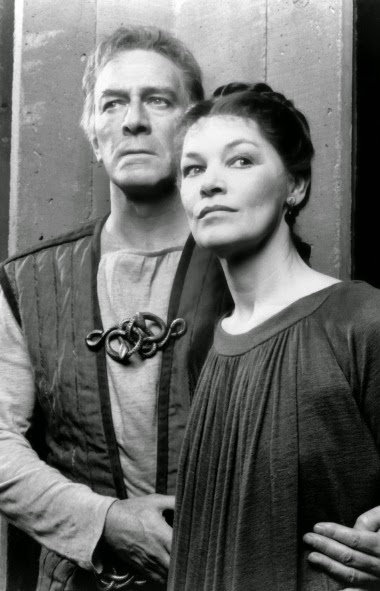
Okay, that is why I said it, and it's probably not true.  But oddly,  for a play that is produced so often, I have seen Macbeth mostly on film. I've only encountered one stage production other than the one I was in (it starred Christopher Plummer and Glenda Jackson, and it wasn't very good).  Of course, you can learn a lot about a play that way.

Macbeth is scheduled to be produced at NCRT in early 2015, and so it will be the first North Coast Shakespeare production in nine years I won't have the opportunity to review. The participants may not be lamenting this.  My point of view on producing Shakespeare is that with great plays comes great responsibility.  I've been harder on Shakespeare productions than the rest, although (like Shakespeare himself perhaps) I became more generous towards the end.

My first real pan came fairly early, of the first Shakespeare I reviewed.  Because it was my favorite of the comedies, and because I had seen a stage production and a few on film that were wonderful in part, and I knew the play so well, I was looking forward to this show.  Perhaps too much.

 Anyway that review caused a mild kerfuffle, which both scared and delighted my editors.  It was then that somebody told me that previous reviewers in town had been unceremoniously sacked if a theatre (I think the expression was "community theatre") complained about a review.  (I was later assured privately that  the community theatre in which this production appeared had no problem with my review.)

So at the risk of opening old wounds, I am reproducing that review here.  Consider it in the abstract (made easier by the fact that even at the time I didn't name any names), as a point of view on the perils and opportunities of producing Shakespeare, or of going to see a Shakespeare play.

Next time--and for this retrospective, it will be the last time--I will include the Stage Matters column I wrote after this one, responding to the response.

As I Didn't Like It    2006

In Truth and the Comedic Art, Michael Gelven calls As You Like It “one of the rarest few of the greatest comedies ever written.” A Midsummer Night’s Dream is funnier, he believes, and Much Ado About Nothing is wittier. But As You Like It “seems to fuse love with comedy almost to perfection.”

That’s how I feel about it. It’s my favorite of the comedies.

 Shakespeare wrote for a particular group of actors and the audience of the time. Romances were in style and the cross-town rivals of Shakespeare’s company had a recent success with a Robin Hood play. So he adapted a popular romance, and created a band of exiles in the Forest of Arden, infusing the conventional story with a wide and wonderful humanity.

 This is one of Shakespeare’s most performed plays. Rosalind, the woman who pretends to be a man, who then pretends to be a woman so that Orlando (the man she loves) can practice wooing the woman she actually is by pretending he is she, is perhaps the greatest woman’s part in the comedies. Famous actors have therefore pined to play her, from Dame Edith Evans to Katharine Hepburn, Maggie Smith and Gwyneth Paltrow, with Vanessa Redgrave’s 1961 Royal Shakespeare Company performance among the most lauded.

 It’s been done for television several times, with the 1978 BBC version of the full play (starring Helen Mirren) available on DVD. A 1936 movie abridgement can be found on video, notable for a young and dazzling Lawrence Olivier as Orlando, and some creative film editing by the young David Lean. Elizabeth Bergner, an accomplished Central European actress, plays a spirited Rosalind, though her accent sounds disconcertingly like Bela Lugosi.

 Later this year, As You Like It will get the Kenneth Branagh film treatment, starring two young actors with strong theatre credentials who are becoming movie stars: Bryce Dallas Howard as Rosalind, and Adrian Lester as Orlando.

 This is a rich and accessible history, for those who make and those who go to new productions. Every local company that does a well-known play has to compete to some degree with the best stage productions as well as existing films and videos. It’s unfair, but a reality, as is the justice of being judged.  Even when the players aren’t paid, they are often asking audiences to spend their money as well as several hours of their lives.

 Sometimes, as in the case of North Coast Rep’s last production, Once Upon A Mattress, they create something that’s better than the pros. Mostly they offer other virtues, the most basic of which is the privilege of seeing a good or a great play up close, when it’s done competently, with at least a few intriguing or pleasingly surprising elements.

 This in my view is unfortunately not the case with NCRT’s current production of As You Like It. Some directors have played it strictly for laughs, even as farce, which seems to be the intended direction of this attempt. Even when done reasonably well, this approach tramples on the play’s greatest virtues. As Michael Gelven observes (and I heartily agree), the central characteristic of this play and its characters is grace.

 But even on its own terms, I didn’t find this production anywhere near a minimal standard of watchability. On a nearly bare stage, it is set in a confused and unappealing version of the 1960s, with Beatles songs replacing those in the text, inflicting only slightly less damage on the Beatles than on Shakespeare.

 The acting style is apparently meant to be broadly funny, somewhere between sitcom and camp. It doesn’t work, as the lack of laughter from Friday’s audience made terribly clear. The only Shakespearian element of the acting is from Hamlet’s advice to the players on what not to do: mug the words and saw the air too much with the hands. Those who didn’t mumble went to elaborate lengths to act out their lines with stock gestures and motiveless moves that were likely antique in Shakespeare’s day.

 At times it all came across as laboriously condescending, both to the play and to the audience. The blocking was awkward, the costumes seemed deliberately ugly (likely somebody’s idea of a hoot), and the almost non-existent set was perfunctory at best.

 I wish there was an element of the production I could single out for praise, apart from the assumed sincere effort. I hold out for you the possibility that everything changed for the better in the second half, for I was long gone by then.

 It’s especially unfortunate, if my view has merit, because this comedy should have special appeal to Humboldt, particularly in the multiple contrasts of country and city. Think of it set in the Forest of Arcata. And be grateful that your happy memories (if such they be) of “The Long and Winding Road” remain intact.

Tuesday, November 4, 2014

Chekhov on Ross Street

"Modern playwrights begin their plays with angels, scoundrels, and clowns exclusively.  Well, go seek these elements in all Russia!  Yes, you may find them, but not in such extreme types as the playwrights need.  Unwillingly, you begin forging them out of the mind and the imagination, you perspire, and give the matter up.  I wanted to be original: I did not portray a single villain, not a single angel (though I could not refrain when it came to the clown), did not accuse anyone, or exculpate.  Whether all this is well done, I do not know."

Anton Chekhov 
commenting on his early play Ivanov

In 2012 I wrote about watching Chekhov plays on DVD and video, lamenting that North Coast theatres hadn't done a Chekhov in decades.  This year we came closer with Christopher Durang's delightful comedy Vanya and Sonia and Masha and Spike, done so well at Redwood Curtain.

Recently I've gone back to the DVD collection of Chekhov plays I mentioned.  I watched the 1981 National Theatre version of The Cherry Orchard, the Chekhov play most often produced these days, directed by Richard Eyre, with Judi Dench.  I watched the 1970 BBC production of The Three Sisters. And though I didn't look at The Seagull again, another viewing of the 1991 BBC version of Uncle Vanya confirmed my feeling that this is my favorite Chekhov play.  (I also took the very rare opportunity to see The Wood Demon, Chekhov's earlier play which contains much of Uncle Vanya verbatim, although there are significant differences between the plays.  The 1974 BBC production preserved in this collection is probably one of the few ever attempted.)

The character of the doctor (Astrov in Uncle Vanya) is present in both plays, and in both of these productions, seven years apart, he is played by Ian Holm.  My impression of Ian Holm was formed from the supporting roles he played in various Hollywood films--everything from Greystone: The Legend of Tarzan to Time Bandits to The Day After Tomorrow.  Many know him as Bilbo Baggins in various Tokien films, including the most recent Hobbit movies.  He is competent and sometimes memorable in the movies, producing a sense of confidence and ease when he appears.

 But his ease is deceptive--there are depths to his wonderful tour de force as Astrov. David Warner is an excellent and very relatable Vanya, and Mary Elizabeth Mastrantonio is fascinating in the very tricky role of the professor's young wife who everybody else is in love with.  But Ian Holm is a revelation, and it makes me want to find his King Lear.

Seeing this production again led to two firm conclusions: First, this 1991 version of Uncle Vanya is the best I've seen, and the best I ever hope to see.  The 1994 American version captured in Louis Malle's last film, Vanya on Forty-Second Street, is almost as good, but it is almost too contemporary and American.

Uncle Vanya is the only major Chekhov play I have never seen on the stage.  My second conclusion is that, with this version on DVD, I don't need to see it on stage.  A corollary of that conclusion is that no North Coast theatre appears capable of doing it well enough.  I suspect not many theatres are.  So I take back my lament that North Coast theatres don't do Chekhov.

Elsewhere:

Suzan-Lori Parks has an ambitious new play opening at New York's Public Theatre to high praise by the New York Times.  Her play Venus was produced at HSU in 2012.

Dan Kois at Slate on the pleasure of reading plays, specifically Annie Baker's The Flick.

Stephen Booth is a Shakespeare scholar I didn't know about until this article.  He's written specifically on Macbeth, the next Shakespeare on North Coast Rep's schedule for January.

Thursday, September 25, 2014

TV or Not TV? I Hate Hamlet at NCRT

Another version of this review has appeared in the North Coast Journal.  There are additional notes below.

Several blocks from where a royal henchman cleverly castigates Shakespeare to his face in Redwood Curtain’s Equivocation, some contemporary Americans (and a distinguished ghost) are very conflicted about the Bard in the 1991 comedy I Hate Hamlet, now onstage at the North Coast Repertory Theatre in Eureka.

 After the TV series that made him famous was cancelled, Andrew Rally (played by Evan Needham) has been rediscovering himself as an actor in New York. His agent (Gloria Montgomery) encouraged him to audition for the title role in a Shakespeare in Central Park production of Hamlet, and he is cast.

 His romantic and virginal new girlfriend (Jennifer Trustem) swoons for the Shakespearian hero she wants him to be. But he immediately has second thoughts, especially after his Hollywood director (Anders Carlson) brings him a deal for a network series about a crusading young teacher in an inner city school who also has superpowers (he can fly, “but only about ten feet up. See, we’re keeping it real.”)

 All the action transpires in a vintage Manhattan apartment that Rally’s real estate agent (Kristen Collins) has found for him. It just happens to be the former abode of actor John Barrymore, whose 1920s Hamlet became legendary. A seance summons Barrymore from the beyond to advise Rally on his own portrayal of the conflicted Melancholy Dane.

 Should he or shouldn’t he? To be or not to be? TV or not TV? Does he hate Hamlet, or himself?

 I Hate Hamlet is a comedy by Paul Rudnick, rich in jokes but with a bit more substance than it pretends to have. It is also awkwardly constructed, especially at the start. With all the set-up, exposition and unfamiliar New York and German accents, the first act at NCRT wobbled gamely forward until Anders Carlson as the irrepressible Hollywood director infused the stage with comic energy. The character certainly provides it, with lines like: “Am I like the most self-obsessed person you’ve ever met? My answer? Yes.”

Carlson's character is also very funny on the supposed obsolescence of the stage.  After theatre and movies came television, he says.  "That's like, art perfected...I mean, when I go to the theatre I sit there and most of the time I'm thinking, which one is my armrest?"

The first act climaxes with a sword fight between the reluctant Rally and the buoyant Barrymore (choreographed by Jasper Anderton) that sparkles like the champagne Barrymore is simultaneously imbibing. Christian Litten is a lithe and athletic Barrymore, and even looks like the actor, especially in Laura Rhinehart’s costume that reproduces Barrymore’s Hamlet togs as seen in old photos.

 Most of what the play says about Barrymore is historically accurate and relevant to Rally’s dilemma. Barrymore was the theatrical equivalent of a sitcom actor until he triumphed as Hamlet on Broadway and perhaps more impressively, in London. Then he left for Hollywood.

 Director David Moore and cast seem to have elected to do a fairly subdued version of this sometimes raucously produced play. That choice perhaps allows for more human feeling in the Barrymore-Rally scenes in the second act—in any case, this is where Needham and Litten especially excel. Gloria Montgomery also delivers a moving set piece in Act II.

 On opening night some comic timing and delivery wasn’t yet sharp, a not uncommon occurrence. There seems to be more potential in the script for vocalizing (and projecting) some lusciously comic lines. Fortunately there are three more weekends in the run to discover such opportunities and possibly make a funny show funnier.

 Calder Johnson is scenic designer, Telfer Reynolds designed lighting, Michael Thomas the sound, Laura Rhinehart properties as well as costumes. I Hate Hamlet is performed weekends at NCRT through October 11. 442-6278, www.ncrt.net. 

[Aside]: In portraying a stage legend, I Hate Hamlet's 1991 Broadway production itself became legendary. The brilliant English actor (and former Hamlet) Nichol Williamson was increasingly erratic in his performance as Barrymore. In the sword fight one evening, he swatted costar Evan Handler in the back. Handler immediately exited the stage and kept on going, out of the theatre and out of the play forever.

I Hate Hamlet: Additional Notes

Why John Barrymore?  Why is he the Hamlet actor that returns from the beyond to counsel our TV-star protagonist in I Hate Hamlet?  After all, there have been more recent and therefore more familiar Hamlets: Laurence Olivier certainly was identified with the role, while Richard Burton and Peter O'Toole famously played it.

A short answer is that it was John Barrymore's former Manhattan apartment that playwright Paul Rudnick was shown (some online articles say that Rudnick lived there, but he doesn't make that assertion in his script notes.)  This coincidence sparked the writing of the play.

But there are meaningful parallels between Barrymore and our protagonist as well.  First, however, who was John Barrymore?

Perhaps even in 1991 it was too early to mention that John Barrymore is Drew Barrymore's grandfather.  The first generation of Barrymore actors were Georgiana and Maurice Barrymore (Drew's great grandparents.)  The next and most legendary generation was composed of the siblings Lionel, Ethel and John.  They all are best known now for their movie performances, but they began on the stage.

  Ethel was the first to become a star in 1901, in the unlikely Broadway show Captain Jinks of the Horse Marines by an early Broadway playwright I've been reading a lot about lately, Clyde Fitch (His play Her Own Way was the first ever done by Humboldt State, and is being restaged as a radio-style drama by HSU Theatre, Film & Dance on October 3 and 4.)

Captain Jinks was also John Barrymore's first Broadway appearance. As I Hate Hamlet says, he started with mostly light comedy, but he did try more serious drama before Hamlet, including a role in Ibsen's A Doll's House (again with sister Ethel) and more individually in an adaptation of a Tolstoy play,confusingly retitled Redemption (since that was the title of a different Tolstoy novel.)  He also did an historical drama called The Jest with his brother Lionel--and this made Lionel a star.

John Barrymore warmed up his Shakespeare with voice lessons and a reputedly very uneven Richard III.  But then in 1922 came his triumphant Hamlet.  His erratic behavior and lack of concentration and consistency were on hold for awhile.  He prepared for Hamlet "meticulously," writes famed critic and theatre historian Brooks Atkinson.  The result: "John Barrymore played a Hamlet that most people ranked with Edwin Booth's, by tradition considered the greatest."

Another critic wrote that Barrymore had revolutionized Shakespearian acting by ending the "school of recitation."  Barrymore's performance was "alive with vitality and genius--a great, beautiful, rare Hamlet--understandable and coherent."

John Gielgud, whose own Hamlet would eventually break Barrymore's Broadway record for performances, saw the Barrymore performance and "admired it very much," noting that he had "a wonderful edge and a demonic sense of humour...Of all the actors in my time I felt he must be the nearest to Irving, with the same kind of extravagance and flowery, sinister power."

Barrymore's Hamlet is also notable for his interpretation of Hamlet's relationship with his mother as Oedipal.  This Freudian approach was adopted wholesale by Olivier, especially in his movie version of Hamlet, which he directed. (Gielgud also mentions that Barrymore "cut the play outrageously" so he could extend the scene between Hamlet and his mother that exemplified this approach.)

A few years later Barrymore took his Hamlet to London, and triumphed again.  He then gave up the Broadway stage, moved to Hollywood and made movies, where  he fully earned his reputation for womanizing and especially for drinking (apparently emphasized more in the original I Hate Hamlet Broadway production than at NCRT.)

But it is not true, as stated in I Hate Hamlet, that he never returned to the stage.  He made one last Broadway starring appearance.  In a reputedly mediocre play (My Dear Children) he gave "a first-rate performance," Atkinson writes.  "There was a kind of admirable, if perverse gallantry about this final fling at the stage..." (Atkinson saw this play himself, and may have seen Barrymore's Hamlet.)  This play ran for four months in 1940.  John Barrymore died in 1942.

So the parallels between Barrymore and Andrew Rally, both obvious and subtle, underlie this "boulevard comedy" as Rudnick describes it.  Rally comes from commercial TV but at least part of him longs for artistic challenge and expression (so he auditioned five times for this Hamlet.)  Barrymore came from commercial theatre and was uneducated and untrained for classical roles, yet he pursued such roles and worked hard to excel in them.  Barrymore also knew the temptations of Hollywood--in his case, the movies.

They are both conflicted.  And of course they are talking about the most famously conflicted character in classical drama: Hamlet.

The contrasts between Rally and Barrymore--notably involving women and drink--also figure in the comedy, but the relationship they build in the second act is based on these common threads, as well as one more: the brotherhood of Hamlets.

Playing Hamlet is a kind of rite of passage for actors (which is partly why there is a new Hamlet somewhere in England almost continuously.)  Especially for a young actor it is the most complex role, offering the most challenge and the most breadth of opportunity for interpretation.  (Lear is the equivalent for older actors.)
David Warner Hamlet 1965

There is a kind of brotherhood established by the actors (a few of them women) who have played Hamlet, and a feeling established in theatre lore that after playing Hamlet an actor is never the same.  You get some sense of this in the conversation that David Tennant has with other Hamlets like Jude Law and David Warner  in the BBC's "Shakespeare Uncovered" series, which is viewable on YouTube.  I remember Tennant talking about this brotherhood of Hamlets and the mystique of the role in an interview, which I can no longer find.

A personal note: I don't recall actually meeting Paul Rudnick when we were both writing for Esquire, but I heard about him from mutual friends and editors.  The word was that he was very funny, and very New York.

Wednesday, September 10, 2014

An Unequivocal Success at Redwood Curtain

David Hamilton and Ambar Cuevas at Redwood Curtain
It is 1606 and the chief minister to the new English King (James I) commissions the most popular playwright of the day to write a play about the notorious Gunpowder Plot that sought to blow up the Parliament building while the king and his family were there. That playwright is William “Shagspeare”--one of several ways Shakespeare’s name was spelled by his contemporaries. The English weren’t big on consistent spelling at the time.

 So begins Equivocation, now on stage at Redwood Curtain in Eureka. It is a comedy and a political whodunit, told in contemporary language by a playwright who also wrote an episode of TV’s political potboiler “House of Cards,” but it's set in the early 17th century: Shakespeare In Love meets All the President’s Men.

Shakespeare’s sleuthing begins with a motive unknown to Woodward and Bernstein, or even Sherlock Holmes. He’s worried that the official version of events just won’t make a good play. For instance, the gentlemen conspirators were supposed to have dug a tunnel. How could they? It needed supports, and pumps to keep the river out. And what did they do with the dirt? “There will be 700 penny-a-place standees at every performance, all of whom make their living with their hands,” Shakespeare says. “And if there’s anything these groundlings will want to know about, it’s the dirt.”

 But the bigger dramatic problem is that the plot was foiled, so the explosion didn’t happen. What was good for the King is bad for Shakespeare, because the play has no ending.

 The actors of the company are very funny as they grapple with these problems (as well as Shakespeare’s latest confusing play about a crazy King Lear. “If we could get through his comedies-don’t-have-to-be-funny period,” lead actor Richard Burbage reassures the company, “we can get through whatever this is.”)

 In search of theatrical reality Shakespeare speaks with two of the alleged conspirators, and the play moves into the darkness of the time: political intrigue involving religion and the state, with the King’s chief minister and spymaster, Robert Cecil at its center. Shakespeare begins to wonder who profits from the Gunpowder Plot, and why.

 Equivocation is by Bill Cain, a Jesuit priest and writer who started a Shakespeare company in Boston. Another Jesuit (Henry Garnet) features prominently in the story, especially in regard to the concept of “equivocation” he championed: telling the truth, but indirectly. The moral questions raised by equivocation turn out to have significance as well for Shakespeare (who wants to "tell the truth but not get caught at it")  and his plays.

 Eventually Shakespeare completes a play, though not exactly the one commissioned, and it is the occasion for more mesmerizing action, including as a sword fight. Prior knowledge of Shakespeare and these times aren’t required, but they’ll add to the appreciation.

 Even more than usual for Redwood Curtain, the acting is excellent. This time the clarity and conviction of the acting are elevated as the actors meet the challenges of a witty, theatrical and multi-layered script. They respond with performances that rank among their best, at least in my experience.

 David Hamilton plays Shakespeare through the moods of his journey, revealing his humanity. Gary Sommers as Burbage and others, especially the Jesuit Garnet, is precise and evocative. James Hitchcock navigates both the wily Robert Cecil and Nate, the most grounded of the players, with economy and force.  Dimitry Tokarsky likewise inhabits his roles with an assurance we share. As both Richard Sharpe (the youngest player) and King James, Cody Miranda has a startling moment playing a scene between the two. With his posture and his eyes, he conveys the cruelty hidden in the cocksure King.

 The play also involves the central role of family, especially the relationship of Shakespeare and his daughter, Judith, whose cynical skepticism is eventually transformed. Ambar Cuevas plays all those colors well, but her performance in the closing scene is exceptionally moving.

 The other elements of this production are equally admirable: the elegant and spacious set by Ray Gutierrez, dramatic lighting by Michael Burkhart, pleasing costumes by Jenneveve Hood, among important others. Director Catherine L. Brown knits all these elements together into a convincing and entertaining world. Though not perfect in preview, this show is an unequivocal success.

This is an unusually rich and thematically ambitious play, and one that takes chances.  After all, it is a play about a play that doesn't get written about an event that doesn't take place. It even violates Shakespeare's rules (histories end in battle, comedies in marriage, tragedies in death): it is a history and a comedy that ends in death.

 To mention more about it would involve too much space and too many spoilers for an opening review, so I’ll suggest some of its textures in the notes below, especially for those who see it. But playgoers should be prepared for some enacted and mostly suggested violence, including torture. (It’s no coincidence that this play was written during the Bush administration.)

 Craig Benson is the fight choreographer, Brandi Lacy the dialect coach, and various effects are engineered by Jared Sorenson, Jillian Park and Hanah Toyoda. Christopher Joe is sound designer, Shea King assistant director and dramaturg. Equivocation is on stage at Redwood Curtain weekends through September 27. 443-7688, www.redwoodcurtain.com.

Equivocation: Notes and Spoilers

yesterday and today: The Globe
These notes contain spoilers, but mostly they address questions that might be raised by seeing the play.

 Equivocation is so rich in characters, themes and resonance (too rich for some tastes) that to do much more than introduce the basic action, as I did in my review, would just be confusing.

The play is set in 1606, yet in style it's contemporary.  Previous productions in fact have been done in modern dress, as the playwright suggests.  Redwood Curtain chooses a modified period style.

"The Shakespeare Code"
Since at least Tom Stoppard's Rosencrantz and Gildenstern Are Dead, there have been a number of plays that use Shakespeare's stories with a twist, or in which Shakespeare himself appears, usually as a more or less contemporary person in historical circumstances--from Shakespeare in Love (Stoppard again) to a classic episode of David Tennant's Doctor Who ("The Shakespeare Code.")  Equivocation follows in this "tradition", and depends on what are now the conventions of it.  Especially that we aren't thrown off by people in 1606 talking a lot like 2006, minus contemporary references.

Yet the play purports to show the interplay of  English politics and William Shakespeare's theatre company in the early 17th century, and involves a famous historical event--the Gunpowder Plot, which is still the focus of holiday celebrations in the UK. (We mostly know it as Guy Fawkes Day, celebrating both the anarchic spirit and the survival of the British government, with bonfires and fireworks.)

 So the first question that might arise after seeing the play could be: how much of the history is made up?

Robert Cecil
Most if not all of the characters named are authentic historical figures.  The play begins with Robert Cecil commissioning Shakespeare to write a play about the Gunpowder Plot, based on a history written by King James himself.  Robert Cecil was indeed Secretary of State to both Queen Elizabeth and then James, and was widely regarded as James' spymaster.  James did write essays etc., though perhaps not this particular history.

Elizabeth's long reign had ended in 1603.  She died without children and without naming an heir.  Cecil was (as noted in this play) instrumental in having James installed as King.  James was the son of Mary Queen of Scots, and was ruling Scotland at the time.  By becoming King, he became head of the Church of England.

Since Henry VIII, the official religion in England was the Church of England, with the King as its head.  Previously England had been Roman Catholic (with the Pope as its head), and ever since Henry there had been religious and political conflict between outlawed adherents of "the old religion" and the official Protestant religion.

The Gunpowder Plot was ostensibly a conspiracy of various English gentlemen and perhaps clergy to overthrow the government and establish a new monarch (Mary's young daughter Elizabeth, with a Catholic regent acting on her behalf.)  The idea was to plant a large quantity of gunpowder beneath the room where Parliament had its opening ceremonies, with the King, his family and ministers attending.  (Wikipedia has an extensive entry on the topic.)
King James

The official version of these events--the letter that eventually alerted Robert Cecil to the plot, the arrests that foiled the plot--are as described in this play.  The conspirators were said to have dug a tunnel to a room under Parliament--Shakespeare has problems believing this in the play, and subsequent historians have found no evidence for a tunnel.  Such a room existed (and still does.) Oddly it was in private hands at the time and no such extreme measures as a tunnel were needed to store gunpowder in it.  If the gunpowder said to have been found in this room really was there, it was more than enough to demolish Parliament and kill everyone in the room (according to a British TV experiment.)

Equivocation

Garnet
Two other historical figures and characters in the play are Thomas Wintour and the Jesuit priest Henry Garnet.  They were among those imprisoned, tortured and executed in the manner described in the play.  The play faithfully follows the version of his involvement that Garnet asserted--he knew only what had been said to another priest in confession.  He did in fact write a treatise on "equivocation," although he was not the only one or even the first to relate it to "mental reservation", a concept within Catholic and specifically Jesuit ethics, though it has earlier origins.

"Equivocation," as Garnet defines it in the play: "Don't answer the question they're asking. If a dishonest man has formed the question, there will be no honest answer. Answer the question beneath the question. The equivalent question. Answer the question really asked. And answer it with your life."

This play suggests that Robert Cecil himself was behind the gunpowder plot, or at least the story of it that he wanted told.  This was a suspicion of the time, and was developed as a theory by Father John Gerard in 1897.  Others refute these claims.  That Cecil learned of the plot and let it develop for awhile before exposing it is more credible, and more credible still is that he used it for his own political ends.

Cecil, by the way, was a hunchback as suggested in the play, and both his family's prior history he refers to, and its subsequent important history in British government he foresees into the 21st century (including a Nobel Peace Prize), are broadly accurate.

Besides Cecil and other figures involved in the gunpowder plot and its aftermath, Equivocation makes William Shakespeare a character, as well as depicting members of his theatrical troupe.

Shakespeare and all the King's Men

from Shakespeare in Love
 I could verify all the players in Shakespeare's troupe--the King's Men-- that this play names, except "Nate," but in an interview, Equivocation's playwright Bill Cain claimed that an actor by that name was in fact among them.  Richard Burbage was Shakespeare's lead actor.  Robert Armin played the clown roles and had an excellent singing voice.  He was a more verbal comic than Will Kempe, who he replaced.  Richard Sharpe was indeed a young member, who before he joined the company started out very young playing women's parts.

Shakespeare in fact did have a daughter named Judith, and she was the twin sister of his son Hamnet, who died at age 11.  But it does seem she was back with her sister in Stratford and not living with her father in London, as in this play.  The play also shows her reading and even editing Shakespeare's texts, but (according to Shakespeare biographer Peter Ackroyd) in fact she was probably illiterate.

There are many witty lines about Shakespeare and his present day status made by Cecil and others.  He's all things to all men, Cecil says, and adds later, "People will go to your plays as they used to go to church. Reverently. And they will leave exactly as they went in, unchanged but feeling somehow improved."

  It's also suggested that Shakespeare was a long-retired actor in his troupe, and not a very good one.  However it's probable that he stopped acting just a few years before, in 1603 or 04.  And there are those (including Orson Welles and Peter O'Toole) who looked at the parts he played and concluded he must have been one of the troupe's better actors.

This play shows the company rehearsing King Lear, and then performing Macbeth.  In fact Macbeth was performed for King James probably in the spring of 1606. King Lear was probably performed that December, so the earlier rehearsals aren't outlandish.

Equivocation begins with Shakespeare being given a commission to write a play based on the official version of the Gunpowder Plot, as written by King James.   Being named the King's Men was an honor but it also meant that the company performed many plays a year before the king and the court.  Still, there's no record of such a commission.

But the idea might have been inspired by a slightly earlier event, in which Shakespeare and his company may have been deliberately used as an adjunct to violent political plot, with potentially disastrous results.  In 1601, supporters of the Earl of Essex paid for a performance by Shakespeare's company of his play Richard II, which involves the deposing of the king.  Some of these were also conspiring with Essex to start a rebellion against the government.  It was alleged later that they were using the performance both as a cover for their activities that day, and as inspiration and justification for overthrowing the monarch.  But the revolt failed, and after some uncertainty, Shakespeare and players escaped punishment.
Orson Welles as Macbeth

Shakespeare, in this play and in reality, never wrote a play about the gunpowder plot, but as in this play, the next play he wrote and produced was Macbeth.  Scenes from it, with some theatrical additions, are the climax of Equivocation.

The relationships of Macbeth to James I, the gunpowder plot and the concept of equivocation drawn in this play are drawn elsewhere in the critical literature. From one point of view, Macbeth is about the consequences of killing a king.  It's the Scottish play, James was a Scot, and (according to Ackroyd) "King James had been greeted by three sibyls at the gates of an Oxford college and hailed as the true descendant of Banquo."  In Shakespeare's play, Banquo is declared the father of kings by three witches, and Macbeth murders him.  Shakespeare differs here from previous stories about Macbeth, in which Banquo is among the conspirators against the rightful king Duncan (who Macbeth also murders.)  This can be seen as illustrating of the charge Cecil makes in Equivocation, that Shakespeare, a master of equivocation, made sure to stay on the right side of the powerful.

In Equivocation, much is made of King James wish that there be witches in Shakespeare's play.  James was known for his interest in occult or malign spirits, and had written on the subject.

Judith Shakespeare
At the end of  Equivocation, Judith makes a powerful point about Shakespeare's last plays, and the father-daughter relationships within his general theme of family.  Peter Ackroyd makes much the same point in his biography of Shakespeare--in fact, since this book was published in 2005, it may have suggested this observation to playwright Cain.  "The essential bond is father and daughter. It may not be the pattern of his life," Ackroyd wrote, "but it clearly is the pattern of his imagination."


Contemporary Flavors

Equivocation was first produced up in Ashland at the Oregon Shakespeare Festival in 2009, so it's reasonable to assume Cain wrote it during the G.W. Bush administration.  There certainly are echoes of the Bush administration's use and justification of torture.  There's suggestion of the political exploitation of the plot that succeeded (9/11) as well as the plot that failed (the gunpowder plot.)


There's also some echo of today's polarized politics. In the play Robert Cecil admits that his political purpose is to keep the country sharply divided. "When a country is evenly divided - and plots can be so helpful for that - the slightest touch of a royal finger on the scale changes the balance."

But contemporary as well as historical relevance go beyond these specifics, at least in Cain's stated intent.  He'd visited the Tower of London, seen where prisoners had been tortured, and noticed that the Globe theatre was close by.  He said that this play is about "the relationship of the Tower and the theatre," and that Shakespeare's troupe "was the only functioning democracy anywhere in the world in 1605."

Symmetries

There are several witty comments on Shakespeare's dramaturgy, and the nature of plays in general that this play turns into elegant symmetries.

In Equivocation Shakespeare complains that the gunpowder plot can be made into a dramatic play because the explosion never happened--it's a story without an ending.  He tries various ways to write this play, but does not succeed.  Yet what is Equivocation itself about? A play that never gets written about an event that never takes place.

But this Shakespeare also wants to revolt against the strictures of what must be in a play. He tells Judith he yearns to write "A new kind of play. Not the clash of opposites, but their union. Not tearing; joining. Forgiveness, not blame." "A play that's not about revenge?" Judith retorts. "It can't be done."  But he does it in his later plays.

Several times Shakespeare also bemoans other conventions of the stage--histories end in battle, comedies in marriage and tragedies in death--and longs to write a play that defies these.  Arguably Shakespeare also did this in his later plays, but so does Bill Cain: Equivocation is a history and a comedy that ends in death (Shakespeare's.)