Tuesday, November 22, 2011

The Illustrated Mousetrap

Anders Carlson and Shannan Dailey in The Mousetrap at NCRT


Joan Hickson 
Though Agatha Christie is the best-selling novelist of all time, I suspect most of us now know her stories principally from the many television and movie versions. Christie herself adapted a dozen or so of her stories for the stage, sometimes ruthlessly. She staged three stories starring her famous detective, Hercule Poirot, but eliminated Poirot. In Appointment with Death she outfoxed her readers by reproducing the novel’s plot and characters but she chose a different murderer. This play premiered in 1945 with a young Joan Hickson in the cast. Christie wrote to her, hoping she would one day play her other famous detective, Miss Marple. Hickson did—in the 1970s BBC series that’s arguably the best of the available DVD sets.


Agatha Christie

Marlene D. in 1957 Witness movie
 Aficionados rank three of her plays among the best of the genre: Witness for the Prosecution (which was successfully filmed at least twice), Ten Little Indians, and by far her most celebrated play, The Mousetrap, now on stage at North Coast Repertory Theatre in Eureka. The Mousetrap premiered in London in November 1952, where its record as the longest running play in history is unlikely to be broken, especially since to this day it is still running at the St. Martin’s Theatre.

Albert Finney as Poirot


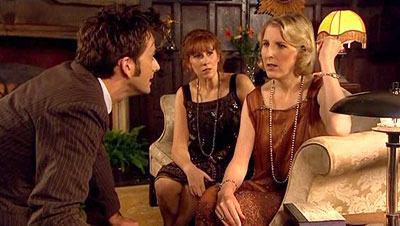
"The Unicorn and the Wasp" on Doctor Who: David
Tennant, Catherine Tate and Fenella Woolgar
as Agatha Christie
With their relatively slow pace and reliance on plot mechanics, stage mysteries aren’t done much anymore. Christie’s plots in particular inspired parody, from the self-consciousness of the all-star movies in the 1970s based on Christie novels (with Albert Finney and Peter Ustinov each portraying Poirot) to the hilarious burlesque of Tom Stoppard’s play, The Real Inspector Hound, and an affectionately funny episode of Doctor Who a few years ago.

The Mousetrap is handsomely mounted at NCRT, as directed by Tom Phillips, with set by Calder Johnson, costumes by Shelley Stewart and lighting by David Tyndall. The cast capably provides the required shades of sympathy and suspicion for each character. Shannan Dailey and Anders Carlson are Mollie and Giles Ralston, welcoming a group of strangers into their old Guest House in suburban London during a snowstorm. The guests are Mrs. Boyle, a demanding older woman (played by Toodie SueAnn Boll); Major Metcalf, a retired soldier (Scott Malcolm); Christopher Wren, a fey young man (Selavy Skaggs); Miss Casewell, a mannish woman (Gloria Montgomery, with the best British accent.) David R. Simms plays Mr. Paravicini, a mysterious foreigner who arrives unexpectedly. (Christie hoped audiences would think he might be Poirot.) Jasper Anderton plays Detective Sergeant Trotter, who shows up to investigate a murder.

The characters are recognizable types, and while some of the portrayals might seem over the top, the main task of keeping the mystery alive is accomplished. The first act ends with another murder. By the end, the murderer among them is revealed, but there are enough clues (and enough loose ends left dangling) to lead plausibly to several other suspects.

The Mousetrap includes the sly social commentary that enlivens some of Christie’s stories, and it preserves a sense of the dislocations in British society being felt in the years immediately following World War II. Absent the expectation that it will rival the televised stories, it may provide fun for an entertaining night out.

Thursday, November 17, 2011

This North Coast Weekend

Opening Thursday at North Coast Repertory in Eureka is The Mousetrap, a stage mystery by Agatha Christie.  The longest running play by the best-selling author in history, it's a whodunit without Poirot or Miss Marple.  Actors Benefit and champagne reception Thursday, continuing Fridays and Saturdays at 8 p.m. through December 10.For reservations, group rates, or more information, please all 442-NCRT (6278). http://www.ncrt.net/.

 For one weekend only at the Arcata Playhouse, the award-winning Human Nature troupe from Petrolia presents its latest climate crisis comedy, Two Old Birds or Tripping on the Tipping Point.  It runs Thursday through Saturday (Nov. 17-19) at 8 p.m. For reservations: the Playhouse at 822-1575.

Tuesday, November 15, 2011

North Coast Auditions

Auditions for Redwood Curtain's 2012 acting company will be held Saturday November 19.  Details: www.redwoodcurtain.com/auditions.

College of the Redwoods will be holding auditions for their tenth annual spring comedy, The Miser by Moliere on Dec. 1 and 2. Auditions will take place at the CR Forum, room FM103, from 7 to 10 p.m. both nights. No preparation will be required.

HSU Theatre, Film & Dance will audition for its Feb.29-March 4 production of Noel Coward's Blithe Spirit on Sunday December 4 (4pm-6:30) and Monday December 5 (8-10pm) in Gist Hall 2.  Cast is 5 women and two men.  Script available at TFD office.  Contact: Jyl@reninet.com.

Looks like I missed posting auditions for Ferndale Rep's upcoming musicals and NCRT's Shakespeare production, Much Ado About Nothing earlier this month.  Apologies.

Monday, November 14, 2011

Couldn't Resist

A second comment has appeared at the NC Journal site to my review of The Last Five Years at Redwood Curtain by someone who signs himself as Jonathan.  He refers to the program note cited by the previous commenter, "Dianne" (presumably the show's director):

“the action moves simultaneously between the present and the past” is definitely a confusing way of describing what’s going on.

i think what the show needs is a preamble describing exactly how Cathy became stuck in the temporal paradox in the first place. was it a highly localized wormhole creating a parallel universe? a massive breech in the anti-matter containment system that fractured the time-space continuum? the audience is left in the dark."

Photo: The Enterprise-D enters a temporal rift in the classic episode, "Yesterday's Enterprise."

Thursday, November 3, 2011

This North Coast Weekend

At the Arcata Playhouse, Bay Area actor and Celtic harpist Patrick Ball performs his musical tribute to Irish legend Turlough O’Carolan in O’Carolan’s Farewell to Music for one night only on Friday November 4 at 7 p.m.

Opening on Friday (November 4) at the College of the Redwoods Forum Theater is the Humboldt Light Opera Company KidCo production of Alice in Wonderland, Jr. Directed by Cindy Cress, with musical direction by Amy Chalfant, this family musical with familiar characters and scenes from the Lewis Carroll Alice books features children from ages 5 to 17, including Ciara Cheli-Colando, Camille Asbill, Kyra Dart, Rachel Post, Isabella Loch, Lily Buschmann, Kayla Kossow, Gabby Fell, Leah Selcer, James Zwiker, Kalex Sweetfire-Spoon, Allie Sanchez, Estelle Fuller, Anna Vodopals, Erin Casper and Kaylie Doebel. It runs Fridays and Saturdays, Nov. 4-5 and 11-12 at 7 p.m., with a 2 p.m. matinee on November 6.

At the Redbud Theatre in Willow Creek, the comedy Academia Nuts by Gregg Kreutz is performed November 4, 5, 11 and 12 at 8 p.m. The cast includes Brian Bottemiller (who also directs,) Roland Grubb, Libby Pinto and Vicki Kurtz.

Continuing at Redwood Curtain, the musical The Last Five Years.  See post below.

The Last Five Years

The Last Five Years, now on stage at Redwood Curtain in Eureka, is the fifth musical produced on the North Coast since August, and the 11th since last September (if you count the two Mozart operas along with the three Sondheims and the two Lerner and Loewes.) It’s even the second time in that period for The Last Five Years, which Humboldt Light Opera performed (in part) in April.

 Written and composed by Jason Robert Brown, this show is almost entirely sung. There are only two characters: Jamie, a young novelist on the rise in Manhattan, and Catherine, a struggling actress. The story is about their relationship as a couple. However, they are together on stage for just one scene. The rest of the time each sings alone.

 On the level of the music and the performances, this is an enjoyable show. Ably supported by the band of Justin Ross, Amber Grimes and Pete Zuleger, the music is pop-oriented in various styles, with literate lyrics. There’s a definite imbalance: Jamie gets the big numbers and Cathy gets a lot of slow songs that are bittersweet at best. At times it’s like Billy Joel versus Alanis Morisette (two songwriters from Brown’s formative years.)

Nanette Voss-Herlihy is heroic in finding and expressing Cathy’s essence, and Kyle Ryan is confidently dazzling as Jamie, both as a singer and an actor. His every moment felt true. Out of his many recent appearances on various local stages, this is Ryan’s most complete performance.

 But regarding the story, if (like me) you haven’t seen this show before, I have some information you will probably find useful: Jamie’s story is told from the beginning to the end of the relationship, but Cathy’s story is sung from the end to the beginning. I learned this later from Wikipedia. I certainly didn’t learn it from seeing the show (or even from the enigmatic program note.)

 Starting at the end of a relationship and going back to the beginning has worked on the stage, notably in Harold Pinter’s Betrayal. Deconstructing a relationship from each person’s perspective, going in different directions in time, is a provocative postmodern idea, and it could even work if the procedure was made clear to the audience. Playing with relative time has its moments, but you shouldn’t have to be Einstein to figure out what’s going on. There is so much ambiguity in this text, helped not at all by the staging, that much of its emotion and possible meaning are lost.

 Apart from the universals of relationship, this story about the perils of success (first produced in 2002) has an almost nostalgic, 1990s Bright Lights, Big City, Masters of the Universe feel. However, the problems of two-career couples in the arts are particular and perennial.

 The Last Five Years is directed by Dianne Zuleger, with scenic and lighting design by Michael Burkhart, and costumes by Kevin Sharkey. It is on stage at Redwood Curtain Thursdays through Saturdays at 8 p.m. through Nov. 17, with a 2 p.m. matinee on Nov. 13,

 So what about this run of musicals since summer? Qualitatively, I’d suggest Mary Jane: The Musical as the most relevant, Dirty Rotten Scoundrels as the most fun, Into the Woods as the most family-friendly. Sweeney Todd was the best play and Brigadoon had the best music.

 Generally speaking, North Coast companies do musicals well, and this run kept people busy but stretched the talent base thin, not to mention the audience. It also suggests that communication among these institutions could still be a lot better.

 Coming Up: At the Arcata Playhouse, Bay Area actor and Celtic harpist Patrick Ball performs his musical tribute to Irish legend Turlough O’Carolan in O’Carolan’s Farewell to Music for one night only on Friday November 4 at 7 p.m.

 Opening on Friday (November 4) at the College of the Redwoods Forum Theater is the Humboldt Light Opera Company KidCo production of Alice in Wonderland, Jr. Directed by Cindy Cress, with musical direction by Amy Chalfant, this family musical with familiar characters and scenes from the Lewis Carroll Alice books features children from ages 5 to 17, including Ciara Cheli-Colando, Camille Asbill, Kyra Dart, Rachel Post, Isabella Loch, Lily Buschmann, Kayla Kossow, Gabby Fell, Leah Selcer, James Zwiker, Kalex Sweetfire-Spoon, Allie Sanchez, Estelle Fuller, Anna Vodopals, Erin Casper and Kaylie Doebel. It runs Fridays and Saturdays, Nov. 4-5 and 11-12 at 7 p.m., with a 2 p.m. matinee on November 6.

 At the Redbud Theatre in Willow Creek, the comedy Academia Nuts by Gregg Kreutz is performed November 4, 5, 11 and 12 at 8 p.m. The cast includes Brian Bottemiller (who also directs,) Roland Grubb, Libby Pinto and Vicki Kurtz.


Additional Notes on The Last Five Years

My review of the current Redwood Curtain show, The Last Five Years, is in the current NC Journal and here online.  If you check the online review at the Journal site, you can also see a "rebuttal" that seems to be from the show's director.

I'll skip over the dismissive tone of her comments to get to the substance.  I stand by my experience of the show, both of the outstanding performances (I don't know who she's arguing with there) and the failure of the play.  On that I feel even more strongly than I expressed in the review.  On the matter of intelligibility, she seems to think the program statement ("The action moves simultaneously between the present and the past”) clarifies the matter. In my review I said it was enigmatic, and that's being kind.  It's meaningless nonsense.  It's unintelligible just as a sentence let alone as a description that clarifies the narrative procedure.

 She notes that the songs are listed with dates in the program.  There is no indication however of what the dates mean (usually it would be date of composition), and they are phonied up anyway for this production.  As I suggested in my review, setting this in 2011 has doubtful credibility( based on references within the songs as well as the cultural realities.)  Anyway, should we have to be reading the program during the show to understand what's going on?  Let alone the theatre website.

As for the implication that this is just the misjudgment of one cranky reviewer, it isn't.  There are other cranky reviewers of other productions who had the same problem.  When I'm baffled by something I've experienced, I try to find out if it's something I missed that is clear to everyone else.  That's not the case with this play, beginning with the New York Times review of the original production. 

It is the experience of the play that strips it of emotional force, except within the context of each song.  There is no way to match the perceptions of the two characters in time.  Mostly they seem to be singing about a completely different person from the one we just heard sing--which may be part of the point, but as an experience it is simply incoherent.  There is no reference point, no ground to stand on. At the beginning of the show it's not at all clear they are even singing about each other--there are no clear indications in the text or the staging.

(See also this relevant temporal mechanics note.)

 Basically, the device (of one character starting from the beginning of the relationship while the other character starts from the end) may be clever but in practice, it just doesn't work as a play.  Presented in a concert setting perhaps, with titles of some kind to set the time, or people rustling through their programs to find the date, it minimally might.  Even blocking the play so that the character moving forward in time moves left to right like a clock might help, though in the digital age this may also be less psychologically suggestive.  

There are other problems I didn't get into.  The characters are barely credible.  Jamie is supposed to be a suddenly successful novelist. The playwright might have known about New York theatre from experience (he's writing about himself apparently, and his relationship at the time) but he's questionable about how things work in the literary world, or even did work in the 90s.  In this production, as wonderful as Kyle Ryan's performance is, his stage persona is a bit too likeable for the character of Jamie.  It makes many of Cathy's complaints and characterizations seem delusional. 

I'm glad to hear that audiences are enjoying the show. There's plenty in the songs themselves and certainly the performances to enjoy (as the review said.)
Theatre of Meaning

This is a variation of an original 1936 poster
The reading of It Can't Happen Here at Dell'Arte on October 24 went very well. It was a great experience being part of the reading with such good actors. I was most impressed however by the attentiveness of the audience. There was no scenery, no costumes, no music, not even a microphone, and nothing much was happening on the stage--just fifteen people sitting at tables across the stage, reading the play and interacting as much as they could, but sometimes conducting dialogues at a distance. And people were listening to every word, for 2 and a half hours total, including one 15 minute intermission. I noted in my introduction that the original Federal Theatre showed there was a popular audience for a "theatre of meaning," and this evening indicated that is still true.

Not only the audience but the people on that stage were also attentive to my brief summary of the Federal Theatre Project.  Since that evening, I've spoken with Darryl Henriques, formerly of the SF Mime Troupe, who started this national event marking the 75th anniversary of the original Federal Theatre production.  He also had been struck by how few theatre people as well as others knew anything about the Federal Theatre.  It was a remarkable chapter that has virtually disappeared from American theatre history.

According to Joan Schirle (who Henriques credited with making the event a success, as well as Dell'Arte by lending its institutional name and credibility to the project), there were 24 readings that week.  Henriques said there were 3 in Los Angeles alone.  He said the one in Seattle was elaborate, with over 300 people attending.  And someone brought it in the actual poster that had been in the lobby for the 1936 production there.

Henriques feels that this isn't the end of it either.  He's encouraging other readings throughout this year, and he sees growing interest in the subject of the Federal Theatre Project.  I feel the same way.  Its endlessly fascinating historically and has a great deal to say to us today, in ways we've just begun to explore. 

Sunday, October 23, 2011

It Can't Happen Here?: Reading at Dell'Arte Monday


On Monday (October 24), Dell’Arte joins a national celebration of the 1930s Federal Theatre Project with a reading of the play It Can’t Happen Here written by Sinclair Lewis, 75 years after its historic opening in 18 cities simultaneously. This time there will be readings in at least 20 locales, including Blue Lake.  Dell'Arte is a national sponsor along with the San Francisco Mime Troupe.  Darryl Henriques, formerly of the Mime Troupe and Dell'Arte's Joan Schirle are the principal organizers.

Among the 20 or so readings are by theatres including the San Francisco Mime Troupe, the Ghost Road Theatre in Los Angeles, Bruka Theatre in Reno, Rogue Theatre in Tucson, the Desert Rose Playhouse in Albuquerque, the Anateaeus Company, DeafWest Theater in North Hollywood, and Locust Productions in Des Moines, Iowa.  There will be readings on university campuses, and at the Museum of History and Industry in Seattle. It will be read in a WPA-built amphitheatre in Louisville, Kentucky, and in Cleveland it will be accompanied by a short play about the original production in that city.

The play dramatizes how fascism might arise in America. Joan Schirle directs Michael Fields, Lynne Wells, Jackie Dandeneau, Marjorie Armstrong and other readers from Dell’Arte and the community, including me. I’ll also impart a little of the history and lasting impact of the Project and this play. It all starts at 8 p.m. in the Carlo Theatre. Admission is free but reservations are recommended.  Update: As Joan Schirle notes in the comments, the show is almost "sold out" so please call for any remaining reservations. (707) 668-5663. http://www.dellarte.com/.

As usual, I've done way too much research but it's been fascinating.  The following posts reflect some of what I've found.

It Did Happen Here: The Federal Theatre Project

Seventy-five years ago this week, there was a singular event in American history as well as American theatre: one play opened simultaneously in 18 cities, to overflow audiences. It Can’t Happen Here was a play about how a fascist dictatorship might take over the United States, written by Sinclair Lewis, the first American to win the Nobel Prize for Literature.

This 1936 production was the most ambitious effort of the Federal Theatre Project, part of the Works Progress Administration which sought to break the cycle of economic depression in the 1930s by employing millions of Americans in construction, conservation and other endeavors, including the arts.

The two people most directly responsible for the Federal Theatre Project were Harry Hopkins, the Roosevelt advisor who ran the WPA, and Hallie Flanagan, the Federal Theatre’s first and only administrator. They were midwesterners, and had been classmates at a small liberal arts college in Iowa, Grinnell College, where the arts were considered part of the fabric of life and knowledge. After a stint at Harvard studying playwriting, Flanagan returned to teach drama at Grinnell and became one of the first women to receive a Guggenheim fellowship, which she used to observe how theatre was done in European countries, including Russia, during a most creative period.

She then taught at Vassar, where she developed experimental theatre productions. She had just returned from another tour of European theatre, in Italy and Greece, when Harry Hopkins called her to Washington. Hopkins knew theatre and knew her work, but more surprisingly, so did Eleanor and Franklin Roosevelt. He knew about her because he’d been a Vassar trustee.

But she was doubtful she was the right person, and a little overwhelmed. Hopkins persisted, and brought her to a gathering of people already involved in the Federal Art, Music and Writers Projects. They all had spent some time in small towns, and they talked about the music teachers who had never heard a symphonic orchestra, the drama teachers and the children who had never seen a professionally performed play. She was impressed that none of them doubted that she would find talented actors and other theatre professionals on the relief rolls, capable of creating good theatre, and taking it everywhere. Hallie Flanagan joined up.
Hallie Flanagan
The Federal Theatre Project had two defining features: its primary purpose was to employ as many theatre professionals as possible, and its mission included making the fruits of their work available to as many Americans as possible.

Together this meant creating theatre across the country beyond New York, and bringing it to the people, with low ticket prices and by taking shows to new venues, including parks, hospitals and the streets for free. There were deliberate efforts to include minorities, as participants and as audiences. Emphasizing employment meant that while there was little money for materials, there were plenty of people to apply their creativity, ingenuity and enthusiasm to create productions with large casts and even larger ambitions.

Harry Hopkins

But those most responsible for the Federal Theatre Project also had large dreams for an American theatre and its role in lifting the country out of its Depression while creating the framework for the future—in the words of Hallie Flanagan, “not an art which would be an occasional unrelated accompaniment to everyday existence, but a functioning part of national life.”
In a time of relentless hardship for many, with “one-third of a nation ill-housed, ill-clad, ill-nourished,” as President Roosevelt said, many of the Project's original productions were socially conscious. The Living Newspaper wedded journalism to theatre in a new way, and pioneered new multimedia techniques.


But Federal Theatre did much more. The Project produced classic plays for new audiences, such as Marlowe’s Doctor Faustus, featuring Orson Welles in his first starring role. But it didn’t play just to the usual audience for classic revivals, Welles noted. “One had the feeling every night,” he said, “that here were people on a voyage of discovery in the theatre.”

In addition to integrated productions, there were 16 African American units—or Negro units as they were called then—which offered opportunities for black technicians as well as actors in non-stereotyped roles. They did classics and modern plays, and they did new plays by new black playwrights. The Harlem unit’s Macbeth (directed by Welles) was re-imagined as the story of a Haitian dictator. The Federal Theatre took this powerful and very popular production out on tour, to Dallas, Chicago, Indianapolis, Detroit and Cleveland.

Murder in the Cathedral by T. S. Eliot
A Midsummer Night’s Dream in Wilmington, Othello in Chicago, Twelfth Night in Oakland--Federal Theatre brought “Hamlet to every hamlet,” as one actor said. But it also mounted the first American production of T.S. Eliot’s Murder in the Cathedral. It staged Arms and the Man in San Diego, Ibsen’s Ghosts in Miami, Uncle Vanya in Los Angeles, Ah Wilderness in Des Moines, Room Service in San Francisco, and Uncle Tom’s Cabin in Springfield, Illinois.

The Federal Theatre brought plays in French to Los Angeles, in German to New York, in Spanish to Florida, in Italian across Massachusetts, and in Yiddish on both the East and West coasts.

There were plays about American history, several about Abraham Lincoln, including one about his early years and his relationship with Ann Rutledge, who was played by her great-grandniece, also named Ann Rutledge. It played for a year in New York and toured across the country in several productions.

There were plays about local history. Several were produced on the very spot they were about, such as one about the Lost Colony of Roanoke, Virginia that proved so popular that it is still running, every summer.

     
Federal Theatre broke the barriers between so-called high art and low, by producing slapstick comedy and modern dance, musicals and vaudeville (more than 2,000 performances), and even circuses (one employing the young Burt Lancaster.)

There was puppet and marionette theatre, and the Project introduced the concept of adults performing children’s theatre to America. One of its most popular productions was Pinocchio, a favorite of adults as well as children. Walt Disney and his technical staff saw it eight times in Los Angeles, shortly before Disney made Pinocchio his next animated feature, and copied aspects of the set. (There’s no record however, of Disney attending another Federal Theatre play called The Ballad of Davy Crockett.)

Many productions played for months, and some 45 major productions toured through cities and small towns. 65% of all FTP productions were given free in parks, hospitals, transient shelters, schools and CCC camps.

The total cost of the Federal Theatre Project was estimated at $22 million, or as actor Burgess Meredith said, half the cost of a battleship. Playwright Arthur Miller—who worked in the playwriting unit-- estimated that four or five FTP actors who went on to lucrative careers probably paid back the cost of the entire program in income taxes over the next 15 years. “I’m not exaggerating,” he said. “Their income tax probably paid for the whole damn thing.”


 There were problems—bureaucracy, all kinds of conflict, censorship and internal politics.  Federal Theatre in California provides examples of all the dynamics.  The structure of Federal Theatre was federal: the policies and final decisions were set in Washington, but states and individual theatre projects had local power.  But the Project itself was within the WPA, and the state WPA administrators had power.  In southern California it was a Colonel Connolly who ran his WPA with military discipline.  However at first he gave administrative responsibility to theatre people, and together with Hallie Flanagan they worked out a plan that (she wrote) was "the clearest and least expensive" and "was responsible for what was for the next two years one of the most vigorous Federal Theatres."

It happened so quickly that the first Federal Theatre show in the U.S. to be staged in a real theatre and charge admission opened in Los Angeles.  Together with units in San Diego, San Francisco and Oakland, California had everything: classics, modern plays, historical plays, contemporary plays (a musical satire of dictatorship), black theatre, dance drama, plays in French and Yiddish, children's theatre, revues, vaudeville, and the "Theatre of the Magic Strings" marionettes.  Shows were popular and lauded in reviews, even in Variety.

kids line up to see Alice in Wonderland in San Diego

But there was also accusations of immorality and subversion, and internally of theft and misappropriation of funds.  Everything was investigated, nothing was true.  Rivalries and jealousies joined a growing national undercurrent of suspicion (immorality and subversion again), until Colonel Connolly took control.  A play by Elmer Rice called (with uncomfortable irony) Judgment Day was cancelled, and Flanagan warned that she considered it censorship and would say so publicly.  It then became uncancelled, but postponed.  California productions began to turn towards musical theatre, though several superior productions were mounted.

The final glory of the California Project--and in some ways of the Federal Theatre--was at the Golden Gate Exposition in San Francisco, where some of the best of Federal Theatre (together with Music) was displayed, to enormous audiences and acclaim:  the Living Newspaper's One-Third of a Nation, the hit musical of the black theatre, Run, Little Chillun, a marionette version of Snow White, the dance theatre's American Exodus. But soon a new state WPA administrator tied everything in knots, a few incompetent people were appointed, and that was the end of California Federal Theatre.


Most of the 12,700 Federal Theatre employees at its
height worked backstage, like these seamstresses
    
All of this had happened in one way or another elsewhere in the country.  Administrators and local politicians who saw FTP as an opportunity to provide jobs for their favorites, and were disappointed,  wounded or killed their projects.  A single untrue rumor--that a show in a CCC camp featured a fan dancer--resulted in the entire state of Minnesota abandoning Federal Theatre.  There was no Federal Theatre unit in Washington, D.C., partly because no play was considered non-controversial enough to risk certain Congressman seeing it.  And so on.   

But mostly, in the end, the Federal Theatre Project was destroyed after just four years by external politics, by the same forces that would return to create the Blacklist and McCarthyism.
The WPA and New Deal programs in general left a visible legacy with buildings and bridges that still stand and serve, parks that still shimmer in the sunlight, murals that still grace the walls of post offices and court houses across America. While the legacy of the Federal Theatre Project is less obvious, it is just as real.

These 1200 stage productions in 35 states, reaching an audience of 3 million, were only part of what the Federal Theatre Project accomplished. The Project also produced 3 thousand radio programs a year, aired over commercial stations and networks.They included 15 minute programs on public safety, a series on The Seven Arts, on the development of Mayan culture, 12 one hour dramatizations of Ibsen’s plays, programs about the arts, about science, the Repertory Theatre of the Air , dramatized short stories by Scott Fitzgerald, work of Oscar Wilde and Jules Verne, and a series of Shakespeare for the air so popular that commercial networks started their own series.

Together these stage and radio productions inspired major motion pictures, and radio and television formats and shows for at least a generation. The performers, producers, directors and writers it nurtured and nourished went on to great accomplishments in all these media.

"Power" in Portland, Oregon
 

  The legacy for American theatre itself is wide-ranging. These productions led to innovations in lighting and other technical capabilities, as well as educational and outreach aspects of theatre productions. Its legacy is also found in theatre we take for granted now—Shakespeare in the Park, historical pageants, street theatre.

But the Federal Theatre did more than produce shows.  It encouraged community drama and dramatic training.  It established a National Service Bureau which sent synopses, scripts, bibliographies and translations to theatres around the country.  For particular productions--especially Living Newspaper shows--meticulous research was done to back every assertion with fact.  It conducted research into theatre and theatre history, leaving a rich legacy for scholars.  It began applying theatre to "psycho-drama" experiments as therapy in hospitals. It published a theatre magazine, and ran playwriting contests in CCC camps and colleges.

So this legacy lives in aspects of theatre education, communication, play translation and even the use of theatre for psychological and physical therapy. In all these ways, the Federal Theatre pioneered aspects of how community theatres operate, how theatres conduct and use research. In the relationship of some theatre units to their communities, they provide insights and experience in locally based theatre and theatre of place.


"Altars of Steel" in Miami
 Apart from keeping theatres alive and inspiring new ones through a dark time, this legacy is embedded in new generations of regional and community theatre artists and audiences. Above all, it lives in the unbroken chain of astonishment produced by the artistry, commitment, skill development and mentoring that the Federal Theatre continued and enhanced in those dark days when so much in America stopped.

The Federal Theatre provided a legacy of possibility, including evidence that a theatre of meaning is possible in America, and that it can reach through the fourth wall to engage and enrapture a popular audience. That’s one reason that the production of It Can’t Happen Here remains worthy of celebration.
Today the themes of It Can’t Happen Here still resonate—with people aligned all along the political spectrum. It’s famous on the Internet for the line, “When Fascism comes to America, it will come wrapped in the flag and carrying the cross.” However, that line actually doesn’t appear in it.

It resonates particularly now, with economic conditions uncomfortably reminiscent of the 1930s.  Still, it's important to note the differences that bear on the play.  Private armies within the U.S. are part of its story--while we got fleeting glimpses of what that might be like in New Orleans after the hurricane, in the 1930s there were fresh examples of the Pinkertons and other private forces, plus the ostensibly public police serving industrialists, used to break strikes in various parts of the country.  (All this is noted by Jan-Ruth Mills in her paper, "Not a 'Simpler' Time," issued by the Rogue Theatre in Tucson, in connection with the readings Monday.)

The Federal Theatre production was controversial from the day it was announced. “Some people thought the play was designed to reelect Mr. Roosevelt,” wrote Hallie Flanagan. “Others thought it was planned in order to defeat him. Some thought it proved the Federal Theatre was communistic; others that it was New Deal; others that it was subconsciously fascist.”


The Birmingham production
 It was too much for a couple of cities. New Orleans officials feared it, St. Louis officials wanted to change its intent, so both productions were withdrawn. But theatres that embraced it were allowed to make it their own. The all-black production in Seattle emphasized what fascism does to minority groups, as did the Spanish version in Tampa. Each theatre staged it differently—in Birmingham it was done as a big political rally, in the Brooklyn-Queens production, the set suggested a whole town. The Yiddish version in New York, playing to recent refugees from Germany and Austria, was set against an encroaching darkness.

On opening night, the head of the League of New York Theatres called it “a bold adventure in a field we all ought to enter if we really want to keep the theatre throughout America alive.” By night’s end, telegrams from other cities—Bridgeport and Cleveland, Miami and Indianapolis, Omaha and Denver, Tacoma and Boston—told of capacity audiences and popular acclaim.
the Seattle production

Also opening successfully that night were two productions in Los Angeles (one in Yiddish), plus productions in San Francisco, Newark, Detroit, Bridgeport and Yonkers. Federal Theatre productions opened later in nine more cities, including Philadelphia and Des Moines.

It Can’t Happen Here played long runs in New York and elsewhere, and six units took it on tour. It was so popular that in 1938 Sinclair Lewis rewrote the script for a commercial run, in which he played the hero. It was revived several more times.

In fact, the script that most of us will be reading on October 24 is this revised script--it's shortened, more focused and with fewer characters.  The original script was by Lewis and screenwriter and playwright John C. Moffitt, which they finished while not speaking to each other--they were ensconced in different hotel suites, and communicated through Hallie Flanagan, who went back and forth.  The play wasn't even begun when the production was announced, and they changed it so frequently that they were driving the theatre directors crazy with changes--pages would arrive changing scenes they'd just been rehearsing.  Sinclair Lewis was so upset by the set in the big Manhattan theatre that Flanagan had to supervise the making of a new set the night before opening.  Some of the readings are using this original script (Cleveland) or scenes from it not included in this version (Seattle.)  Both contain elements of the novel, but are quite different.

Yet with the same play in at least 21 theatres in 17 states, nothing like that October 1936 opening night of the Federal Theatre production had ever happened before. And it has never happened since.

Friday, October 21, 2011

Brigadoon


Who can resist discovering a magic world?  Brigadoon is one of the classic Golden Age musicals, but isn't performed as often as the others.  Now it's on the Van Duzer Theatre stage at HSU, beginning Thursday (October 13) at 7:30 p.m. for two weekends (Thurs.-Sat.), including two Sunday matinees at 2 p.m.  It's the big musical produced by the HSU Department of Theatre, Film & Dance with the HSU Department of Music every two years.

The story: Leaving the cynical city (and its cynical musicals) behind, two New York men drift out of cell phone range into the Scottish highlands, where they discover an enchanted village that lives only for a day every 100 years, called Brigadoon. There they find new love and a different way to live. But can the magic last, and if it’s lost, can it be found again?

Brigadoon is the first Broadway hit by Lerner and Loewe, who later were responsible for My Fair Lady and Camelot.  The HSU production updates this 1947 show slightly to make the modern point of view relevant to today's audiences, but the timeless village of Brigadoon--and the great songs and music--remains the same.   Brigadoon is co-directed by Bernadette Cheyne and Richard Woods, with musical direction by Elisabeth Harrington. It has the special advantage (for me at least) of a full orchestra, playing the lush score that captures the spirit of Scotland, conducted by Paul Cummings.  Jeff O’Connor is the choreographer.

Miles Raymer plays Tommy Albright, a troubled young man from 2011 Manhattan, and Brandy Rose is Fiona MacLaren, the woman who wins his heart in Brigadoon. Philip de Roulet plays Charlie, and Jessi Shieman plays Jean, the Brigadoon couple about to be married as the play begins. Camille Morgan plays the playful Meg, Michael Thomas is Jeff (the other New Yorker), and Fran Whittman is Lundie.  There's much more information at HSU Stage & Screen and HSU Music, authored by yours truly.

There have been a lot of musicals in a row hereabouts (with a small one yet to come), but Brigadoon is the only one that's from the classic Golden Age of the Broadway musical, usually considered to be from the 1940s into the 1960s.  It's probably the least known of the first tier of those musicals, which definitely must include two other Lerner & Loewe shows, My Fair Lady and Camelot. 

The New York Drama Critics Circle named the original production the best musical of the year, praising its “thoughtful beauty” representing “the lyric theatre at its best.” Lerner (book and lyrics) and Loewe (music and vocal arrangments.) It includes the classic song, “Almost Like Being in Love.”

I don't want to get into full review mode here, but I did see it on opening night--and above all, I did hear it, all of it--which has sometimes been a problem in the Van Duzer Theatre.  Thanks in part to presentation, and in part to the new miking and sound system, this HSU musical is fully audible as well as visible.  Based on the music alone, I would advise not missing this opportunity.  The singing is terrific, and at times wonderful and moving. There are individual songs--yes, real Golden Age songs in a musical!--and some impressive choral singing.  The orchestra makes a big difference, too. 

The village of Brigadoon lives but one day, then disappears for a century.  When this show disappears, it could be a long time before there's another Brigadoon on the North Coast.

 David Kenworthy is scenic designer, Lynnie Horrigan designed costumes, Kitty Grenot the makeup, James McHugh lighting and Glen Nagy the sound. Brigadoon is on the Van Duzer Theatre stage at HSU for one more weekend.  More information at HSU Stage & Screen.

Saturday, October 15, 2011

The 39 Steps

The 39 Steps is most famously a movie made by Alfred Hitchcock in England, before he relocated to Hollywood. It was preceded by the John Buchan novel and followed by several other film and TV versions, all from the UK.

In his published conversation with Alfred Hitchcock, fellow director Francois Truffaut observed that in the spy thriller The Thirty-Nine Steps, Hitchcock was willing to “sacrifice plausibility in favor of pure emotion.” “Yes, that’s right!” was Hitchcock’s entire response. On stage, there’s no theatrical form more willing to sacrifice plausibility for emotion than farce, if the result is laughter.

 And it’s farcical comedy that Ferndale Repertory Theatre presents with Patrick Barlow’s 2005 stage version of The 39 Steps, in which four actors play 150 characters.Well, it’s more like three actors playing 149 characters. Well, really it’s two actors playing 147 characters. You get the idea. There are four actors playing a lot of people—especially spies and femme fatales-- in a lot of different places, including a train and an airplane. The story more or less follows the plot of the movie (and the novel) at breakneck speed, in a script praised for its hilarity. Apparently getting all the Hitchcock references is a bonus.

At Ferndale, Gary Sommers plays the hero, Richard Hannay. Kyra Gardner plays the three women he encounters. Millie Casillas and Jeremy Webb play everybody else—assorted police officers, bad guys, a milkman, etc. And it’s all played for laughs.

 The story: Hannay is watching a stage show in London starring Mr. Memory, whose talent is that he remembers obscure facts. A shot rings out, a woman accosts Hannay, and he’s off on an adventure that takes him to Scotland and back, in pursuit of enemy agents, secret military plans and the mystery of whatever the 39 steps are.

 The intrigue and sleuthing genres have inspired many styles of spoofing. This is not the verbal and countercultural comedy of Firesign Theatre—it’s no Nick Danger, Third Eye (although a Dr. Memory does appear in another Firesign production.) It’s not exactly a film parody, in the manner of Neil Simon’s movie The Cheap Detective. It is mostly the Hitchcock story done as physical comedy, especially as directed by Dell’Arte grad Barney Baggett.

 “What I like in The Thirty Nine Steps are the swift transitions,” Hitchcock told Truffaut. “You use one idea after another and eliminate anything that interferes with the swift pace.” The play mimics that idea. The emphasis is on virtuoso character switches, slapstick and acrobatics. Which is fortunate, since bad Brit accents and an abundance of otherwise unintelligible dialogue don’t add much.

 The fast pace depends on stage magic performed by scenic and sound designer Dan Stockwell, lighting designer Greta Stockwell and costume designer Lydia Foreman, plus backstage managers Ben McBride and Juan Reynosa.

 Sommers threads the action with the appropriate awkward aplomb, Gardner is an appealing love interest, while Webb and especially Casillas display admirable clown skills. There are gaping holes in the story and this presentation, but that’s Hitchcock, too. If you’re expecting no more than a diverting show this may fit the bill, especially with a bag of the popcorn from the lobby.

 The 39 Steps continues weekends at Ferndale Rep through October 30. Tickets and information: (707) 786-5483, http://ferndale-rep.org.

Monday, October 3, 2011

Quoth


"Theatre tells us who we are, and the health of the theatre is determined by how much we want to know."

Edward Albee

Thursday, September 29, 2011

This North Coast Weekend

At Dell’Arte for two weekends beginning Thursday (Sept. 29), the physical comedy ensemble Under the Table presents The Hunchbacks of Notre Dame. Yes, that’s “hunchbacks” plural (three to be precise.) It’s an adaptation of the Victor Hugo classic created in Blue Lake with Dell’Arte’s Ronlin Foreman. It’s performed in the Carlo, Thursdays through Saturdays at 8 p.m., through October 8.

Into the Woods continues at North Coast Rep.  My review is in the Journal, along with an unattractively presented October preview.

For the record, Beti Trauth reviewed HSU's Fat Pig in the Humboldt Beacon.  (A rave.) 

Friday, September 23, 2011

This North Coast Weekend


Into the Woods continues at North Coast Rep, while Fat Pig is in its final weekend at HSU's Gist Hall Theatre.

There were two reviews of Fat Pig this week: in the Lumberjack (a rave) and the Journal (a pan.)  I saw it opening night and for me it was definitely worthwhile.  I don't know any of Neil LaBute's other work, and from what I've read about it, I likely won't be seeking it out.  But I read this play several times and the writing is intriguing.  A very sparse and realistic-seeming style--it's no accident that it's dedicated to David Mamet, who early in his career wrote about people of about this age (in their 20s.) So the sound of it from this cast was interesting to me, and something of a revelation.  The actors made it their own, and made it contemporary in a way that I didn't imagine, so I learned something.

In terms of acting and production, I always discount for opening weekend a little, as a play is finding its feet and the actors are learning more about their characters and how to play them.  But from the first beat, Colleen Lacy brought her character alive, which makes the other characters possible. Kyle Ryan has the most difficult part, I thought when reading the play, and he's a gamer. He's up to the challenge. He has to keep this guy on the edge without getting shrill.  He had already found some interesting spaces and ways to explore them.  His performance is alive, and I like being there for that, even when it isn't perfect.  They all have to find a rhythm with this unusual dialogue and play.  That's intriguing. And they put the play across clearly enough to communicate it to the audience, which is their basic task.          

There was a talkback opening night, and the responses were often more about the lives of the people (mostly students) who talked, than about the play.  So they got themselves into the play and its issues, which confirmed my feeling that students are the main audience for this play.  That makes the Lumberjack review (a very rare event) especially appropriate.     

My review of Into the Woods will appear in the Journal next week.  If you like Sondheim and specifically this play, you'll probably go see it, and you should.  It seems an especially good production for children and older kids.  The performances, the basic clarity of the direction and the production, all praiseworthy.  So if you're inclined to see it, don't wait until next week for any review.  But, you know, read it afterwards. 

Sunday, September 18, 2011

Into the Woods: Fractured Fairy Tales

 Another opening, another Sondheim musical. For the current North Coast Repertory Theatre production of Sondheim’s Into the Woods, Calder Johnson’s wide and mostly open set, festooned with woodsy red leaves, signals an airy difference from the cramped and dark London of Sondheim’s Sweeney Todd, as produced last month at Ferndale Rep. This is a brighter sort of show, with more motion and humor, and even some dancing.

Nevertheless there is darkness in these woods, and in the fates and hearts of these characters. Fairytales are the starting point for Into the Woods. There is a linking story—of a baker (played by Evan Needham) and his wife (Megan Johnson) whose desire for a child is being thwarted by a witch (Andrea Zvaleko.)

 The witch’s demands send the couple on a quest that conveniently involves archetypal fairytale characters: Little Red Riding Hood (Katy Curtis), Cinderella (Molly Severdia), Rapunzel (Caitlin McMurtry) and Jack, of Beanstalk fame (Riley McFarland.) Leave it to Sondheim (music and lyrics) and James Lapine (book) to restore the grimmer aspects to the often-sanitized Grimm fairytales.

 There’s also some wicked humor in how they update the characters. Little Red Riding Hood is shyly and then slyly attracted to wolfishness. Though Cinderella easily wins her Prince Charming, she is blankly disenchanted with her happily ever after.

 But the ironies have a light touch, even when suggesting some moral confusion in the supposed morals of the fairytales. The old tales wind up more or less where we remember them as the first act ends, but things become unhinged with further developments in Act II. Morals are even harder to come by, and when the Giant’s giant mate comes seeking revenge for Jack’s pillaging and the Giant’s death, the characters argue over whose fault it all is.

 A society collapsing from the consequences of its unthinking actions is probably the show’s most relevant and unsettling suggestion.

 Director Adina Lawson keeps a crisp pace and a large cast in motion, without sacrificing clarity. Some of the complex lyrics get lost in ensemble numbers, but the major moments are front and center.

 Megan Johnson in particular takes command of the stage for her big second act number. Molly Severdia and Katy Curtis make the most of their roles, young Riley McFarland is an appealing new presence, and Caitlin McMurtry showcases another of her mesmerizing talents—a bloodcurdling scream. Keili Marble (who also handled the neat choreography) does wonders with her silent role as Milky White, while Andrea Zvaleko effects a memorable transformation.

 The entire cast performs well, individually and as a unit, including the so far unmentioned Anders Carlson, Antonio Waller, Luke Sikora, Chyna Dale, Laureen Savage, Emily Chand and Jason Chand (among others.) Craig Klapman plays a genial narrator that gets offed by the characters—one of many suggestions that postmodern deconstruction was as much an influence on this play as Bruno Bettleheim’s psychological study of fairytales, The Uses of Enchantment.

 Nanette Voss-Herlihy is the music director, Marcia Hutson designed the inventive costumes, Lauren Wieland designed hair and makeup. The orchestra is excellent: skillful, tasteful musicians who support the singing and fill the action perfectly. Its members are Justin Ross, Gary Ross, Caitlin Denning, Hilson Parker, Amber Grimes and Aaron Lopez.

 As in much of Sondheim, the lyrics are clever and the music fitfully attractive. The character moments in this production are mostly the musical comedy kind, and in general the treatment is efficient and superficial. I’ve seen this script done with more emotional impact.

 The story as presented has the peculiar logic of fairy tales, with events that would otherwise seem arbitrary but may be symbolic or otherwise meaningful. That approach combined with writer Lapine’s purposeful jumble of incident and accident results in a spectacle of moments, a collage of fairytale tweets.

 I saw this with a young audience, and this production does seem particularly appropriate for children who may enjoy seeing the fairytale characters, as well as grade school and high school students ready to revisit them on a different level. These audiences—and others—may also thrill to a big live musical done with such enthusiasm and skill.

 Into the Woods continues at North Coast Rep in Eureka through October 15.

 Coming Up: At Dell’Arte for two weekends beginning Thursday (Sept. 28), the physical comedy ensemble Under the Table presents The Hunchbacks of Notre Dame. Yes, that’s “hunchbacks” plural (three to be precise.) It’s an adaptation of the Victor Hugo classic created in Blue Lake with Dell’Arte’s Ronlin Foreman. It’s performed in the Carlo, Thursdays through Saturdays at 8 p.m., through October 8.

 Also on Oct. 8, Arcata Playhouse presents Elemental, an “outdoor community theatre spectacle” that features giant puppets, stilt walkers, a paper lantern procession, a giant shadow play and a fire performance. It starts at 7 p.m. at the Mad River in Blue Lake.

Sunday, September 11, 2011

Cloak & Brew: Yankee Tavern a 9-11 Conspiracy Drama

The tenth anniversary of 9-11 got the media’s full attention this past weekend. News outlets offered new information and new surmises concerning those terrible events. Also last weekend, a play that centers on 9-11 opened at Redwood Curtain in Eureka.

 Yankee Tavern by Steven Dietz is set in a New York City bar five years later, and the characters all have memories of that day. Adam is the young owner of the bar, which he inherited from his father. Because of the derelict hotel on the floors above it, the bar’s future is doubtful.

 Janet is his fiancée, who urges him to complete his doctoral thesis so he can leave the bar behind. Ray is the vagabond conspiracy theorist who has been coming to the tavern for so long that he has his own key, and is squatting in a room upstairs, where the rats and ghosts (he claims) keep him company.

 Palmer is the mysterious stranger who orders two Rolling Rocks, but drinks only one. It soon turns out that several of them have more than memories. They have theories and perhaps facts that question the official accounts, and they are still involved in pursuing the truth. Their conversations reveal bits of personal history but also threads of a possible conspiracy involving 9-11.

 Though a few details of their assertions were new to me (or were made up), most have been around for awhile on the Internet, and the general idea has been out there for years. Some audience members may be surprised and shocked by these allegations, some may take them seriously, some may react with disgust or anger.

 But I’m not reviewing a conspiracy theory. I’m reviewing a play. Stage mysteries involving crimes, clues, spies, intrigue, etc. aren’t as plentiful as they used to be. But of course there are many such dramas on television, and a fair number at the movies. So audiences have standards by which to judge them.

 Believing in the reality of the story, at least provisionally, is crucial. The stage offers the intensity of live actors in real time. This places a particular burden on the actors, who have to maintain your belief and sustain your interest, particularly in a play that has a lot of fairly complicated talk, as this one does. In this regard, the Redwood Curtain production succeeded for me, at least through the first act.

 Nathan Emmons is always a formidable stage presence, and as Adam he finally he has a local role as the prime mover of a play. Victor Howard is another local actor who demands attention in comedy or drama, and as Palmer, his performance is appropriately taut and focused.

 Jenner Cohune steps forward from ensemble roles to creditably play Janet, the character at the fulcrum of the drama (director Jyl Hewston keeps her firmly at the center of the stage.) While Steven J. Carter as Ray is in danger of being typecast as the crazy guy, he propels his mercurial character through all his apparent changes.

 Director Hewston efficiently navigates the characters across Liz Uhazy’s comfortably detailed set—no small feat in a first act with almost no action. With some eloquence and laughs, this first act tosses numerous balls in the air.

 Unfortunately, too many dropped out of sight in the second act. Perhaps other audience members caught them, but I didn’t. Plot and character points vanished or failed to pay off. Not much that did happen in the second act worked for me either—not the halfhearted gunplay, not the script’s clunky misdirection and awkward ambiguity of the final scenes.

 Probably there are themes to ponder, concerning coincidence and conspiracy, or the price of public and private secrets. That a play that casts a skeptical eye on coincidences seems to dramatically depend on them may be the droll point.

 Maybe the characters are more archetypes than stereotypes. But this much-praised play did not work for me either in basic dramatic terms (finish what you start), or in respecting the expectations of the genre (details matter.) There seemed so many gaps and flaws that the ending—which some may find provocative--just left me feeling cheated.

 Whether or not you’d agree, the acting and stagecraft is enjoyable. Yankee Tavern continues at Redwood Curtain on weekends through October 1.

 Coming Up: Two plays open Thursday, September 15. HSU presents Fat Pig by playwright and film director Neil LaBute for two weekends in the Gist Hall Theatre on the HSU campus. Michael Thomas directs.

 North Coast Repertory Theatre in Eureka opens the Stephen Sondheim musical, Into the Woods, which continues weekends through October 15. Adina Lawson directs.

 On Friday and Saturday (Sept. 16 and 17), the award-winning physical comedy troupe from San Francisco called Pi presents its clown show, Slices for All, at the Arcata Playhouse.

 On Saturday, Jeff DeMark performs a “loose work-in progress” called That Train Has Sailed, with a cadre of local musicians at Redwood Yogurt in Arcata. Check this week’s Calendar for details.