Thursday, May 5, 2011
McCarthyism in America
The City University of New York has refused to give playwright Tony Kushner a planned honorary degree because a member of its board of trustees objects to Kushner's views on Israel.
Now historian Ellen Schrecker of Yeshiva University is returning her CUNY honorary degree in protest, with a very pointed statement. According to Salon, her statement reads in part: "I received my honorary degree from CUNY because of my scholarship on the McCarthy period, when over one hundred professors (including at least fifteen from the New York City municipal colleges) lost their jobs for political reasons," writes Schrecker. "I assume that no one within CUNY’s Board of Trustees or administration wants a repeat of those dark days."
Justification for this response is inherent in the statement made by the objecting board member, who wrote in a New York Times oped that Kushner's "libelous statements against Israel were made by anyone outside the Jewish community, that person would be correctly labeled an anti-Semite." This is precisely the kind of inflammatory charge that McCarthyism represented.
Tuesday, May 3, 2011
Sunday, May 1, 2011
Almost, Maine
Almost, Maine, now on stage at Redwood Curtain, is a collection of love stories told in ten scenes with two people in each, united only by the time of a winter night and the place, a mythical unincorporated town in rural northern Maine.
Only a couple of the 19 characters recur in more than one scene (though you do hear some names repeated.) Cumulatively it’s a romantic comedy, perhaps even a sideways small town portrait in a literary line that includes Edgar Lee Masters’ Spoon River Anthology, Sherwood Anderson’s Winesburg, Ohio and Thornton Wilder’s Our Town. Though there are suggestions of larger meaning that may stick with you, the play itself doesn’t aim for the depth of those works, especially since its sole focus is love relationships: some over time, some coming together or coming apart in the moment.
Without giving too much away, it takes a number of figures of speech, familiar metaphors, even cliches, and makes them literal. (So two people literally fall in love.) The comic surprise this stratagem achieves is itself surprising. It adds a kind of magic realism to dialogue with a realistic ring—a repetitive terseness that may owe as much to Mamet (without the vulgarity) as it does to Maine.
But then as we all know, there is inherent bittersweet wonder to living in a rural town, where the night sky is a presence and a reminder of influential mysteries.
All 19 characters are played by four actors. Dmitry Tokarsky, Wanda Stapp, Daniel Mariscal and Brittany Williams pretty much nail every moment. The roles are great for actors (it’s no surprise that the playwright, John Cariani, is primarily an actor) and they all make these characters live, with conviction and presence.
Some scenes are better than others, but the actors make you believe in the innocence and wistfulness, the bursts of anguish and joy. They perform the at times hilarious physical comedy just as well. With focused direction by Gail Holbrook and a simple set by Daniel C. Nyiri, the actors run away with this script. It’s a sweet and poignant theatrical evening.
This play has a fascinating history. Cariani drew on his background in rural Maine to write his own audition scenes for acting jobs in New York. Assembled as a play, Almost, Maine was named (by the Wall Street Journal and American National Theatre) as one of the best regional productions of 2004-05, and (by Entertainment Weekly) as one of the worst shows of 2006. After its disastrous New York run, it became an international hit, and replaced A Midsummer Night’s Dream as the most frequently produced play in American high schools.
Apart from its other virtues, it solves a contemporary production dilemma by the genius of 19 characters that can be played by 19 actors (schools love large cast plays) or just four (almost every other kind of theatre loves small casts, for mostly economic reasons.)
Michael Burkhart and Meeka Day did the lighting, Karen Kenfield the costumes, John Turney the sound. Almost, Maine plays at Redwood Curtain in Eureka on weekends through May 21st. Redwood Curtain has a special “cheap date” price on Thursdays—and this is a date night play if there ever was one.
Coming Up:
On Friday (April 29) and continuing Fridays and Saturdays at 7 PM, Sundays at 2 PM, through May 8, Humboldt Light Opera presents a version of Mozart’s comic opera, The Marriage of Figaro, in the Forum Theatre at CR. Director Carol Ryder has condensed the basic love-and-marriage story to an hour of dialogue with all of Mozart’s musical “hits.” “We're not performing it as high opera,” Ryder said. “Instead it's musical theater with fantastic vocalists.” Mozart is paired with a modern take on the same marriage theme: The Last Five Years by Jason Robert Brown. Both are fully acted productions, with costumes by Kevin Sharkey and lights by Justin Takata. James Gadd, Essie Bertain, Bill Ryder, Katherine Kinley, Sarah Benzinger, Bonnie Cyr, Jim Willits and Mira Weidman are the “Figaro” cast, with Kevin Richards and Molly Severdia starring in The Last Five Years.
Dell'Arte's first year students present the self-explanatory Clown Thursday through Saturday at 8 p.m. in the Carlo.
Native Stories: Basically Factual by California Native performance artist James Luna (Luisueno) visits for one night only, Friday at 8 p.m. in HSU’s Gist Hall Theater. It's free and doors open at 7:30.
Thursday, April 21, 2011
This North Coast Weekend
The HSU Opera Workshop presents Mozart's opera The Magic Flute for three performances this weekend: Friday and Saturday (April 22, 23) at 8 p.m., and Sunday (April 24) at 2 p.m. in Gist Hall Theatre. Students Brandy Rose and Philip de Roulet, and community singers Nanette Voss, Christopher Hatcher and Steve Nobles sing the principal roles. With dialogue in English, it’s relocated by director Elisabeth Harrington and scenographer Rachel Parti to the Mayan culture, which adds color and imagery (a leopard, a lion and lots of birds) and strengthens a nature-based emphasis. “It’s a show for all ages,” Harrington said, “with magic and comedy and drama, but focused on love and friendship, nobility and bravery.” Paul Cummings, who directs the accompanying 20-piece orchestra, says the music is among Mozart’s best. More info.
The Fence In Its Thousandth Year by contemporary British playwright Howard Barker is presented at Dell'Arte Thursday through Sunday (April 21-24) at 8 p.m. in the Carlo. According to Dell'Arte: "Written in 2005, Barker's play is a powerful theatrical journey into the borderlands between social classes, metaphorically presented as a literal fence where the powerful and the powerless exist in a tense, emotional symbiosis. Sexually explicit, viscerally emotional and hauntingly poetic, Barker's imagined world speaks to our contemporary social and cultural divisions through the heightened language of the theater." This project on tragedy by the Dell'Arte School's second year MFA's is directed by Stephanie Thompson.
Continuing: Final weekend for the HSU dance concert Gravity Defined in the Van Duzer; Othello continues at North Coast Rep, South Pacific at Ferndale Rep.
Labels:
Dell'Arte,
Ferndale Rep,
HSU Dance,
HSU Music,
North Coast Rep
Auditions
Open auditions for the musical Brigadoon to be produced by HSU Theatre, Film & Dance and HSU Music departments in October: Thursday and Friday April 28 and 29 from 6 to 8 p.m. in Room 131 of the Music Department annex. Prepare to sing one refrain from the musical theatre canon, recite a one minute monologue and participate in group movement. This is a large ensemble show, with characters ranging in age from teens to 50s. More information: 826-3566.
The North Coast Repertory Theatre announces open auditions for the comedy The Kitchen Witches by Caroline Smith, directed by Carol Escobar. There are roles for two women (ages 40-60), one man (age 20-40) and one man or woman (age 18 or older.) Please come prepared to read from the script. Auditions will take place Saturday, April 30 from 3pm to 5pm and Sunday, May 1 from 6pm to 8pm at NCRT, 300 Fifth Street in Eureka. A copy of the script is on reserve at the Eureka public library. Production dates are July 28 through August 20, 2011. Please call 268-0175 if you have any questions
Friday, April 15, 2011
This North Coast Weekend

Opening this weekend for two weekends--Thursdays through Saturdays at 7:30 in the Van Duzer Theatre--is Gravity Defined, the annual HSU dance concert. While that begins this weekend in the Van Duzer, the HSU 10 Minute Play Festival has its final 3 performances in Gist Hall, Friday and Saturday at 7:30 and 2 pm on Sunday.
Continuing: Othello at North Coast Rep (see review below) and South Pacific at Ferndale Rep, directed by Ginger Gene, with musical direction by Dianne Zuleger, choreography by Linda Maxwell, scene design by Daniel Nyiri and lighting by Greta Stockwell. Headlining the large cast are Brad Curtis, Christina Comer, Brian Morrison and Spanky McFarlane.
Thursday, April 14, 2011
Othello in Eureka
This is a very slightly extended version of my North Coast Journal review. There are a number of other posts on this site about Othello, especially the film versions. They don't cover the most recent, called "O," which I haven't seen. There's also a review of the previous David Hamilton/Jabari Morgan collaboration on this play. (Clicking this link will start you out with this review again--just move on down the page for the rest.)
For those seeing their first production of Shakespeare’s Othello, North Coast Repertory Theatre in Eureka provides stylish and vivid entertainment as well as impressive individual moments and plenty of food for thought. But there are reasons that people return to this play (and other classics) even when they know the story of Othello the Moor, General of the army of Venice, and his trusted aide Iago, who leads Othello relentlessly into a fatal jealous rage.
With the same Shakespeare text, a different combination of actors and other theatre artists make their production unique, providing the audience with opportunity for different impressions and insights. That’s true at NCRT even though the director (David Hamilton) and lead actor (Jabari Morgan as Othello) collaborated on the last local Othello, at the Arcata Playhouse in 2007.
For example, Iago’s unwitting co-conspirator Roderigo is sometimes portrayed as completely clueless, but Victor Howard plays him as passionate, not entirely trusting Iago but willing to believe what is to his advantage. Ethan Edmonds gives Cassio substance and a reality that justifies him as Othello’s lieutenant. As Emilia (Iago’s wife and confidant of Desdemona, Othello’s young wife,) Megan Johnson releases suppressed and imposing power.
But the most telling portrayal is by Calder Johnson in an impressive performance, who plays Iago not as a capering fiend or bitter conniver but as mostly calm and deliberate (with only a few strangled moments of self-betrayal), worriedly helping everyone get what they want, while manipulating every willing victim to serve his evil ends: pretty much the model of a modern major psychopath.
Jabari Morgan is compelling and masterful as Othello, raising the game of everyone around him. Claudia Johani Guerrero is a lovely Desdemona, the still center of these crazed storms. JM Wilkerson gets the play off to a confident start with his authoritative Brabantio, Desdemona’s father. David Hamilton’s mostly solid and at times provocative direction, Pat Hamilton’s sumptuous costumes together with Daniel Lawrence’s somber and elegant set as well as Gabriel Groom’s sound and music and Bridget Barsotti’s lighting, all combine with these stellar performances for an accomplished production of high quality.
Audiences can also see this play differently in the changing context of the times. Racist anger directed at a black General plays differently when we have a black President. But whether on first or repeated view, theatre has been powerful for so many centuries because people learn something about themselves there, as individuals and societies. Drama and other literatures don’t always depict tragic consequences of ungoverned passions and weaknesses just to confirm they are human nature. The act of consciously portraying them suggests consciousness as itself a vital part of human nature as well.
Everyone in Othello is prey to passions, even the coldly calculating Iago. (As Robert Heilman notes, "Of the insights that create Iago, none is deeper than the recognition that a cool rationality may itself bring about or serve the irrational.") But the tragedy in this play results from the characters’ decisions. The thought may occur of applications beyond this story: becoming conscious of our powerful unconscious and how it works is essential to the human future.
Othello is at NCRT weekends through April 30.
Wednesday, April 6, 2011
This North Coast Weekend
As local theatres compete for actors and audience, naturally they schedule their plays all at the same time. So after a relatively motionless March, we have the avalanche of April.
Opening Thursday (April 7) is Shakespeare’s Othello at North Coast Rep for a four-weekend run ending April 30. Director David Hamilton and actor Jabari Morgan as Othello reunite from their Shake the Bard production of this play in 2007. The cast also features Calder Johnson as Iago, Claudia Johani Guerrero as Desdemona and Ethan Edmonds as Cassio.
Also opening Thursday is the popular HSU 10 Minute Play Festival, which runs for two weekends in Gist Hall Theatre, Thursdays-Saturdays at 7:30, with a Sunday matinee at 2 on April 17. It features seven student-written, directed and acted plays with the usual mix (and collision) of comedy and drama, of new takes on universal themes and up-to-the-second topical treatments. This year there’s a comedy about a guy addicted to milkshakes from Toni’s in Arcata. I’ve written more about the festival on HSU’s dime at HSU Stage & Screen.
Also on Thursday, Brooklyn's Under the Table opens Mad Dog and Big Guy Are: “In the Box” opens a three-night run at Dell’Arte’s Carlo Theatre. Two Dell’Arte grads are the clowns who enter the stage and do their best to leave, despite obstacles. Showtime Thursday though Saturday is 8 p.m.
Then on Friday (April 8), Ferndale Rep opens South Pacific for a four-weekend run, closing May 1. South Pacific is a big, colorful musical — its most recent (and award-winning) New York revival boasted a cast of 40. It’s probably unique for being a Pulitzer Prize-winning musical play based on a Pulitzer Prize-winning novel (by James Michener), and its Rodgers and Hammerstein songs quickly became standards in the 1950s. Its World War II story about U.S. armed forces personnel (especially lots of sailors) and the natives of a South Pacific island won praise for confronting racial issues, but in more recent years there have been complaints about racial and gender stereotypes. So navigating through all of that while preserving its romance and high spirits should be an interesting creative challenge.
I've received no photos or information on this production, but the Ferndale website flashes some photos that suggest that two of my favorite local performers, Brad Curtis and Christina Comer, are featured.
And this is just the beginning of the April avalanche. Stay tuned.
Thursday, March 31, 2011
Stoppard's Start

[This is an expanded version of my North Coast Journal review of Tom Stoppard's Rosencrantz and Gildenstern Are Dead at the College of the Redwoods, where it completes its run this weekend, April 1-3.]
Celebrated for his erudition and wit, British playwright Tom Stoppard never went to college. Admired for his stagecraft, his only experience in theatre was as a newspaper drama critic. His “overnight success,” Rosencrantz and Gildenstern Are Dead, took years before an Oxford student group did it in 1966. It nearly failed, until rescued by praise in a newspaper column. Audiences, tipped off that it’s a comedy, came and laughed. Then Kenneth Tynan (another drama critic) got Laurence Olivier and the National Theatre interested, and Stoppard has been a major playwright ever since.
Stoppard’s m.o. is as a clever wordsmith, but it’s not just the vocabulary or even the ideas—it’s the rhythms. They make his plays appealing to actors (for the movie version of R&G, Gary Oldman and Tim Roth kept exuberantly running scenes even after they’d been filmed) and especially appealing to read. That’s fortunate, because Stoppard’s plays aren’t often available to see.

But there were new dimensions suggested by seeing the current College of the Redwoods production of R&G. As on the page, it’s still an “elsewhere in Elsinore” story while Hamlet is center stage. It’s still Samuel Beckett meets Beyond the Fringe (or perhaps Firesign Theatre—Stoppard was writing its prototype while in a traveling fellowship program with Firesign’s Peter Bergman.)
But on the stage it’s also Laurel and Hardy as scripted by Oscar Wilde. There’s the same fabled existential situation of two lost souls swept along in an indifferent world. But it occurred to me that there’s also a class aspect: they are powerless middle class gentlemen caught in the struggles of royals.
Not that this is necessarily the CR version’s viewpoint—it’s just a product of seeing live actors perform it. The mesmerizing words reveal structure and metaphor. These two characters are so gripped in the logic of fate, of formal tragedy, that time itself is disappearing, like an episode of Doctor Who (already a BBC hit in the 60s when Stoppard started writing for that TV network, around the time that R&G was first produced.)
In particular, the correspondences and refractions with the Players who entertain at Elsinore are more robust on stage than on the page. Rosencrantz and Gilderstern find themselves as trapped in their roles at court as actors in a play—which of course, they also are. They speculate that they could have refused the summons from the King, and they ruminate on decisions they could make, but in the end they are exactly like the Players—they have some latitude in what they play, but they are fated to be players at the beck and call of their patrons.
Except for some edited (or dropped) speeches, some funny physical business and the larger crowd scene for the ending eliminated, CR honors us with the whole play. The physical comedy written into the play but not played is a real loss, though. Stoppard’s theatricality is not just verbal: his early plays are full of physical humor. Sometimes he employs variations on tried and true gags (there's even a pants falling down scene in R&G) but often the visual and physical jokes are outrageous and completely integrated into the plot.
He added even more to R&G in the movie version, which he directed, including a running gag of Rosencrantz offhandedly inventing all kinds of things, including the Big Mac. (The movie DVD, by the way, is well worth obtaining, especially for the extensive interviews with Stoppard, Roth, Oldman and Richard Dreyfuss, whose performance as the Player is terrific.)
At CR, Daniel Lawrence provides a simple set and Kjeld Lyth directs a straightforward production. Lexus Landry as Rosencrantz and Charlie Heinberg as Guildenstern are a physical contrast, and they use this for character as well as comedy. Landry, like Oliver Hardy (of Laurel and Hardy) is a big person who moves delicately, and that’s on view in his many tip-toe strides to see and report what’s happening elsewhere in Elsinore.
The two keep up with the relentless dialogue for the most part, and make its humor and rhythms sing at certain moments—even in the third act, remarkably, for this play takes stamina to perform.
The other key character is Dmitry Tokarsky as The Player, who provides crucial connections. Tokarsky is a seasoned actor, so he communicates what’s needed from this character, though he didn’t look entirely comfortable on that stage. Aaron Thiele as Hamlet and Jesse Chavez as Polonius make the best of their fewer moments. Other roles are played by Jonathan LaValley, Levi Goldin, Morgan Johnson, Raylene Henderson, George Thorpe, Laurene Thorpe and Amanda Wood. Many of the supporting players are CR students in their first post-high school shows. Denise Ryles and Rosemary Smith provide the theatrical costumes.
Stoppard by now has an impressive body of work. A rough count of his original plays still available for performance plus his adaptations that have supplanted the originals in performance comes to about 30. Some of his 1970s plays require large casts and elaborate staging (one calls for a symphony orchestra onstage), and so are done rarely (though ACT in San Francisco did Travesties in 2006. See photo at right. They also did Stoppard's Rock & Roll in 2008.)
But beginning with The Real Thing in 1982, even his full-lengths--which sometimes received elaborate staging in London or New York--were contained enough and with small enough casts that smaller theatres could do them. But (except perhaps for The Real Thing), theatres seldom do. Hereabouts, not even the Oregon Shakespeare Festival does them--one in 1997 (Rough Crossing, an adaptation--it was my first summer here and I was tremendously jealous of people I knew who could afford to go up to see it) and another adaptation, On the Razzle in 2007, which I happily did see. So I guess we can expect another in 2017?
I'm not aware of another North Coast production in the past decade. Not even one of Stoppard's outrageously funny short plays. The Real Inspector Hound, for example, is perfect for community or college theatre. I saw it only once, a student production in western Pennsylvania, and I don't know why it isn't done more often. (This is from a production in the Boston area.)

Addendum for Stoppard Scholars
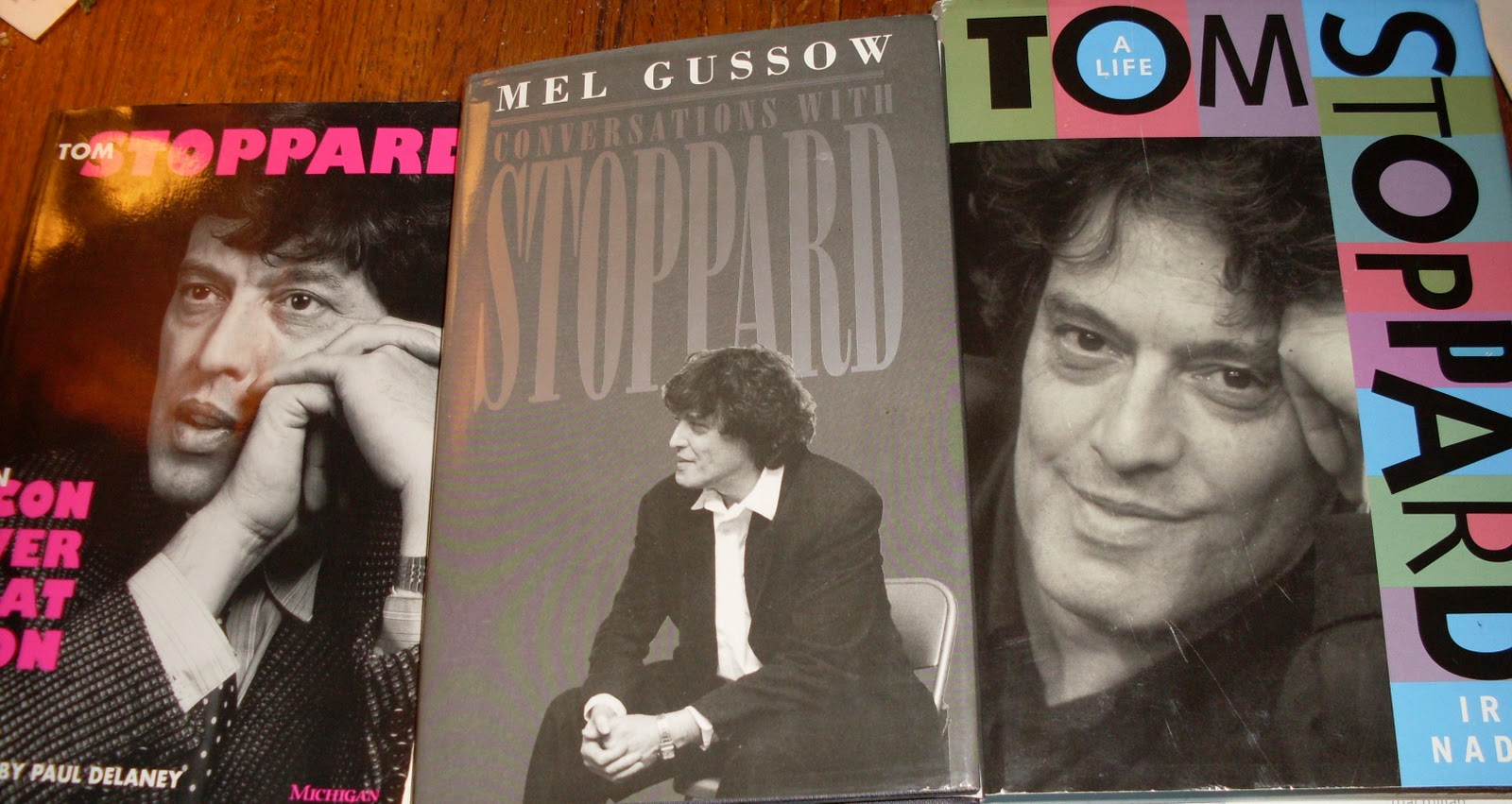
Another factor in Tom Stoppard success--or at least a big part of his reputation from the beginning--was that he gave good interview. There are filmed or videoed examples on youtube, though most are recent, but the influential and substantive interviews were for print. The University of Michigan Press collected about 40 of them from 1967 to 1993 (though some are quite short) in Tom Stoppard in Conversation. This volume includes 3 interviews by Mel Gussow of the New York Times. Gussow published a separate book, Conversations with Tom Stoppard (Limelight Editions, 1995) that includes four more, plus Gussow's introductions and afterword. Gussow was always the Times second string critic, and really prospered in that position. Without the pressure of the Times lead reviews, he could pursue enthusiasms and delve in depth. He put together similar volumes of conversations with Harold Pinter, and with (and about) Samuel Beckett. I consider his career exemplary. (Apparently this book is out of print now--I see on Amazon it's alarmingly expensive.)
There's a good biography: Tom Stoppard, A Life by Ira Nadel (Palgrave/Macmillan, 2002.) The biographical chat at the beginning of this piece is based largely on this book.
Thursday, March 24, 2011
This North Coast Weekend
Wednesday, March 16, 2011
Response
It's time for me to answer the comments of Janet Waddell on my review in the North Coast Journal of the Ferndale Rep production of Amadeus. Those comments appeared first here at this site, then on the North Coast Journal site, and this week in the print edition. Apparently as a matter of Journal policy, I am not given an opportunity to respond along with the letter itself.
First I'll reproduce her comments in full, as they appear here and on the Journal site. The editors evidently cleaned up the misspellings for the print edition:
It makes me sad to see actors who go to work, school, and travel on a shoe- string budget trying hard to contribute to high quality productions only to be upstaged by a mediocre review. Mr. Kowinski's review of Ferndale Rep's "Amedeus" was mainly devoted to a detailed account of Kowinski's discomforture and annoyance at having to drive to Ferndale to review a show. It makes one wonder why others can drive to Ashland to review plays with out a feeling of martyerdom.
Then Mr Kowinski felt the need to tell us that he had seen the show years earlier in London and therefore there were no longer any surprises. The on-going ontological debate (Salieri vs Mozart) has ended by local proclamation. Has the rest of the world been informed? Should the MLA Abstracts be revised?
Kowinski should devote more time to writing plays. I've been in one of his and his his skill is in writing more than reviewing.
Janet R. Waddell
Janet Waddell does not disclose that she acted in this production. My review doesn't mention her. She had a leading role in Doubt at North Coast Rep last spring, a performance I complimented in my review.
I want to respond to the factual claims only. Here's the first one: "Mr. Kowinski's review of Ferndale Rep's "Amedeus" was mainly devoted to a detailed account of Kowinski's discomforture and annoyance at having to drive to Ferndale to review a show."
Here in total is the portion of my review, in which I name the day I saw the play: "(That was on Sunday — and with a 90-minute round trip and a nearly three-hour play, it pretty much was Sunday.)" This parenthetical expression in a review of some 490 words is what she refers to as a "detailed account" that the review was "mainly devoted" to. Her description is longer than this sentence.
She devotes a paragraph of comment on this assertion: "Then Mr Kowinski felt the need to tell us that he had seen the show years earlier in London and therefore there were no longer any surprises."
Here is the relevant part of my review: "I saw the play in 1982 at Her Majesty’s Theatre in London, with original cast members Simon Callow and Felicity Kendal joined by Frank Finlay as Salieri. Such early productions and certainly the movie were memorable for their spectacle. The Ferndale Repertory production, entering its final weekend, does not have that luxury — even with Daniel Nyiri’s handsome set and Lori Knowles’ sumptuous costumes. But guided by visiting director Karma Ibsen, it has the virtue of being clear."
My judgment on the production was this: "This production provides an enjoyable community theater experience, with impressive presentations by Craig Benson, Kyle Ryan and the entire cast." I suggested that the play itself is mediocre.
She ends her letter with this: "Kowinski should devote more time to writing plays." On this we totally agree. She finishes with the opinion that "his skill is in writing more than reviewing." I can only hope this is true.
Wednesday, March 9, 2011
Race and the North Coast, & the KC 4, An Introduction

photo: CSU--East Bay cast of Xtigone
From my latest Stage Matters column about the Kennedy Center American College Theater Festival productions at HSU, the North Coast Journal cut a paragraph that had to do with race.
The paragraph followed the description and review of Xtigone, produced by CSU—East Bay. Here is the paragraph:
At the standing ovation the cast seemed relieved as much as elated. The journey from East Bay to Arcata was in some respects a long one. Those involved in the production were a diverse but largely black and Latino group, so they made sure all of their vans had at least one white passenger. Even so, one van was stopped by police.
The editorial objection was to the implication that the van was stopped as racial profiling, without providing evidence that this was the case. The objection was communicated to me in a couple of emails and a phone message. I responded by asking whether this editor knew of a case in which the police admitted to racial profiling. But I added that I could confirm nothing beyond what I wrote, so if the last sentence was objectionable, they might drop it. I assume it was then felt that the rest of the paragraph didn’t make much sense without it, so the whole graph was cut.
The paragraph doesn’t in my view assert any fact about racial profiling, one way or the other. It is about the expectations and experience of the people from East Bay who came here.
I was told by an East Bay faculty member about making sure every van had a white person in it, and that a van was stopped by police, much closer to Arcata than to Oakland. She also said that students were upset by seeing a Confederate flag in a store window in another town along 101.
Xtigone is a play about urban gun violence, brought to HSU and presented by a highly diverse cast from another CSU school in a very different part of California, the East Bay or Oakland area. By all accounts, the cast and other members of the production were very committed to what the play had to say. It took courage for them to bring it to this festival audience—which included a lot of schools in non-urban areas, and which looked largely white. And though it may surprise people on the North Coast to know this, it took courage to bring it to this part of California.
That idea, however, and trepidations based on race may surprise people here, and even offend them. But apart from the well-known fact that even well-heeled African Americans have been pulled over at least once for driving while black, perhaps I can illustrate my limited understanding of their point of view with this anecdote that happens to also involve theatre.
I was at the Eugene O’Neill Center during a summer National Playwrights Conference, one of four people who piled into a station wagon one afternoon to go into the nearest town of Waterford, Connecticut. Three of us were white, one of us was not, and he was August Wilson, the double Pulitzer Prize-winning playwright. (By the way, I've embarrassed myself by referring to this summer as "ten years ago." It was 20. That's hard for me to fathom.)
We all had various errands, and eventually we all had to find cash machines. In those days not every bank card worked in every machine, so this involved several stops. Finally only August and I hadn’t gotten cash, and we searched with increasing urgency for another bank before they all closed. We found a small one, just at closing time. There was no bank machine outside, so we all rushed in the building, looking around frantically for one inside.
The people inside looked startled, and for a moment it crossed my mind that we might be giving the impression we were up to no good. After seeing there was no machine I was ready to dash out to the car and continue our search, but I saw August talking earnestly to one of the bank employees. He was patiently explaining what we were doing. He even introduced himself. The employee smiled, and said something to the effect that I know who you are, Mr. Wilson. If for no other reason, I realized, than we were all still wearing our name badges, which everyone was required to wear every day at the O’Neill.
Back in the car, August and I confirmed that we had the same thought simultaneously—that we may have looked a little like bank robbers for a moment. I thought it was very funny. August Wilson did not. It was not an impression that a black man could take lightly, he more or less said.
Sometimes you can imagine what things look like from another’s perspective. Sometimes you can’t. You just have to listen.
Of course it doesn’t take being black to see that racism is still real. Since some people woke up to understand that the President of the United States is black, it’s arguably gotten worse, or at least more overt. You can argue that the police have lots of reasons to stop a vehicle, and that the Confederate flag is a novelty item. I think you can also argue that the Old South does not have to rise again. In significant respects, it never left.
I will say that even this hearsay evidence is enough to concern some people at HSU, who see this with the perspective of a school that is trying to encourage diversity.
Now I’ll wind up these posts on the KCACTF productions by clarifying how they came to HSU. Throughout the year, schools (from community colleges to large universities) invite “respondents” from KCACTF to visit at least some of their productions. The respondents (who used to be called adjudicators) view the production one night and talk to the members of the production afterwards. I’ve been to several of these at HSU, and they are always interesting and valuable. In fact, I suggested to the student critics at our first session that they would find it helpful to attend such a session. The respondents, who are usually theatre faculty from various member schools, describe their responses in great detail. (And as a sidelight, the two respondents who came to HSU most recently to see An Evening With Rumi were Joseph Gilg and Bill Wolack. These two veterans of KCACTF were also the only two awardees of this year’s District 7 Golden Medallions, which I gather is the equivalent of a lifetime achievement award.)
Then before the regional festival, a committee of respondents selects four productions out of all they’ve seen to be “invited productions,” which means they are brought in to the festival. This year, the four plays I write about in the following posts were selected. Often this happens weeks or months after the play was originally produced, so everybody has to be gathered together again. Then they have to figure out how to re-mount their production to fit the host theatre, and to fit into the available trucks. At the festival they have a set number of hours to “load in” and set up the production, set their lights and sound, their projections and so on. And then they have a certain time to tear down and “load out” after the show.
This is quite a task under any conditions, but additional problems do arise. There were some lighting glitches for the second show (Xtigone) which I heard were at least partly due to a burnt-out circuit. Whatever it was, it seemed to also affect the third show (The Time Machine), which was still getting ready at show time. It began late, which in addition to further frustrating the crowd that in some cases stood for an hour outside or in the corridors, it probably penalized the production.
For after all the shows, another festival committee decides which of them should be “held,” or made eligible for selection to go to the national festival at the Kennedy Center in April. That doesn’t mean it will go—only four or five productions from all 8 regions are invited. But it seems that everything counts in determining the production to be “held,” including efficiency. That makes a certain amount of sense—because efficiency will be even more important to successfully mounting a show way back East at the Kennedy Center in Washington.
But it’s also worth noting in terms of this year’s festival productions. While Up was the production that was held—perhaps for the reasons I suggest in my post on it below—I wouldn’t call it the most significant production at the festival. In my view, that was Xtigone. This was a new production of a new play, ambitious and intriguing in both form and content, that’s clearly the first step for a play with a bigger future. More about that in the following post.
Saturday, March 5, 2011
The K.C. Four: Xtigone

This post and the following post are about the two original plays seen at HSU in mid-February as part of the Kennedy Center American College Theater Festival. They are slightly longer versions than published in my Stage Matters column last week in the North Coast Journal. One of them is in fact shorter in the Journal than I’d planned. I will publish here the paragraph that was cut, and an explanation, early next week. Also a kind of introduction, explaining how these four plays came to the Van Duzer stage as part of the Kennedy Center American College Theater Festival.
It was not the production selected to be considered for presentation at the Kennedy Center in April. But in my view it was the most significant of the four productions, and one of the most significant to be produced on the North Coast in years: Xtigone, a re-telling of the Antigone myth (and the Sophocles play) to address urban gun violence, by Chicago playwright and actor Nambi E. Kelley, presented here by California State University—East Bay.
“This play is my response to the gunshots I hear outside my window,” Kelley wrote to me in an email, “and is for the children I see hanging in the streets with guns in their back pockets with no one stopping them from hurting themselves and each other.”
At the same time that Kelley was confronting such issues in Chicago, East Bay director Darryl V. Jones wanted to address gun violence against youth in the Bay Area. L. Peter Callendar, Artistic Director of the African American Shakespeare Company in San Francisco, brought the two together, resulting in this production of Xtigone.
The play’s future already includes a staged reading at LaMaMa in New York (with the playwright playing Xtigone), and a full production in the fall by the African American Shakespeare Company. Though essentially a workshop production, the East Bay staging was finished enough to be judged as one of the four best college shows in the 9-state region this year.
I understood the story to be this: Marcellus (Ray Holston III) is the new mayor of Chicago, but his two nephews, each the head of a rival gang, are gunned down just as they were ending their violence at his behest. It turns out that Marcellus himself arranged the hit. His financial support comes from those who profit from guns. Tigs--the Antigone figure (Chalia La Tour)-- sister to one of the nephews, defies Marcellus and causes a community uproar. Marcellus condemns her to a living death, but when his reign and his family is threatened he relents, though too late to prevent a series of tragic consequences. The chorus implores him to “Listen to the people.”
Why address this topic using Antigone? “Because to me it is a play about a single voice affecting change, and about how revolution comes at the hands of the young,” Kelley responded. “I believe our children in this country, certainly in my city, are in a war, and the people who are supposed to protect them, don't.”
The rapid first act of the East Bay production revealed an idea whose time has come—the natural affinity of classical verse with hip hop rhythms and rap rhyming. Even when the words went by me, students around me were responding to them. (Tommy Shepherd contributed original music and sound.) Another impressive element was the integration of dance into the drama, choreographed by Laura Elaine Ellis.
There was a central set that suggested Greek theatre, with tall, narrow screens behind it that effectively projected images of the city. Three tall platforms in the back were home to the singers and dancers of a Greek chorus. After the gun murders there was a particularly haunting moment when the female chorus voices became sirens, wailing like the approaching police and emergency vehicles, while retaining the weary sound of repeated human pain.
The pace slowed in the second act, as the tragic story unwound. Bay Area star Donald Lacy as the seer had one of several tasty acting moments. Apart from technical mishaps, there were issues of clarity in presentation and story. But the energy and focus on stage was electric. It was an exciting event, with great potential.
The KC Four: The Time Machine

The other first production of a play was The Time Machine or Love Among the Eloi by Seattle playwright Edward Mast, presented by Ohlone College of suburban San Francisco. I was told that this re-imagining of the H.G. Wells novel was written years ago but revised for this first staging.
The basic Wells’ story is there: an Edwardian era inventor travels to the far future and finds a beautiful but simple race, the Eloi, only later to discover a separate race of Morlocks for whom the Eloi are literally their lunchmeat. This play focuses mostly on the Eloi, giving them an invented language that’s chiefly about sex.
This imaginative production directed by Tom Blank had a sprawling set that encouraged a very acrobatic young cast. While their physical performances and the invented language itself were mesmerizing for a time, it all got repetitive. This may have been part of the point, but several of the student critics couldn’t get beyond their reaction to the one dimensional nature of this invented world, and how long the illustration of it went on.
The Eloi section was bookended by scenes in the inventor's home, somewhat as in the Wells novel. (It’s moved forward in time a couple of decades into the early 20th century, and the Traveller—as he was known in the novel—is given a name.) The time travel lighting effect itself was dazzling. It was probably a fairly simple computer program but unlike any I’d seen before.
In his re-telling, Mast seems to be playing mostly with ideas about Eden and the Fall, and only someone who already knows Wells’ intent to take the severe class divide of the industrial age to its logical future conclusion is likely to pick up its subtle presence in this production. One such correspondence is interesting—Mast makes the Morlocks literally the mealtime servants of the Eloi, though they are seemingly invisible to the Eloi. Back in his own time and house afterwards, the time traveler is startled when his own “invisible” servant speaks, and he looks at him with a bit of alarm.
Subscribe to:
Posts (Atom)